Mortality Tables – 25th October 2024
Christopher Nosnibor
Some time in the last decade or so, genre distinctions simply exploded to the point of obsolescence. People – many people, and I won’t deny that I’m not immune or above doing so – will spend endless hours quibbling over categories. Is it post-punk or goth? It is doom or stoner doom? Country, or Western? Or both? It does seem that the ever-fragmenting microgenre, once the domain of dance, with its infinite focus on detail, has more recently become a battleground within metal – but then, a friend recently described an act as being ‘Jungle adjacent’ and I felt my brain begin to swim. What I suppose I’m driving at is that artists themselves are breaking out of genre confines and the place we find ourselves now is a point at which anything goes. But listeners – not to mention labels and journalists – or perhaps especially labels and journalists – find themselves clawing desperately to define whatever it is. There have to be benchmarks, touchstones, comparisons. We’re simply not attenuated to music which doesn’t conform to some parameters or others. This is one of a number of reasons that I tend to try to focus my attention on what a work does, what it actually sounds like, the sensations and emotions it elicits and other more tangential provocations – because the way we respond to music tends to be personal, and instinctive, intuitive. One may react immediately, and enthusiastically to a punch in the guts from an overdriven guitar, or may instead feel a greater emotional stirring from something soft and delicate, be it an acoustic guitar, a harp, or a flute. In summation, one’s first instinct is not to assess whether or not those opening bars belong to a specific microgenre, at least when it comes to a ‘blind listening’ experience.
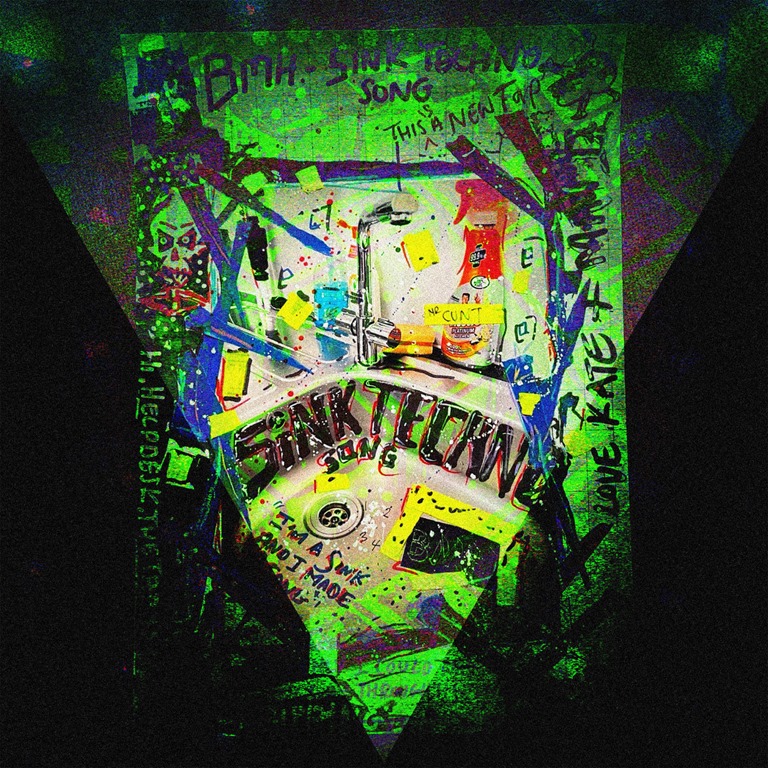
But then there’s always a spoiler, and here I find myself facing a ‘spontaneously-created acoustic punk techno EP made with a dripping tap’. What the hell do you do with that? How do you prepare for listening to something so far beyond the outer limits? Personally, I start by pouring a large vodka, and putting the light off.
The EP features four tracks; two versions of the title track, plus two versions of the longer ‘Water Sink Song’. The former centres around a relentless thudding beat, clearly derived from a dripping tap, with swishing, swashing, gurgling watery noises and other scraping and thumping and crashing incidentals. There’s nothing quite like taking the sounds from one’s surroundings and manipulating them in order to forge new sounds, and new sonic experiences. It’s life, but not was we know it. Or, perhaps it’s too close to life as we know it.
“Matt Jetten and I made the track in the sink at work,” says BMH’s Kate Bosworth. “The tap was leaking and we managed to get to it minutes before the engineer did. The original is in mono, but our mate Stuart Chapman (Terminal Optimism) suggested we ‘do a Beatles’ on it and bring it into stereo by duping and layering and adding effects etc. All in all, the process was very quick.”
‘Water Sink Song (End Dark Train 21st October 2024)’ features a haunting vocal which drifts mistily over a swampy swell and a thick wash of static, as well as more watery sounds, like heavy rain and swashing, glooping, the disconcerting sounds of ingress in a storm. The shuddering electronic rhythms call to mind Suicide, but with an esoteric folk twist; one can almost picture the performance of a pagan ritual at a stone circle in a torrential storm – but then stammering vocals cut through in a rising tide of mains hum and buzzing electricals. Synths buzz and crackle at the fade. The ‘Original’ version (17th October 2024) is more heavy rainfall and water running from a roofs onto gutters – or the sound of a number of men urinating hard onto a corrugated shed roof. Thuds, clatters, clanks, trickles and sprays, a bottle or jar filling at pace; the incidental sounds, the additional layers, are wet and uncomfortable.
It may be that my response is as much coloured – a hazy amber – by my recent experiences of a trip to Castlerigg stone circle in a saturating downpour, and a train journey whereby the train was rammed solid with rowdy football fans, who, unable to make their way to the broken toilets, resorted to urinating in water bottles and Costa coffee cups, which they left on luggage racks and on tables, while cheered on by mates passing more cans of cheap shit lager and a bottle of lager along the carriage.
Jetten’s vocals are breathy, semi-spoken, and there’s a sense that they’ve been recorded quietly in the bedroom of a flat or terrace, trying not to disturb the neighbours. There’s an element of triumph in the tone as Jetten announces the title, as if he’s utterly pumped by the experience – or something seedier.
As an experimental work that encapsulates the DIY ethos, this is a quality example of the kind of weirdness that can only happen independently. It’s perverse, and imaginative, and it’s different. Oh, and all proceeds go to Kidney Cancer UK.
AA

 Aural Aggravation