Posts Tagged ‘Ashley Sagar’

3rd February 2025

Christopher Nosnibor

This one may have started at the beginning of the year, but is an open-ended project which has been added to over the subsequent months, meaning that there’s more to absorb now than there was previously, and some five months in, it seems like a reasonable point to take stock of the progress so far. Although released under his Sunday name and therefore perhaps not a release that leaps out, Ash Sagar has been operating as Meanwoood Audio for a while, as well as being involved in numerous Leeds / York based collaborative works, notably The Wharf Street Galaxy Band and Neuschlafen, and perhaps notably the one-off experimental improv collective Beep Beep Lettuce, who will one day be hailed as a 21st century Big in Japan or Immaculate Consumptive. Well, we can but hope.

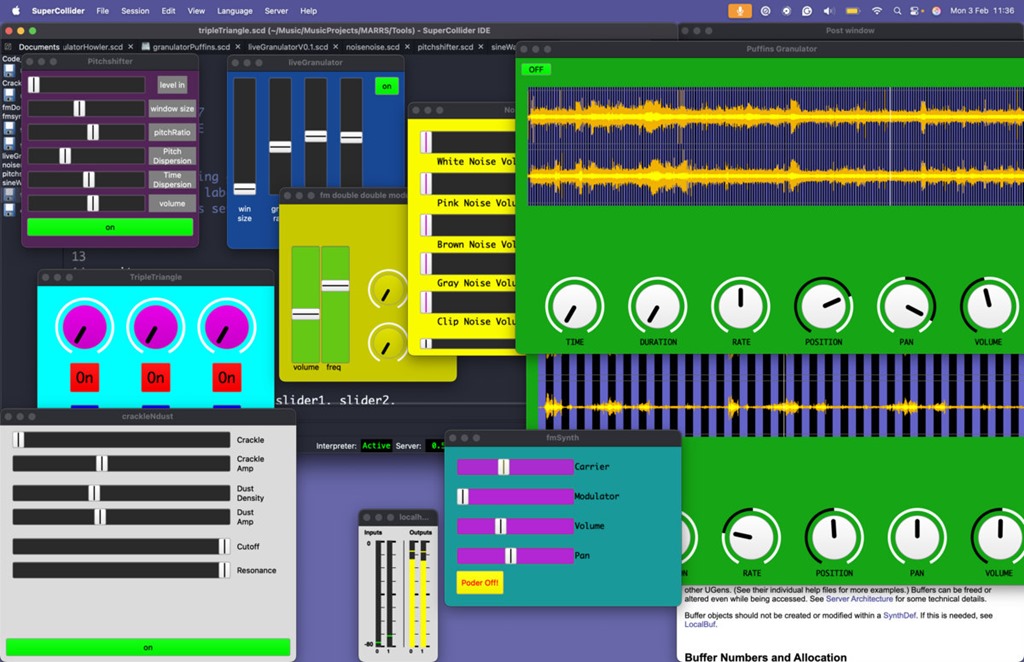
M/A/R/R/S tools is one of those albums that could only ever exist in the digital age, consisting as it does of some fourteen experimental pieces with a running time of around a hundred and eighty-five minutes. Yes, that’s over three hours – even longer than recent sprawling Swans releases.

Sagar’s notes are succinct – or scant, depending on your perspective – summarising M/A/R/R/S tools as ‘Audio recording from tests of building tools in SuperCollider for Meanwood Audio Recording & Research Services {"M/A/R/R/S"}.

My instinct is – because my instinct is dictated by my brain, which is brimming with stupid nonsense and is excessively prone to misfired associations – is to ‘pump up the volume’. But this proves to be rather unwise, as the release contains an endless stream of unsettling discordant rumbling, hovering hums, and fizzing extranea which is just around the tinnitus range.

‘Audio_25_01_20_1’ makes me feel tense: it reminds me of a ‘breather’ in a Teams call – there’s always one freak who positions their unmuted mic right in front of their open, gasping mouth, and the sound is like a gale on a mountain top.

Dripping, dropping, dribbling electronic abstractions dominate, with microtonal bibblings running on and on, sounds like twanging elastic bands and scratches and scrapes, atonal strings and R2D2 malfunctioning. I recall running my nails along an egg-slicer as a child. It’s a memory I had largely forgotten until hearing this remined me. M/A/R/R/S tools offers up an oddball array of sounds, and it feels random in the extreme. Oftentimes, it’s barely there, or it’s nothing more than the rumble of passing traffic or a distant radio. Occasionally, there are stuttering drums. Other times, there is not much at all.

This is a work which has been a long time in development: there are two full live sets, recorded five years apart, with a set recorded in London sitting at the midpoint, and another live set, recorded in Leeds, drawing the curtain on this colossal release. The fifteen-minute London set is a challenging work, which confirms what anyone who has seen Ash live will already know, and that’s that he in unafraid to test an audience with monotonous, woozy oops which are as uneasy on the intestines as they are on the ears. This is reinforced by the thunder-filled, sample riven discomfort of the Leeds set – something that his set in Leeds just this last weekend extended still further. Distorted, heavily reverbed and practically impenetrable vocals spitting out randomly sequenced words cut through the speakers, and it’s almost too much, too disorientation. A derangement of the senses. Both John Cage and Brion Gysin would have been proud. It’s dark and murky, and droning notes quaver in the background.

M/A/R/R/S tools is not an easy listen, not only on account of its duration. Despite its superficial minimalism, there is a lot going on. And none of it is kind, comfortable, or particularly easy on the ear or mind.

AA
a4289167092_10

30th May 2020

Christopher Nosnibor

Having begun May with a new release in the form of Beyond Life, an exploratory ambient work in the form of a single twenty-six minute track, Ashley Sagar ends the month with a follow-up, and counterpart of similar scope and scale.

If the title suggests something a bit new-age, a bit hippy, trippy cosmic, and a bit pretentious, the music is contains isn’t anything of the sort, although there is a certain haze of mysticism and perhaps a sniff of incense about the album’s slow-drifting atmospherics.

There’s a faint scratching pulsation, like a metal object scraping against scratched glass, that grabs my attention early on: the arrival of slow, sedate, rolling percussion– possibly conga or similar hand drums – provides a new focus for the attention, and changes the tone considerably. With a rhythmic structure providing a framework and solidity, the piece becomes less overtly ambient and abstract. Shifting further over time towards cyclical, non-percussive rhythms transports the listener into a softer pace, before an unexpectedly weighty segment around the eleven-minute mark where the beats crash in and dominate, however briefly.

Thereafter the looming shadows are longer and darker, with rumbling low notes and heavy drones underlying Ian Mitchell’s delicate picked guitar notes and the returning percussion, along with one of Sagar’s distinctively strolling basslines. It may be subtle and muted, but its presence builds depth beneath the numerous shimmering layers which ebb and flow.

The segments are short and the transitions relatively swift, which gives The Temple… a strong sense of movement, movements that’s effortless and natural, since the parts flow seamlessly into one another like a stream flowing through a varied landscape, cascading from a spring-line, down a hillside and through a woodland. This may not be the most fitting metaphor, but you get the idea, and it’s perhaps telling that my mind is drawn to the natural rather than the spiritual, and I’m drawn to the distant horizon as the final notes throb and ripple to the fade.

AA

a0892150820_10

3rd May 2020

Christopher Nosnibor

Ashley Sagar is a man with his finger in manifold musical pies, spanning the semi-ambient droning improv of Orlando Ferguson to the thumping Krautrock grooves of The Wharf Street Galaxy Band. It’s Sagar’s willingness to experiment, and to try anything once that’s a significant factor in his interest as a musician. What’s important for anyone engaging in experimentalism is the acceptance that degrees of success and failure may vary along the way, and it’s with no embarrassment that I recall sharing a stage with him and Namke Communications’ John Tuffen for a hastily-assembled improv set built around a sort of sequence and structure that was actually ok, but not what any of us had really anticipated.

Anyway, under lockdown and unable to play his distinctive wandering basslines live with any of the eighteen or so bands he performs with, Sagar has delivered his second solo album of the year, in the form of the soft ambient work that is Beyond Life, which comprises a single track with a twenty-six minute running time.

It begins with slowly rhythmic vibraphone tones that reverberate softly into a warm atmosphere. Immediately I begin to question this: is it a vibraphone? I’m not strong when it comes to mallet percussion instruments, or synthesised emulations thereof. Equally, I can’t trust that my perception of a ‘warm atmosphere’ isn’t coloured strongly by the unseasonably warm and sunny weather paired with the unusual quietness outside on such a balmy evening, where I’d ordinarily likely be at a gig and the street and back gardens would be chocka with people between pubs and stoking early bank holiday barbecues.

As my thoughts drift, so does the music, and although it doesn’t grab my full focus, is does very much permeate my reflections as I go inside myself, recalling a life before all of this, a life when life was actually life, when, however much going out and being among people may have been a cause of anxiety, it was an option, and live shows provided the opportunity to be among likeminded individuals coming together to escape into sonic domains.

And so here we are, all isolated together, supposedly, in a state beyond life. Sagar provides a subtly-structured soundscape to ease these contemplations along, quietly shifting from one tone and texture to another, from light and airy to low and sombre, piano notes ringing out into the emptiness.

The streets are empty. The pubs, hotels, gyms, shops are empty. The sky is empty. The world is empty. We are all empty. And Beyond Life is beautiful.

AA

a1792484157_10

Wonkystuff – 5th September 2019

This one’s been a long time in coming: the liner notes document that the three pieces that make up Traditional Computer Music were ‘conceived and composed from various SuperCollider recordings over the years 2010 – 2014 [and] edited and compiled in Logic.

Then again, both Ash(ley) Sagar and Wonkystuff label boss John Tuffen have been kind of busy for most of the five years since this was finished, what with their being one half of The Wharf Street Galaxy Band, as well as operating as Orlando Ferguson and contributing to myriad other projects.

The title of this release is clearly a wilful oxymoron on the one hand, but on the other it’s entirely fitting, and a recognition of the tropes which have established themselves around digital musicmaking. Computer Music, once radical, is now a convention with a substantial lineage. And yet there is, somehow, a certain idea of what ‘computer music’ sounds like when presented with ‘computer music’ as a term, and Sagar manages to encapsulate that on this release.

The three numbered pieces – impersonal, inhuman, digital – are lengthy: 1 is 14:21, 2 is 19:24 and 3 is 18:58. And while Sagar doesn’t delve into retro robotix with bleeps and bloops, Traditional Computer Music explores digital soundscapes that have become synonymous with electronica.

Bulbous, warping drones weft and warp in the opening moments of ‘1’, with sounds of indecipherable origin – are they voices? Are they synthesised sounds? Tapering to an undulating mid-range droning hum after a couple or so minutes, coalescing to a throbbing hum around four minutes before dispersing into a vaporous mass after some four minutes, it becmes little more than a drone, before dissolving, fractured, splintered and broken, into painful howls of feedback that continue for a good few minutes before fading to darkness.

‘Part 2’ continues where ‘Part 1’ leaves off, with elongating feedback-filled drones extending outward for centuries and light-years back. It’s simultaneously evocative and sterile, again highlighting and exploring the dichotomies of digital music. Ash is one of those musicians who explores to the core. And yet his technicality is not at the expense of feeling. You can tell by listening to this that he lives and feels the music, wanky as it probably sounds.

The third and final track, ‘3’ moves into microtonal territory, which is crackly, glitchy, bleepy, and finds a slow pulsing beat thumping beneath an array of tweeting twittering R2D2 stutters. It descends into a morass of tweaking laser shots and squelchy pulsations buried under a growling generator hum ad there’s pitch-shifting and slowing drones galore. It becomes increasingly difficult as it progresses, dolorous drones and low pulsations and eternal, deliberate throbs roll on and on, before finally yielding to a climax of retro-futurist wibbles which ascend to a sustained rippling hum that’s not exactly comfortable whatever your preferences for sonic range.

On TCM, Ash shows that he probably knows the boundaries and remains within them, but at the same time tests the listener’s limits in a positive way. And yes, it’s good, and in its field, outstanding.

AA

Ash Sagar - Traditional