Posts Tagged ‘allbum review’

Tzadik Records – 8th September 2023

Christopher Nosnibor

Everything seems to trigger some recollection or another. This is perhaps one of the greater pleasures of interacting with art in any form. As a child, I recall an old bagatelle board sitting in the shed. It always struck me as a quaint item – essentially a wooden board with nails stuck in it, some kind of hybrid between billiards and pinball, with a pile of very heavy, marble-sized metal balls.

If this triggered recollection seems random, that’s because it is, something beyond my control. But then despite everything, it comes to seem relevant, as Vol. 16 – which presents, as the press release puts it, ‘Big Band interpretations of John Zorn’s Book of Bagatelles’. It goes on to explain how ‘Zorn commissioned London-based Jewish composer, Eastmond to make an album from a selection of his 300 pieces: Book of Bagatelles. Arranged for 12 Musicians, the ensemble features some of Europe’s most celebrated creative musicians and improvisors alongside young rising stars of the UK scene.’

My musical palette has certainly expanded through the years, and I have JG Thirlwell to thank for this, as well as Gallon Drunk, for opening my eyes to wild and near infinite possibilities in terms of incorporating orchestral and brass elements into rock and guitar-based music. Everyone needs a route in to forms which aren’t readily digestible and certainly aren’t the norm for most.

There is nothing that’s especially digestible about this raging, ragged, woodwind-blasting behemoth, and that’s as intended. Actually, that’s not entirely true. There are moments, near the start, of the ten-minute opener, ‘Bagatelle #256’ which are immensely palatable in a smooth jazzy way, the kind of smooth jazzy way that might have you nodding along, and your friends saying ‘nice’ in a raspy whisper. But while there are some toe-tapping moments, the majority of this release is eye-popping, bursting as it is with some crazy shit that flies off in all directions at once.

There are some monster stomping moments, ‘Bagatelle #78’ is a proper full on dinosaur thump, and contrasts with the meandering drone of the next track, ‘Bagatelle #143’.

It’s all going on here, and sometimes it feels as if it belongs to a cartoon soundtrack, while at others it sounds like all-out sensory overload. There are some rather nice moments, expansive explorations of soundscapes while afford periods of laid-back-reflection. But then, there are as many moments of truly crazy shit, with everything exploding everywhere, highlighting insane range of this album.

If the climax of ‘Bagatelle #143’ would sit comfortably in the soundtrack to a cartoon, the start of ‘Bagatelle #63’sits in the bracket of headache-inducing wild jazz frenzy. And that’s something that this album quite unexpectedly highlights – the way in which there is no way of predicting the highs and lows and insane range that this album presents. When it’s chilled it’s nice; when it’s racing all over the shop, it’s fucking mental.

The Bagatelles – Vol.16 is all over the place, and it’s a truly wild ride. It goes from oompah to film soundtrack in an instant, and it’s impossible to keep up. And that’s its appeal.
D6944EF4-5344-4CFA-995A-487CC27D5BA4

9th June 2023

Christopher Noosnibor

The fascination with true crime has exploded in the last decade, and it’s hard to know what to make of it. Some true crime documentaries, like Making a Murderer and even The Staircase (the 2018 one, that is) have been hard-hitting and ultimately compelling. But then the dramatisations of not only The Staircase, but also David Tennant playing Dennis Nilsen, feel like perhaps a step too far into the macabre serial killer revelry that saw bands like Whitehouse vilified in the 80s. At some point, serial killers and all the dark gruesome shit that historically was the domain of weirdos and outcasts shot into the mainstream.

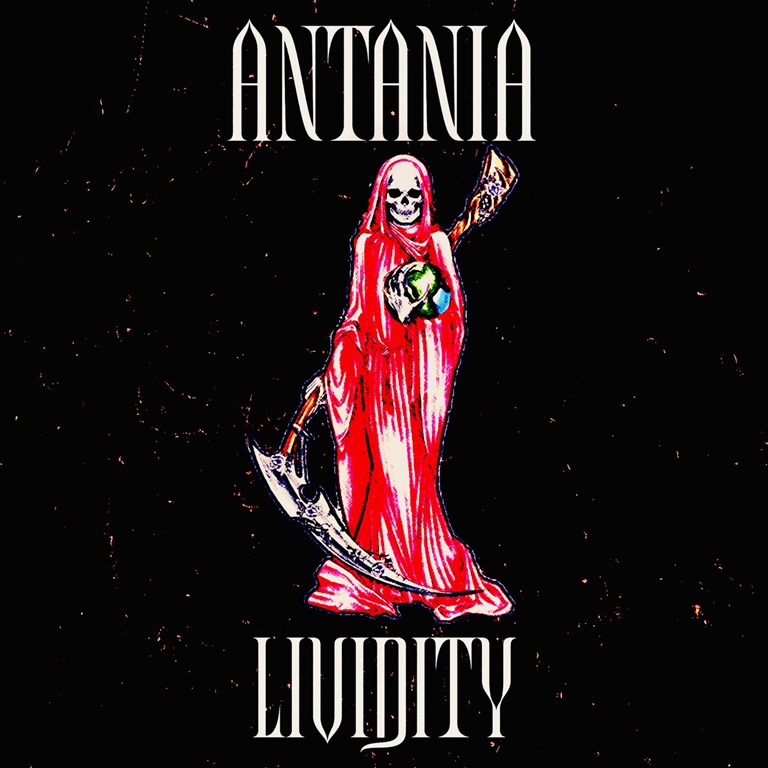
It’s a curious contradiction. While America is immersed in an existential crisis over the right to bear arms, quite literally hundreds of children and teens – and teachers – have been shot dead already this year – and bearing in mind it’s only early June it’s beyond terrifying. The anguish of killings is almost unspeakable… and yet it’s now great TV. What does that say about our society? As the accompanying notes explain, ‘The songs on Lividity were written right from true crime stories, Each song represents a true story of murder and violence as the Antania duo find their inspiration from real events.’

But then, this doesn’t have to be about sensationalism: the title of Antania’s album is pure Law and Order, and we could reasonably trace a lineage back to Ed McBain’s novels of the 60s, which saw pulp pave the way for the birth of the procedural crime novel.

And with this release, they promise a set that ‘mixes a “doom bass” sound with acid metal, for a ‘a slow, rhythmic bass-heavy release’. And that is precisely what they deliver, with ten tracks of rapid-fire drums and gnarly darkness bashing through mangled samples and snarling, swampy synths.

The samples on the first song, ‘3 Days’ are culled from recordings of Angela Simpson, who openly admitted to the torture, murder, and dismemberment of her wheelchair-bound victim: “I beat him to death… I killed him and cut him up,” Simpson told 3TV in a jailhouse interview shortly after her arrest in 2009. Hot on its dingy heels lands ‘Antania’, and it’s got that back metal sound to it, grainy, gritty, as if recorded on a 90s Walkman from the room next door.

This kind of production makes sense at times, but at others – at least for me – it doesn’t so much. Yes, to obfuscate the details creates an intrigue, and imbues the recordings with a quite literal obscurity. But if Bathory created a gnarly template that ploughed the deepest subterranean depths to drag the burning coals of Satan’s soul from the bowels of hell, most of those who followed in their grim wake have simply mined the seems of unlistenability.

The heavily processed vocals on here, which are so OTT cliché ‘scary’ that they actually emerge on the other side to be genuinely scary, are paired with swampy synths and creepy extranea. There are even some riffs happening here, as on the churning grind of ‘Angels and Demons’. It’s utterly fucked up and tormented, the sound of a soul in torture. There’s o clear indication, however, of what each of the individual tracks were inspired by. It’s a shame, because although Lividity is about the blacker than black atmosphere., given the context, it would be interesting to know whose vocal samples occupy the various songs, and which cases the songs are inspired by. I daresay there are clues for the hardcore true crime fanatics, but the rest of us would like to feel included, too.

That said, there aren’t many points of entry into what is a difficult and utterly brutal album. Every track feel like the soundtrack to the goriest, bloodiest, most brutal murder ever. Every track feels loser, slower darker, heavier, gnarlier.

‘August’ plunges yet deeper, darker depths, and Lividity just keeps on getting nastier and nastier. From whichever perspective you view it, it’s not a pleasant album: as the songs succeed one another you feel the life slowly ebbing from you, as one by one they pound away without mercy. You will it to stop, but no: Antania keep on bludgeoning away until you’re beaten, your head lolling with exhaustion.

As I felt myself being battered, tortured, by this most brutal racket, I felt myself sag, and also recalled the earlier days of the internet – specifically, the discovery of sites like gruesome.com where you could find a full reel of film of pics taken by a couple who had dismembered the body of the woman’s husband and posed the body parts to show him picking his nose and the like.

There’s little need for crime fiction when true crime is this sick, and Antania provide the perfect soundtrack to this gruesome shit.

A

AA

a3172920995_10

Dret Skivor – 5th May 2023

Christopher Nosnibor

The liner notes to Trowser Carrier’s A Flower For My Hoonoo, originally released in some form or another back in 2013, say everything you need to know about Trowser Carrier – the duo consisting of Dave Procter (Voice) and Java Delle (Noise) – and their purpose.

‘Noise and vocal delivery tend to occasionally focus on edgelord taboo subjects. Trowser Carrier are not like that. After 10 years, Trowser Carrier once more ask the following question – why can’t noise be nice? Find the answers amongst harsh noise and insipid words.’

Procter in particular is no stranger to the noise scene, performing as Legion of Swine and Fibonacci Drone Organ, among others, not to mention countless collaborations. and he’s no doubt encountered more than his fare share of edgelords along the way. Like many makers of noise, he’s also a fan, but not incapable of critique and criticism, and not without humour. And as such, A Flower For My Hoonoo is something that you could describe as a humorous act of rebellion – and since noise and all of the serial killer and pervo shit that is often the subject matter of noise that’s designed to shock ‘normal’ society – this is a rebellion against rebellion, an attack on cack cliché, a parody of po-faced posturing.

The result is a collection of pieces that resemble Alan Bennett fronting Whitehouse, and the track titles largely speak for themselves: ‘a nice cup of tea’; ‘this ketchup is nice’; thanks for hoovering’; and ‘I remain you humble servant’ are all representative – and it’s perhaps as well the titles do speak for themselves since most of the actual words are, in true noise fashion, largely inaudible for blasts of intense pink, white, and brown noise layered up with distortion and overloading synth meldown. ‘sausages for supper’ extols the virtues of vegetarian sausages, with lines like ‘my body is a temple… and I don’t eat The Lord’s creatures.’

From the words it is possible to make out, ‘nice’ is probably the word which appears with the most frequency after ‘the’, and the bland lyrical niceness, a porridge-slick spill of pleasantry worse than saccharine sweetness in that it’s a world of magnolia in word form. It’s like being forced to sit in a corporate ‘wellbeing’ room plastered posters of motivational quotes, only instead of pictures of beaches and sunrises as the backdrop, there are images of crashed cars and slaughterhouses as the ear-shredding electronic racket blasts relentlessly. The fact that they’re short bursts – most around the minute mark – doesn’t make it any easier on the ear: if anything, it’s worse, as the stop-start nature of the sonic assault has the same effect as various methods of torture. The ear-shredding blasts are of the bubbling crackling fucked-up analogue kind.

The ‘mix’ versions of the tracks – which double up the sixteen tracks to thirty-two place the vocals up to the fore and back off the noise (which is different), meaning Dave’s sappy words are nauseatingly clear as he gushes gratitude for tine spent washing dishes together and courteous manners.

The contrast between the aural punishment and the fist-clenchingly pleasant banalities of the lyrics is amusing and frustrating in equal measure. Procter utters these grovelingly insipid lines in a blank monotone, often repeating a singe verse twice to fill the minute of noise as it froths and sloshes and foams and bubbles and drives the meter needles to the upper limits of the red.

It’s overtly silly, but does make serious points about the genre trappings and songs lyrics and musical forms more broadly.

AA

a0863767941_10

Feral Note – 2nd December 2022

Christopher Nosnibor

I don’t think – or don’t like to think – that it’s an age thing when I say that at some point recently I started to feel not only a separation from certain aspects of mainstream culture, but a seismic wrench away from vast swathes of so-called culture.

Clearly, I don’t fit the stereotype of my peers who decide on turning 35 that there’s been no decent new music since they were 19 or thereabouts, and immediately perpetuate the generation gap musical position that kids today only listen to shit manufactured crap, even if it is largely true.

But more than anything, I simply cannot grasp the concept of the NFT. I mean, what the actual fuck? Cryptocurrencies are insane and seemingly purely for the ultra-rich, but I kinda get them. But paying for a thumbnail GIF? That’s beyond me.

Kaan Bulak’s Illusions has my head swimming, in that it offers not only a multidimensional sonic streaming experience and a length bibliography, but also comes exclusively as a download and offers an art print, and I find myself wondering ‘How’, ‘Why’? The first why is ‘why did it get so bad?’ Like, how is it that artists hawk this shit? As if signed drum heads and the like weren’t exploitative enough (and believe me, they are, and then some). Stepping back from my knee-jerk spasm, I realise I should perhaps give some benefit of the doubt. After all, artists outside of the mainstream have always been compelled to innovate and to find novel ways of not only reaching an audience, but eking an existence that funds their work.

And as the accompanying text reveals, Illusions has been an arduous labour of love:

‘The album had been in the making since 2013, and its creative journey started back then with the track ‘Falling in a Dream’: it was created with violinist Contrapunct playing the melody, when Kaan Bulak had his studio in a techno club above the dance floor, and the thought came that falling asleep must lead to a noisy dream state. In January 2018 Kaan Bulak recorded a prepared grand piano, improvised and locked himself in until numerous sketches were finished. In 2018-2020 he worked on-off on the tracks, including additional recordings on Wurlitzer, oud, frame drums, and electric guitar, and then actually completed them in the summer of 2020. As visible in the quotes in the appendix, it is about a journey into the self through the help of art and philosophy. Zen kōans create an awareness of the illusions and contradictions in everyday life, art makes them tangible.’

Illusions, then, is the product of an immense journey, and ‘Falling in a Dream’ is in fact the last of the fourteen compositions presented here, in a set that’s a shade jazzy, smooth yet angular and unpredictable, with fast-fingered piano and an understated melding of funk and motoric grooves with a dose of hypnotic Doorsy keyboard drone, not to mention minimal techno and spartan disco. There’s a certain slickness to it, too, which gives the album a kind of polish that may attract radio play.

It’s hardly an obvious radio choice, but it’s an album that clearly warrants some playlisting, by virtue of it being, well, a bit out-there. But Illusions  is solid, and real, and a nice album.

AA

FN013_art

DRET 05 — 2nd April 2021

The fifth release on Swedish label Dret Skivor, which coincides with another Bandcamp Friday, is Blue Oblivion by Tore Honoré Bøe. Information about the artist or the material is non-existent, so everything is left open for the listener to extract and interpret from these layered sonic collages. My initial response is the ocean, being immersed in the vastness of the expanse – or, more specifically, drowning, before my thoughts turn upwards, to the eternal endlessness of the sky. Starring up on a cloudless say, it’s easy to lose yourself in the infinite space.

But the sonics captured here evoke neither. This is, for the most part, a snarling, swirling tempest of electronics pushed to – and beyond – their limits, a shrilled, shrieking assault on the senses that utterly engulfs: this is not a pleasurable or ecstatic oblivion, but the oblivion that arrives as a welcome relief from a relentless battering.

On the first piece, ‘Foosa!’ a piano note fades into the fog as a crackle of static builds to a sustained fizz. Scrapes and drones take on the presence of creeping chords in the absence of any overt musicality. It howls and wails and drills into the cranium randomly, one shill blast of noise replaced by another shrill blast of noise of a different frequency. Like cowboys armed with two pistols shooting from each hand alternately, Tore fires off drill-like frequencies one after the other, hand over hand, whirring and buzzing… and then it’s all down the toilet in a single plunge.

‘We Love King Julien!’ is less abrasive, at least initially, but no less challenging: a woozy, stammering mess of glitching drone that cracks and churns through a succession of misaligned subsequences that stammer and lurch, it’s a different kind of discoordinating. Metallic smashes scrape and buckle to forge brain-clenching streams of static noise that bubbles and churns. In time, it all breaks down into a mess of fractured noise and fizzing static, a horrible mass of treble that jumbles all focus. It descends into alternating drones and explosive blasts of speaker-shredding noise, and culminates is a tsunami of churning while noise and synapse-melting overload across a wheezing drone so flat it feels like it died a long time previous.

There is no kind or considered response to this, no neat finisher. It’s not an easy or pleasant release – but then, that’s not what Dret ‘do’, and seemingly, it’s not what Tore Honoré Bøe does either.

Blue Oblivion is unquestionably immersive, but it’s not entertainment: this is harsh, uncomfortable nose. It’s noise to lose yourself in.

AA

a3756016703_10

Cat Werk Imprint – 7th February 2020

Christopher Nosnibor

‘Walk away… walk around it.’ On the page, the words are devoid of threat or menace. But delivered in a fractured, disembodied voice that carries a strange sense of madness, it takes on altogether different shades of unsettling uncanniness. Amidst creeping fear chords, clicking insectoid flickers and scrapes and scratches, the voice, childlike and compressed warps and twists, as through refracted through a temporal veil or a spiritual force-field of some description. It feels like a communiqué from the other side. The voice is that of celebrated modernist sculptor and Henry Moore contemporary Barbara Hepworth, and this is one of the early moments on Olivia Louvel’s latest release, a work which forms the basis of the artist’s Masters degree, in which she investigates the voice ‘from preservation to resounding, while taking further the voice of Hepworth into the physical space as a multi-speaker diffusion’.

The source material is a 1961 recording of Barbara Hepworth’s voice, recorded by Hepworth herself in her studio in St Ives, the tape’s initial purpose was for a recorded talk with slides for the British Council, with an original duration of thirty-two minutes. Louvel’s resounding is of a similar duration, but instead of a linear narration which details the artist’s working methods, we get scrambled cut-up snippets which strangely still give a semblance of sense, reducing the extrapolations to the barest bones to give a sense of Hepworth’s creative processes and focus. But them, Willian Burroughs suggested that cutting up text (and for the purpose of this discussion, we’ll consider audio a form of text) reveals the truth, and while Hepworth’s talk isn’t brimming with political rhetoric and doublespeak, one feels that Louvel’s cut-up of her words does perhaps bring us closer to the heart of her meaning.

‘Must Carve a Stone’ loops and layers a breathy whisper of the word ‘carve’, which becomes an unsettling mantra. Minimal glitchtronica and hovering, echoing notes provide a ponderous, stammering backdrop to the looping, multi-tracked vocal layerings of ‘I Draw What I Feel in My Body’, and the sparse arrangement creates an uneasy backdrop to the words.

There isn’t a moment that’s comfortable or easy here, and Louvel’s ‘resounding’ of Hepworth is relentlessly challenging as an auditory and sensory experience. But it’s also impressive in the way that it provokes the listener to awaken those senses and absorb a multi-faceted presentation of what it is to be an artist.

AACW14_front