Archive for January, 2017

Sacred Bones – 20th January 2017

Christopher Nosnibor

‘Nasty’ is a word you’re likely to hear or read in relation to dark, gnarly, mangled black metal or crust punk, or perhaps some particularly unpopulist industrial effort, or some particularly savage techno. But on Wake In Fright Uniform offer something that’s a different kind of nasty. And yes, it really is nasty, brutal, savage, uncompromising and unfriendly. And while there are elements of metal, thrash, industrial and power electronics, Wake in Fright – described as ‘a harrowing exploration of self-medication, painted in the colors of war’ – throws down the challenge of a noise all of its own.

Preview cut ‘Tabloid’ doesn’t so much open the album as tear the lid off the thing in a squalling, brutal frenzy. The drums are pitched to a frenetic pace but largely buried under the snarling, churning mess of guitars, feedback and distortion. Michael Berdan sneers and hollers venomously like he’s in the throes of mania, and to describe it as raw would be an understatement. It’s still on the bone and walking around. A gnarly mash of early Head of David, Foetus, Godflesh and the most obscure hardcore punk demo tape you’ve ever heard, it’s anything but easy on the ear. It is, however, a real blast of adrenaline, not so much a smack around the mouth as a succession of steel-toed boot jabs to the ribs.

The earthmoving bass grind of ‘Habit’ is coupled with the dirtiest, dingiest guitar noise you’ll hear all year. ‘The Lost’ combines the harsh edge of late 80s Ministry with an old-school punk feel, New Order trampled under the boots of a thousand-strong army of brutalists. It’s a stroll in the park compared to the thousand-mile-an-hour rage explosion that follows in the shape of ‘The Light At the End (Cause)’, which is nothing short of brutal, a black metal assault. There’s nowhere to take refuge with this album: cover your face, the blows land in the ribs, the back, the legs. Uniform are fucked off, and are going to vent their unremitting ire on anything, everything, and everyone.

The most striking thing about this album – short as it is, with just eight tracks and a total running time of thirty-eight and a bit minutes, (aside from its eye-popping intensity, that is) is its diversity. ‘The Killing of America’ is a full-tilt industrial metal slogger which evokes the spirit of Psalm 69, and packs a truly wild guitar breaks. The tempo is off the scale, to, and th third most striking thing about Wake in Fright is its sustained attack. There’s no let up. Not even for a second. Just when you think there might be a moment’s respite, the buggers up the tempo and the volume and the fierceness by at least another ten per cent. By ‘Bootlicker’ (track six), it’s all reached an almost unbearable level of noise, as the drums pound like machine gun fire through a gut-churning barrage of guitars. Seriously, with Wake in Fright, Uniform make Strapping Young Lad sound like Mike Flowers Pops.

Curtain closer ‘The Light At the End (Effect)’ may slow the pace at last, but the murky Swans-like dirge, with its scratched spoken narrative, remains anything but an easy exit or an uplifting finale. It’s six minutes of postindustrial grind, and a fitting close to an album that comes out, fists flailing, whirling chains and spitting venom.

Don’t come to Uniform looking for a hug. Wake in Fright is utterly terrifying, a horrorshow of a record with not a moment of calmness or humanity. It’s horrifying, squalid, beyond harsh: a sonic kick to the gut. You bet it’s already one of my albums of the year.
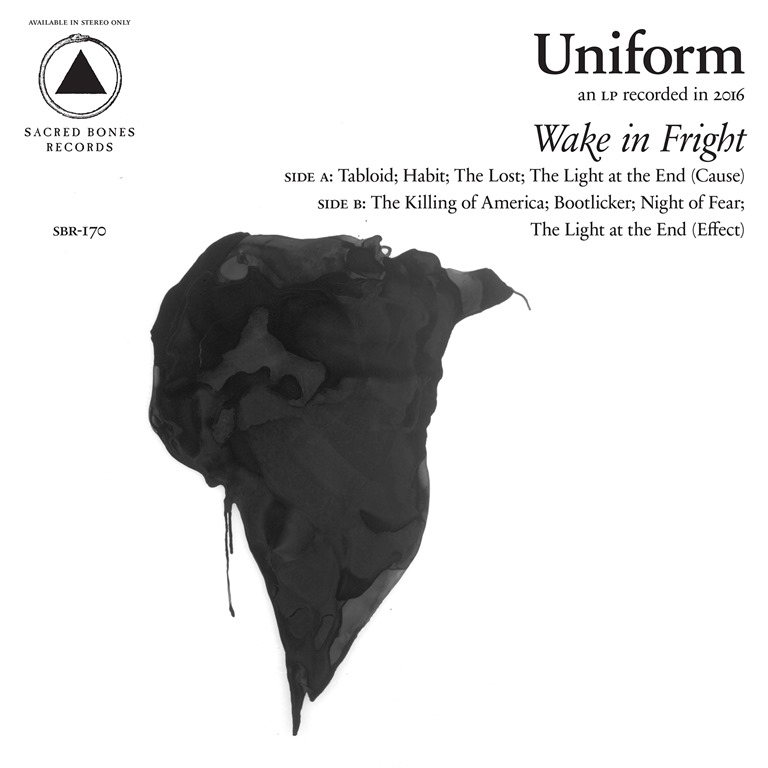
 

Uniform - Wake in Fright

empreintes DIGITALes – IMED 17141

Christopher Nosnibor

The background:

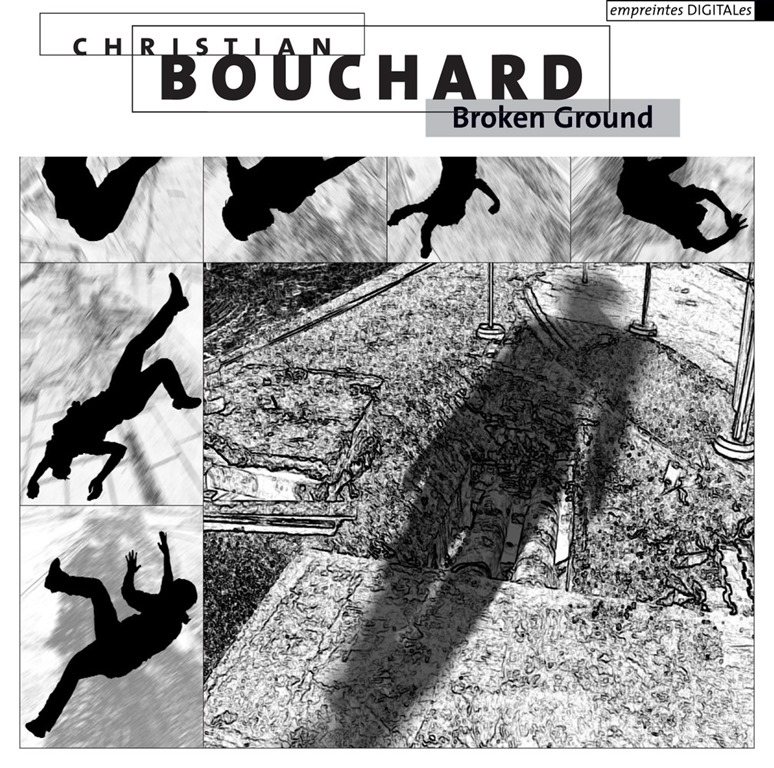
The exhibition Broken Ground looks at seven cities over ten years, and how redevelopment infrastructure changes our perception of cityscapes. These cities could be anywhere (everywhere). Reconstructed from the opportunities of street level construction, I treat the sites more like stage sets, where there are props, actors, entries and exits, and evidence through the debris, disarray, shadows of figures and randomness throughout.

In our contemporary world the works have taken on hybrid references of displaced people from war zones, or natural disasters that fill nightly newscasts in the media.

The review:

It’s an unsettling work. An apocalyptic, post-nuclear work. An album that lurks under the shadow of the bomb. It’s an album for unsettled times, a soundtrack to a return to the distrust of cold war politics and a global culture defined by social and political division, fear, uncertainty and mass murder. Broken Ground is a dark album for dark times.

From the very outset, Bouchard manipulates dark, throbbing layers of undulating, yawning drones and grating tidal waves of noise, dragging them across birdsong-like tweets of analogue twitters, sounding like a corpse in a tarpaulin being hauled down gravel drive at sunset. Yawning, drawling harmonica-like notes drift lazily, and somehow awkwardly, stretched and distended, over groaning low to mid-range backdrops: almost-familiar sounds are bent out of shape and rendered unfriendly. ‘Intergranular Attack’ goes in low, snake-like whispers and bleak monotone narrative samples deliver reports of atomic science with a detached clinicality, and the theme is revisited in the fragmented, fractured post-apocalyptic time capsule that is ‘Resistant Materials’.

Dark tones creep and hover, while washes of snarling noise and contrails of feedback linger amidst screeds of sharp-edged sheets of sound and washes of nebulous noise. Glitchy, crackling beats thud disconcertingly through a stammering hum on ‘Hysteries’, and the scratchy oscillations of ‘Voids Patterns’ offers a fresh take on spacey / spaced out reverby darkness.

Broken Ground finds Bouchard exploring well-trodden experimental fields and offering something new. Charming chimes assume an ominous demeanour; voices drift, detached in empty space. There is no comfort or solace to be taken from their presence: they’re distant, disconnected, out of reach, perhaps by light years. You may be receiving, but there’s no way to make two-way contact: you’re lost in a wave of pink noise and a fizz of rolling static.

As in space, so on earth: each person sitting, alone, boxed in: connected in the virtual world but never more alone and isolated now. Tapping out comments and messages, condolences and sympathy for the displaced and the damaged reported by the media: it’s merely mechanical. You feel nothing for them, you feel nothing for yourself: you’re numb, a drone. You don’t really connect. You’re floating in virtual space.

The voices, stammering, echoing in fractured snippets of different languages from the speakers are no more familiar than the voices from around the world, beamed to your computer and smart phone. This is the world of dislocation and dis-ease Bouchard depicts with such precision on Broken Ground. It’s awkward and uncomfortable, but looking in the mirror always is.

Christian Bouchard – Broken Ground

‘Negative Drone’ is one third of a final suite on the record, born out of his own research into the sound of fear and the weaponisation of audio over the past few decades. It is a piece about “recognising that technologies with huge promise tend to fall into particular tropes that are pre-existent and reflect cycles of power and capital interests.” Lawrence continues to describe how his research led him to all manner of surveillance and target acquisition footage from drones and other military craft… “Needless to say it was harrowing viewing, but it very much made me recognise the dynamic shifts erupting just beyond our everyday horizons. We don’t tend to think about these things, what they are used for and what it is they could be used for. We just assume that their uses are somehow prefigured. For most of us these machines and the implications they carry are distant and in some way unthinkable, but for other peoples across the world their sound alone is enough to bring terror and anxiety. I found this a powerful question to explore and the composition grew out of it. In fact the final third of the album grew from this particular line of investigation.”

Musically, ‘Negative Drone’, featuring Norman Westberg and Thor Harris of Swans, Werner Defeldecker and The Australian Voices, was one of the final pieces to come be completed on the record. It is also one of a number of pieces in which Lawrence plays pipe organ, recorded on what was once the largest organ in Queensland, the state he resides in.

Expanding investigations into the politics of perception, and exploring the possibilities of new recording processes, technologies, locations and relationships, as well as conveying different sonic textures, Cruel Optimism is ultimately a record that considers power (present and absent). It meditates on how power consumes, augments and ultimately shapes two subsequent human conditions: obsession and fragility.

We’re big fans of Lawrence English and Room40 here at AA (as our many reviews of the label’s output attest) and the indications are that this could be one of his strongest works yet. Check out ’Negative Drone’ here:


https://player.vimeo.com/video/194648555


Swedish metal/crust punk outfit Martyrdöd – featuring members of Skitsystem, Agrimonia, and others – has just revealed an official video for the track "Handlöst Fallen Ängel," hailing from the band’s album List, which was released through Southern Lord in November. Filmed and edited by Jimmy Johansson, also responsible for Martyrdöd’s recent "Harmagedon" video, the riotous live-filmed "Handlöst Fallen Ängel" can be viewed below:

Aurora – ACD5084

Christopher Nosnibor

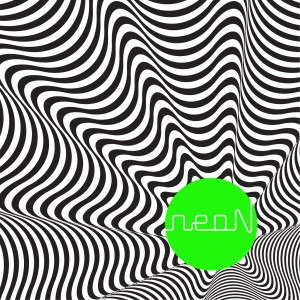
The cover suggests a blinding trip of an album, the sonic equivalent of an immense op-art extravaganza. Ensemble neoN, a collective of twelve Oslo-based musicians present on their debut release performances of compositions by an array of luminaries in the experimental / avant-garde music world, chosen for the uncompromising and original nature of their work. And while the collective’s objective is to ‘initiate, produce and perform music that reflects current trends in music and other art forms’, and to do so with a spirit of youthful conventionalism, they’ve set themselves well beyond the mainstream as far as fashion goes, and have produced an album that shows a lot more restraint than the lurid dayglow Digipak would imply.

Their rendition of Kristine Tjøgersen’s ‘Travelling Light’ heralds the ensemble’s arrival in bold fashion, and sets the tone, manifesting as an energetic sonic excursion that grabs the attention and holds it in a firm grip. Twangs and pings whip into space like a squash ball pelting into zero-gravity while long, quavering drones rise and decay.

There’s a keen element of playfulness which runs through Jan Martin Smørdal’s experimental composition ‘My Favourite Thing’, which toys with the tropes of orchestral soundtrack pieces with an avant-garde bent. Clamouring strings and creeping fear chords meet with marching drums and

The choice of ‘Monocots’ by Oren Ambarchi and James Rushford as the album’s centrepoint is well-conceived: the rippling acoustic guitar hangs in a fuzzy mist while a minuscule sound, like the trickle of water, continues to run through the silent sections.

Alvin Lucier’s epic ‘Two Circles’ is an exercise in uncomfortable droning minimalism. It doesn’t do much, and nor is it required to do so. Instead, it highlights the multi-faceted nature of the ensemble’s playing skills, and taken collectively, these five pieces are well-considered and well-executed. And the liner notes by Jenny Hval make for a nice bonus, too.


Ensemble neoN