Archive for May, 2016

Jess Robinson

Excited? Well gorsh darn it yes, yes I am indeed. To be able to choose between 200 bands for £35, inside the cradle of London’s eclectic Camden? Yes! Slightly bummed about WATO though…

Camden Rocks 2016 (Saturday 4th June) promises bigger names (Cribs, Young Guns, Billy Bragg, Glen Matlock) swirled into a rock cocktail of lesser known acts and up-and-comers. Here’s what I want to see and why, maybe you’ll join me? #prayingforzeroclashes

Black Spiders

If you want Rock, and I mean proper, old-school, riff-laden, ass-kicking, sneering ROCK, Black Spiders will deliver. Perfect for this type of event, I only hope the venue does them justice. But it will. It must. Of course it will. I’m hoping against hope that they play D&B, or even Jitterbug – early Spiders, punchy real rock n roll content but punk-rock song duration, easy to slot in between their standards ‘Just Like a Woman’, ‘Easy Peasy’, ‘Stay Down’ and ‘St Peter’ from their Sons of the North album. I was newly pregnant last time I saw them – this time I can add alcohol to the experience, woohaa \m/ FUBS etc.

Ginger Wildheart

Now, this guy, it amazes me to say, I have never seen live. How? I don’t know! He’s a canny lad, his lyric writing is crazy-good, and he’s a damn fine musician. His songs seem to have a dirty shimmer to them – check out the ‘Only Henry Rollins Can Save Us Now’ track for a taste. A total of three venues are gonna be hosting this energetic dude on June 4th, so, you have no excuse not to see him!

Queen Kwong

Like no other female-fronted guitar band I’ve witnessed before, Carré is utterly enthralling to watch, throwing herself into the music and oftentimes the crowd, with so much energy, screaming enraged lyrics chased up with haunting whispers, that it’s kinda like watching two tiny ass-kickers take on the world. There are droolworthy pedalboards to glimpse too, if you can tear your eyes away from the performance. ‘Baby Did a Bad Bad Thing’ is about as purrrfect an example of this band’s pared-down punk rock resumé. I for one am intrigued to witness the next incarnation of Queen Kwong; after the departure of Fred Sablan will their sonic power be diminished? With Carré holding the reins? Doubtful. Roll on June 4th.

The Tuts

Tight 3-piece pop-punktasic Tuts are on my list to go see. I’m curious to know if they can cut it and aren’t just about looking pretty-yet-alternative-oooh-I-can-play-and-sing… I have my fingers crossed and here’s why; they can play and they can write catchy lyrics and guitar hooks. All of this is promising. Can they hold the crowd’s attention? With punk songs notoriously short can they fill a set without resorting to tooooo many covers (‘Wannabe’, though…. Really? Shame on you grrls…). Can’t wait.

Grumble Bee

Hotly tipped for 2016, Grumble Bee is solo when writing and recording, but does bring a drummer and bass player to his live performances. Four months into the year and he hasn’t set the music world alight, but there’s time yet. I’ve heard him played a handful of times on Kerrang! Radio – usually by Johnny Doom and I’m interested enough to seek him out in Camden….

HECK

“Devastation in the form of a band” so says the husband. He’s seen them four times, so I have to assume carnage will occur. I’m not even going to prepare myself by listening to these guys, I’m just going to immerse myself if their set…and try to survive it.

Yuck

If you’re after something sludgy and shoe-gazey with an occasional uplifting bright element, you could certainly do worse than Yuck. I’m going to head to these guys for some delightful sonic wind-down during an otherwise manic noise-fest of a day. Hey, a grrl can dream.

If time and timetabling allow, I’d also like to try and catch Glen Matlock, Young Guns, Asylums, Vukovi, The Virginmarys…… still be pining for WATO though…

Venues include:

ELECTRIC BALLROOM *UNDERWORLD * PROUD * BARFLY * BARFLY DOWNSTAIRS * DINGWALLS * BLACK HEART * HAWLEY ARMS * MONARCH * THE GOOD MIXER * THE CUBAN * BREW-DOG * DINGWALLS CANALSIDE  * THE FORGE * THE CROWNDALE * DUBLIN CASTLE *BLOC BAR * CAMDEN CAVERN @ BELUSHIS * FIFTY FIVE

https://skinbackalley.files.wordpress.com/2016/04/camden-rocks-2016-poster-6th-april.jpg


More information on the links below.
http://www.camdenrocksfestival.com
http://www.facebook.com/CamdenRocksFestival
https://twitter.com/CamdenRocksFest
#CamdenRocks
At Aural Aggravation, we always say if you’re going to do metal, make it heavy, make it hard, and make it nasty. Ok, so we don’t always say it, but it’s got the potential to become a future motto. It’s certainly a motto that fits Demons of Old Metal (which of course makes the classic acronym DOOM).

Following a storming performance at the Mosh Against Cancer festival in Coventry this April, D.O.O.M. are now gearing up for four summer festivals starting with Wildfire in Scotland on June 24th.  This will be followed by their headline slot at SOPHIE Fest, Coventry on July 16th, then on to the Phoenix Alternative festival in Wales on August 13th and last, but not least, a return by popular demand to Beermageddon during the last weekend of August.

Watch the ‘Fakeskin’ video here.


Music Information Centre Lithuania – MICL CD 089

Christopher Nosnibor

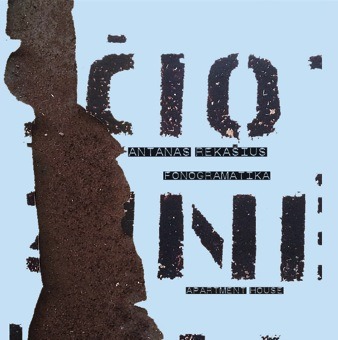
A retrospective collection is perhaps the most instructive place to begin when being introduced to the work of a late artist with a substantial body of work to their name. And so it was that Fonogramatika, 26-track collection culled from seven projects from between 1970 and 1981 featuring the work of Lithuanian composer Antanas Rekašius (1928-2003), as performed by the six-piece Apartment House ensemble came into my possession for review. My first contact with a composer clearly of some renown, but of whom I had absolutely no prior knowledge. A small amount of research revealed the composer is believed to have committed suicide, aged 75, after suffering poverty and depression.

There’s nothing depressive about the quirky music on offer here: indeed, there are humourous touches at every turn in Rekašius’ lively, unconventional and often quite audacious musical works.

Anton Lukoszevieze’s substantial liner notes (subtitled ‘Unsettling Scores and Unstable Tendencies’) are informative, and help to provide some kind of handle on Rekašius’ work, but needless to say it was extracting the disc from the incredibly heavy-duty and immaculately-presented four-way gatefold sleeve (really, the packaging super, and you really can feel the quality) and actually hearing the music therein which proved more instructive.

Rekašius’ style is often informed by jazz, but with a keen ear for atmosphere and experimentation, using the instrumentation of a chamber orchestra to create a range of effects. There’s a fluidity to the compositions, and a certain deftness which makes for rapid and often unexpected transitions from sparse, stark atmospherics to wild brass. The strings howl and mew, bend and bow, and Rekašius makes a trademark of combining dissonance and subtle melody. In fact, it’s the fact that there are strong, albeit brief, passages of melody, and a ken for swinging rhythms and off-kilter repetitions that render the works so beguiling: the listener can marvel at the scope and style of the compositions, the apparent randomness and the dynamics which are worked into the pieces, because yes, it is all very clever. But equally, it’s possible to simply enjoy the music.

Often, the music is jarring, but Rekašius invariably pulls back from the brink of spine-jangling awkwardness with cadent musical flourishes which are pure joy. Wild cacophonies, lumbering menace, twisted folk fiddle and notes that simply sound ‘wrong’ all contrive to keep the listener alert and entertained. ‘Atonic I’ (the individual tracks on each album are known by number only, with the exception of those from Phonogram) evokes the soundtracks of old, silent movies. If anything, Fonogramatika demonstrates just how able Rekašius was at turning his hand to different styles and making them work, while at the same time adding his own idiosyncratic stamps to them. The musicianship of the Apartment House players shouldn’t be underestimated, by any means: they play with nuance, intuition, and passion.

It’s now 13 years since Rekašius’ death. While his work has been performed in the United States, Italy, France, Finland, Sweden, Germany and Hungary, as well as Lithuania and Russia during his lifetime, his substantial output, which includes nine symphonies, 12 ballets, seven concertos and an opera-oratorio, Rekašius’ legacy seems rather limited in most territories. Perhaps the release of Fonogramatika will go some way toward addressing this, and earning Antanas Rekašius wider posthumous recognition.


Rekasius


Apartment House Online

Silo Rumor – May 2016

Christopher Nosnibor

Given the ubiquity of music, perhaps now even more than at any time in human history – and music has been an integral part of life for as long as we know, in ever-evolving forms – it’s something that is generally taken for granted. Few consider the function, or functions, of music, and those who do are more often than not academics: the average individual is unlikely to devote a great deal of time to dissecting precisely why they listen to the music they do, or what it is that specifically draws them to music. That said, the more avant-garde and theory-based the art becomes, so more consideration is given to its purpose, and in some respects, this seems somewhat paradoxical given that much of the work in this sphere is not what the majority would necessarily consider ‘music’. And so we have Jonathan Uliel Saldanha’s Tunnel Vision, a collection of pieces recorded in and around the tunnels of Porto. Part field recording collage, part abstract, part ambient soundwork, the album’s seven segments are not overtly musical, in that they do not feature any of the conventional features of ‘music’.

While the concept of ambient music is now well established, and the theories around it also representing well-trodden territory, it’s still worth considering the purpose of an album like this. What kind of experience does it offer the listener? Specifically, what is the point? After all, Tunnel Vision is, ostensibly, little more than drones, moans, hums and thuds with occasional snippets of voices. And if anything, it’s not really ambient: it’s far too tense and unsettling for all that.

‘I’m what some people call The Tunnel. Whereas most are drawn to what’s on the surface, in the skies, or in space, I’m drawn to what’s beneath the surface,” says the anonymous speaker on the tile track. He continues: “Space seems exotic, mysterious, because it’s distant, far away enough not to fear… the underworld is a void that sits right beneath our feet. It evokes fear…” And while Tunnel Vision is concerned broadly with the use of ‘resonant spaces’, the overall mood and texture is very much of the space below than the space above and around. The purpose of this music is to evoke the space which frightens us, which pricks those subconscious fears through the medium of sound. It’s about conjuring the unfamiliar and appealing to the senses in a way which unsettles them by means of the concordance of the rumbling of distant thunder which rolls beneath a shifting soundscape of mournful brass and unexpected clashes of sound.

The three tracks which occupy side two are noticeably longer, than the four on side one, and feel more formed, building on the atmospheres which emerge through the layering of long, low hums and drones, twittering flickers snippets of voices and thuds and clumps.

And so it is that one does not listen to Jonathan Uliel Saldanha’s Tunnel Vision for its musicality, or for entertainment. Nor does one interact with music on this level for relaxation purposes, but instead to confront subconscious and primal fears. To marvel at the mind which could create such sonic challenges, and to feel a sense of discomfort that’s essential to moving out of one’s comfort zone and instead be shaken into feeling something that evokes a response beyond immediate comprehension.


Silo Rumor

Jonathan Uliel Saldanha Online

Tavern Eightieth – TVEI24 – 29th April 2016

Christopher Nosnibor

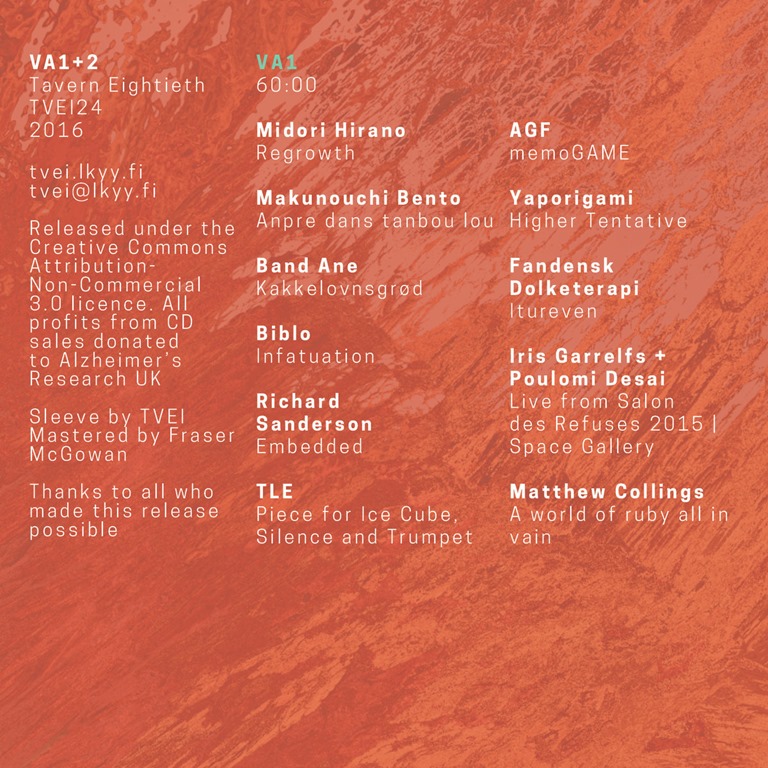
Described as ‘a large compilation of diverse and exciting music from new and exciting artists,’ VA1+2 is, first and foremost, a fundraiser for Alzheimer’s Research UK. Arguably, that’s reason to purchase it in itself, but of course, in truth, any compilation sells on the basis of the music. The immense range of music on offer on VA1+2 is its real strength, and offering over two hours of music (that’s 22 tracks by 22 different artists packing out a brace of discs), it’s a veritable boon of contemporary electronic, ambient, experimental, electro-acoustic, improvisational and more.

From the semi-ambience of Midoro Hirano’s ‘Regrowth’ and the swampy Latina stylings of Manouchi Bento’s ‘Anpre dans tanbou lou’, there’s much to soak in on disc one. Band Ane’s bleepy, space-age ambient Krautock is particularly intriguing.

Disc two spans the dolorous yet delicate piano-led instrumental of International Debris’ ‘Translucent Orb’ to the eerily ominous ‘Kiki and Bouba’ by Isnaj Dui, via the ethereal transcendental post-punk folk hymnals of ‘This Thought Won’t Last’, the contribution from Zelienople and Glacis’ elegiac epic ‘As long as water flows’.

One of the common pitfalls of compilations, and in particular compilations to raise funds for charity, is that they’re often a bit of a hotch-potch mess, no better than the naff giveaway discs that come with magazines (or used to come with magazines: I don’t know as I stopped buying magazines some time ago, at the point when the quality of features and reviews vs cover price became unfavourably skewed toward the latter) plugging whatever was hot at that moment in the eyes of that publication, with a bunch of album tracks and B-sides taking up the majority of the space. VA 1+2 feels – and sounds – very different. Tavern Eightieth haven’t just taken anything that’s been floating around, and while I despise the overuse of the word in our post-postmodern hipsterised word, there’s a sense that they’ve actually curated a compilation which represents the label. There’s clearly a lot of thought and effort gone into this, from the selection of material itself to the mixing and sequencing of the tracks. And so, while it is a fundraiser, and for an extremely meritorious cause (I’ll spare the lecture here on the underfunding of research into Alzheimer’s given the number of people it affects).

Finally, mastered by Fraser McGowan with an ear on optimal clarity and dynamic range over volume, there’s a sense that every aspect of this release is about doing the music justice. And in turn, they do the charity and the listener justice. Everyone wins.

Tavern Eightieth VA1 2

Tavern Eightieth – VA1+2 at Bandcamp

1empreintes DIGITALes – IMED 16137 – 5th May 2016

Christopher Nosnibor

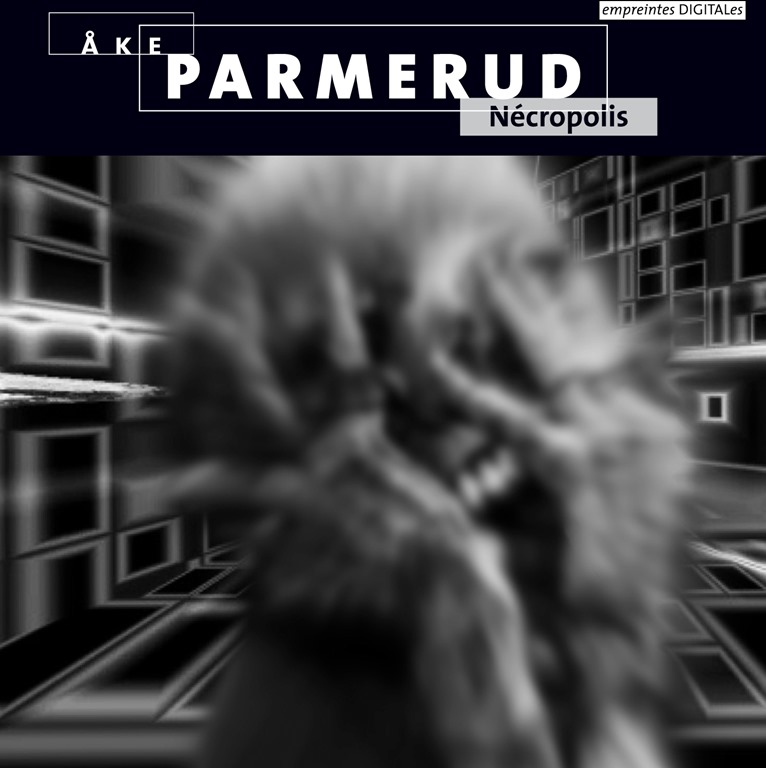
It looks like a box set. But it is, in fact, simply a CD in a box. A very elaborate box at that. It works a little like a matchbox, the interior of which folds out to reveal extensive liner notes in French and English, written by Parmerud himself, and which provide interesting and instructive insight into the four compositions. Created between 2005 and 2011, the extended pieces are united not so much thematically as compositionally, the sounds collected and collaged rather than being shaped into conventional musical frameworks.

‘Dreaming in Darkness’ is forged primarily from small sounds, spaced apart from one another. A chime, a chink or a clunk, and then silence before a scrape or a click or a bump. It’s fragmentary, the origins of the sounds unclear. Taking the question of what a person who cannot see dreams about, Parmerud explains that the piece is an attempt to create surrealistic fragments of a blind person’s dreams. As the piece progresses, the sounds become increasingly densely packed, and with longer durations and overlaid, building sinister abstract scenes: in fact, not so much scenes as shifting shadows and variations in light.

The bubble of conversation marks the opening moments of ‘Crystal Counterpoint’: a recording which sounds like a restaurant or party, the chinking of classes and general hubbub of people grows and stops abruptly with the chime of a glass. Inspired by the sounds of the parties Åke’s parents used to host, and which he would hear from upstairs, the piece uses the very same glasses to create a wealth of sounds, from long, low drones to higher hums, elongated undulations and quick, bright glissandos. Grand swells of sound rise and cease suddenly, replaced by strange, quiet drifts of sound: it’s very easy to forget exactly what you’re listening to. But if anything, awareness of the origin of the sounds only heightens the experience, as you’re likely to marvel and wonder just how glasses could sound like an oboe or high winds across mountain tops. In his notes, Parmerud notes that there already exist a large number of recordings which explore glass sounds, and it is, indeed, an interesting piece to place alongside Miguel Frasconi’s ‘Standing Breakage (for Stan Brakhage)’ (clang records, 2016).

‘ReVoiced’ moves away from musical abstraction and instead uses the voice as its instrument. A single voice is layered up on top of itself exponentially until a whole crowd of one voice is speaking. It’s actually quite a disconcerting experience. Voices are subject to all kinds of manipulation: sped up, slowed down, pitch adjusted, stretched, overlaid, echoed and delayed, in myriad permutations. Chants and dialogue and ululations, crowds and multiple languages meld together, and gradually, extraneous sounds – hard, heavy slabs of sound – crash in, while sharp-edged sounds slash for create a dull, percussive element to the slow-building torture of the familiar becoming twisted, distorted, abstracted and unfamiliar.

The final track, ‘Necropolis – City of the Dead’, is a musical tour through the catacombs of an imaginary city which contain the remains of some of the greatest music of all time. ‘But the condition of the musical bodies that rest in the crypts is unfortunately in various states of decomposition’. As such, in combining a well-worn joke (which is usually about Mozart when I’ve heard it) with a project to assimilate and deconstruct fragments of existing works, ‘Necropolis’ is a sort of a collage. Classical, jazz, film soundtracks, many renowned and bordering on recognisable, at least in essence, all fade in and out and collide against one another.

While the title track may pick over the bones of musical history, it equally breathes new life, and the same is very much true of the work as a whole: the parts are disparate, fragmentary, scattered in origin from around the globe and individually amount to not very much at all. But the sum is spectacular, an experience which is thought-provoking and which has the capacity to be quite unexpectedly affecting.

Ake Parmerud

Åke Parmerud  Online

On June 17, iconic avant-rock ensemble Swans are releasing The Glowing Man,  the fourth and final studio album from this line-up since their reactivation by band primum mobile Michael Gira in 2010 after a 14 year hiatus. This will be followed by their customary year-long world-wide tour celebrating the release after which Gira says, "I’ll continue to make music under the name Swans, with a revolving cast of collaborators…touring will definitely be less extensive." This is an excerpt of "Cloud of Unknowing" from the live concert DVD that will accompany the deluxe 2-CD release:

Neurot Records – 6th May 2016

Christopher Nosnibor

The story goes that Alaric (featuring within its ranks current and former members Of Dead And Gone, Pins Of Light, Noothgrush, Hedersleben and UK Subs) began their journey in 2008 with an eye toward creating a moody and compelling music of a sort not often performed in this time and space. A different concept of doom, beginning with influences from such progenitors as Killing Joke and Christian Death to the darkest, heaviest punk bands and the most epic psychedelia. A good-time, feel-good party band they are not.

I am going for a ‘sheets of electric rain’ guitar sound, says guitarist Russ Kent. This should perhaps give an indication of the fact that End of Mirrors finds Alaric exploring some bleak territory, in which guitar riffs are not the driving aspect of the sound, and whereby the guitars provide texture and density instead of shape or form. Using the guitar in this way is by no means new: from the late 70s and early 80s, bands like Sonic Youth, Swans and Bauhaus shifted the emphasis toward the rhythm section, with the guitar serving not a secondary, but alternative musical function. It’s from this background that Alaric’s sound can be found emerging, and End of Mirrors betrays heavy influence from the no-wave and early goth (before it was called goth and was simply a dark strain of post-punk) scenes, infused with a very metal edge. As such, while it’s very much steeped in a number of 80s styles, it’s an album which incorporates them in unusual and innovative ways.

Eight-minute opener ‘Demon’ sets the tone. A lengthy, atmospheric introduction of trudging percussion and simmering feedback gives way to a crushing riff, from which emerges a big, meandering bass-led groove, part Sabbath, part Neurosis. ‘Wreckage’ builds a bleak scene with squalling, spindly guitars layered over a thunderous drum and heavily flanged bassline reminiscent of Pornography-era Cure. But the throaty vocals are more Al Jurgensen circa The Land of Rape and Honey. Moody and intense, the dark despondency carries through into ‘Mirror’. ‘Don’t look in the mirror,’ Shane Baker growls in a deceptively catchy chorus before the song suddenly explodes into grinding thrash riff that piledrives it to another plane.

It’s unexpected twists like this which break the barren expanses of claustrophobic doubt. And do be clear, it’s very much the Rozz Williams incarnation of Christian Death that manifests in the interloping guitar lines of ‘Adore’, and if ‘The Shrinking World’ sounds like an early JG Ballard novel, the metallic scrape encapsulates a near-future dystopia worthy of the great author. The title track is a Melvins-like blast of grinding thrash, a thunderous tempest of a track that sears in at under three explosive minutes, and marks quite a contrast from the longer goth-orientated pieces which dominate the album.

As a whole, it’s a dark, almost apocalyptic sweep of sound. Sitting alongside the recent releases by Se Delan and Madame Mayflower, 2016 is starting to look like the year goth is reborn. Forget darkwave and all that cal: emerging from a protracted period of social and economic turmoil, uncertainty, unrest, fear and an all-pervading sense of existential trauma, we’re back in the late 70s and early 80s, and this is the real deal.


Alaric_EOM_cover copy 72 pixels


Alaric Online