Posts Tagged ‘zeitkratzer productions’

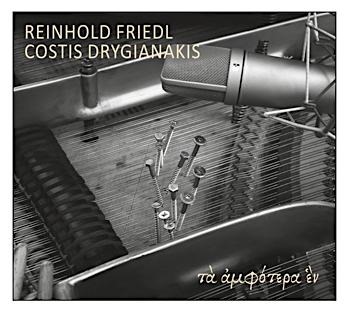
Reinhold Friedl & Costis Drygianakis – ta amfótera en / two into one

zeitkratzer productions – 28th February 2025

Christopher Nosnibor

Reinhold Friedl has been a significant contributor to the world of avant-garde music for a long time, not only as a leading explorer of the potentials of the prepared piano, as pioneered by John Cage, but in excavating the works of historical composers and reconfiguring those of more contemporary ones, leading the zeitkratzer ensemble through performances of Metal Machine Music and selected cuts from Whitehouse’s catalogue.

This particular collaboration coalesced during the pandemic, after which, as we learn, ‘Costis Drygianakis recorded Reinhold Friedl’s special piano sounds on a Blüthner grand piano with a bunch of extremely diverse microphones, ranging from a beautiful old Neumann U67 to a cheap tape cassette machine and even a Dictaphone. The resulting recordings have been classified, selected and processed at his home studio in Kritharia, Greece. No other sounds have been used.’

ta amfótera en is one continuous piece, just over an hour induration, and it’s a journey, to say the least. By ‘journey’, I mean torturous experience. It’s dark, punishing, pulverising, scraping, nightmarish. The first two minutes alone are a soundtrack to extreme horror – fear shaking amidst tremulous piano, heavy discord rumbling low and disconcerting to the point of spiking anxiety, after which there are protracted warped drones and rumblings which drag on, scraping and twisting, sonorous and uncomfortable. Amidst rolling, swirling, churning ambience and awkward, uncomfortable noise, random piano notes spike, seemingly at random. Gongs chime, crash, and clash.

When I was a child, the warping, discordant intro to ‘Rio’ by Duran Duran intrigued me. It created a palpable tension which affected me inexplicably at the age of nine. Perhaps this brief snippet of sound, dissonant, metallic, paved the way to my later obsession with musical otherness. The specific reason I reference this formative experience is that lengthy segments of two into one sound almost exactly like those opening bars of ‘Rio’ – scraping, discordant, a little like twisting metal.

two into one warps and hums, scrapes and drones, and occasionally plonks and thunks, the sounds rising from a random and seemingly unarranged twisting spill of sonic strangeness. There are chimes, and chsllenges.

There is much space – just as there are whistles and feedback – on two into one. The experience is, perhaps inevitably, disorientating, vaguely bewildering, even. There is something about this work which lifts you off the planet: to attempt to pin it to the particulars of contemporary rock music seems to be missing the point. Explore this release… and discover.

AA
Friedl 2

zeitkratzer productions / Karlrecords – 22nd September 2023

Christopher Nosnibor

SCARLATTI represents something of a departure for zeitkratzer, the neoclassical collective headed by Reinhold Friedl, master of the prepared piano and a renowned avant-garde composer in his own right. While their performance and recordings usually focus on modern composers and avant-gardists spanning Stockhausen and John Cage via Whitehouse and Lou Reed, with a reinterpretation of Metal Machine Music, here they turn their attention to the altogether more historical figure of Domenico Scarlatti (1685-1757). He is best known – although this is relative – for composing some five hundred and fifty-five keyboard sonatas, and his being a progenitor of classical music. But a large portion of his work went unpublished in huis lifetime, and much has only been available sporadically since.

As the notes which accompany the album explain, ‘Little is known about Domenico Scarlatti… His music is, so to speak, left to its own devices: free, cheeky, playful, sonorous, surprising… Harmonically strolling again and again into unforeseen regions, the ear leads, not the theory; and also the fingers get their right: playful and haptic it goes. Scarlatti explained, “since nature has given me ten fingers and my instrument provides employment for all, I see no reason why I should not use all ten of them.”

But Scarlatti does not contain music by Scarlatti. Instead, the six tracks presented here are all composed by Friedl in response to Scarlatti’s work.

As such, this is much a celebration of Scarlatti’s ideas and approach to composition and so the explanation of the process and thinking behind it bears quoting: ‘Freedom, friction and listening pleasure instead of convention: “He knew quite well that he had disregarded all the rules of composition in his piano pieces, but asked whether his deviation from the rules offended the ear? He believes there is almost no other rule than that of not offending the only sense whose object is music – the ear.”

‘Reinhold Friedl applied this principle and composed the music for a choreography by dance company Rubato. Dance music drawn from Scarlatti, who was so inspired by dance music. The material of the piano sonata F-minor K.466 is twisted anew in all its richness, shifted back and forth, declined, frozen, noisified, sound structures extracted, floating. Those who know the sonata, will more than smell it’s [sic] shadows.’

The six pieces are indeed varied, in terms of mood and form. ‘lias’ is booming, droning, woozy, slow discordant jazz, low, slow, and with lengthy pauses. It’s not something anyone can dance to, and rather than light and playful, it feels dark and sombre. This is less true of the altogether sparser, but stealthily atmospheric ‘muget’.

‘pissenlit’ blasts in with churning industrial noise, a snarling blast that lurches and thunders, crashes and pounds withy relentless brutality. It’s clearly as far removed from the music of the seventeenth century as is conceivable, but beside the lilting piano and quivering, droning strings and subsequent stop-start levity of ‘reine des prés’ the sequencing of the pieces serves to highlight Scarlatti’s versatility, if not necessarily his predilection for playfulness. The playfulness manifests differently and unexpectedly here: ‘pissenlit’ is in fact the French word for ‘dandelion’, a plant often associated with a certain element of fun, of lightness, so the fact that this piece is three and a half minutes of gut-punching abrasive noise worthy of Prurient or Consumer Electronics is illustrative of the disparity between expectation and actuality.

Discord and discomfort abounds as drones and strings tangle amongst one another, heaving and wheezing and occasionally offering glorious, sun-hued vistas through the breaks in the widely varied forms, which feel elastic, and as if Friedl and co are stretching the fabric of the material to see just how much it will give. And it turns out, there is a fair bit of room. ‘reine des prés’ explores space, the gaps and pauses between the notes, and feels like a sort of musical cat-and-mouse which would equally work as soundtrack piece, but it has a cartoonish quality which means it’s more Tom and Jerry than anything else. But it is by no means flippant, throwaway. Entertainment is serious business, after all.

‘violette des marais’ brings pomp and drama… while the final track, ‘astis’, is skittish, playful but also frustrating in its hesitant, halting structure.

Scarlatti is interesting, entertaining, and bold, going out on a limb to present such an unconventional interpretation of a historical artist’s career. But this is largely the purpose of zeitkratzer: together, they re-present music, excavating the archives but presenting them through a prism of contemporary and avant-gardism, with jazz leanings but without being jazz in the way most would interpret it. In short, zeitkratzer continue to push and redefine musical boundaries, and long may they do so.

AA

a1585066167_10