Posts Tagged ‘voice’

Continuing with their nature-inspired theme, ‘Cwlwm Cariad’ refers to a type of moth, the ‘True Lover’s Knot’ in English. This is the second in a run of singles by singer-songwriters Eve Goodman and SERA from their upcoming collaborative album, Natur, due for release in the Autumn of 2025. It follows their first single ‘Blodyn Gwyllt’ which was released in July.

Where Blodyn Gwyllt was a celebration of freedom and the summer, Cwlwm Cariad is quite different. There are no guitars and percussion here, only one piano and 2 live voices almost until the end. It is delicate and it sings of the peril often tied up in the complexities of love and relationships, the passion, the self-destruction and flying too close to the flame. The delicate moth and the human heart connected in this way.

The track was recorded on an upright piano and the duo’s voices weave together in harmony once again.  Recorded at Wild End Studio near Llanrwst, North Wales, with co-producer Colin Bass. (member of Camel and also producer of the Tincian album from 9 Bach which won ‘Best Album’ at the BBC Radio 2 Folk Award in 2015)

The single is out on 15th August. Watch the video here.

AA

h-k_SGoIMrPy

Mille Plateaux – 14th April 2023

Christopher Nosnibor

ID[entità] is a collaborative work between composer, performer, sound and multimedia artist Gianluca Iadema and Swiss vocalist, improviser-composer Franziska Baumann, which developed over the span of 2017 to 2021, and is as much a work of decomposition and deconstruction and reassamblage as anything.

We’re deep into the territory of artistic concept and execution here, as the accompanying notes detail how ‘the Italian artist composes for the electronic and the acoustic voice, searching for similarities and contrasts that take styles of glitch, techno, and pop music to the extreme. Far from melody and accompaniment, he composes an oscillating interplay of the acoustic and the electronic environment, morphing and sculpting the two realms as equal sound materials. Rarefied moments, melodic outbursts reminiscent of Renaissance vocal music, and rave rhythms give rise to sonic textures embedded in a minimalist framework. The compositions are conceived in “spaces” rather than linear development, although an “ergodic” narrative is present. With a cubist approach, the spatially sculpted sounds transform into intimate moments and vice versa, thus allowing atmospheres to separate identity and non-identity. Born as a cycle of compositions for electronic voice.’

Cubism in music is something I have never considered, let alone encountered, and so I am – naturally – curious to discover what the album’s ten pieces would contain.

Strange, strange sound it what they contain. This is perhaps one of the oddest voice-orientated works I’ve heard since Mike Patton’s Adult Themes for Voice. Like Patton, Iadema showcases just how strange, unsettling, and unnatural the human voice can sound. That most familiar of things can also prove to be the most uncanny when its familiarity is twisted out of shape in any way. Against straggling strains of digital glitchery and fear-chord drones, we gets breathless utterances, muttering mumbles and off-key scales.

I hear eerie discord and dissonance; I hear voices bent out of shape to create forms that aren’t natural or humanly achievable without manipulation – but being human voices, they resonate subconsciously as belonging within the psyche. I hear stuttering glitches looped into helicopter rotors and panic attacks and sultry, soporific drones. I feel choral exultations and moments of contemplative spirituality. I hear uncertainty and a sense of unease. I hear scrambled bleeps and fluttering microtones, snippets in foreign tongues, a sensation akin to Wiilliam Burroughs’ cut-ups whereby words, sounds and images collage together to portray the world as we experience it, consciously and subconsciously, and simultaneously rather than via chronologically-sequenced narrative. There’s trilling and milling, humming and murmuring, and a sense of something just beyond reach, beyond knowledge, beyond perception, and a sense that something is somehow wrong. I may not hear Cubism, but then perhaps I’m not sure what I’m listening for, but I do hear fragmentation, sonic manipulation and all kinds of jarring effects.

With the majority of the tracks stretching beyond the five-minute mark, ID[entità] is a long album, and one which despite being quite calm and gentle in tone, with protracted ambient stretches hovering in an unsettling mist.

It’s a unique and visionary work which pushes multiple boundaries at the same time. ID[entità] is not always an easy listen and it’s by no means immediate, but it is accomplished and utterly compelling.

MP59_art

Karl Records – 21st September 2018

James Wells

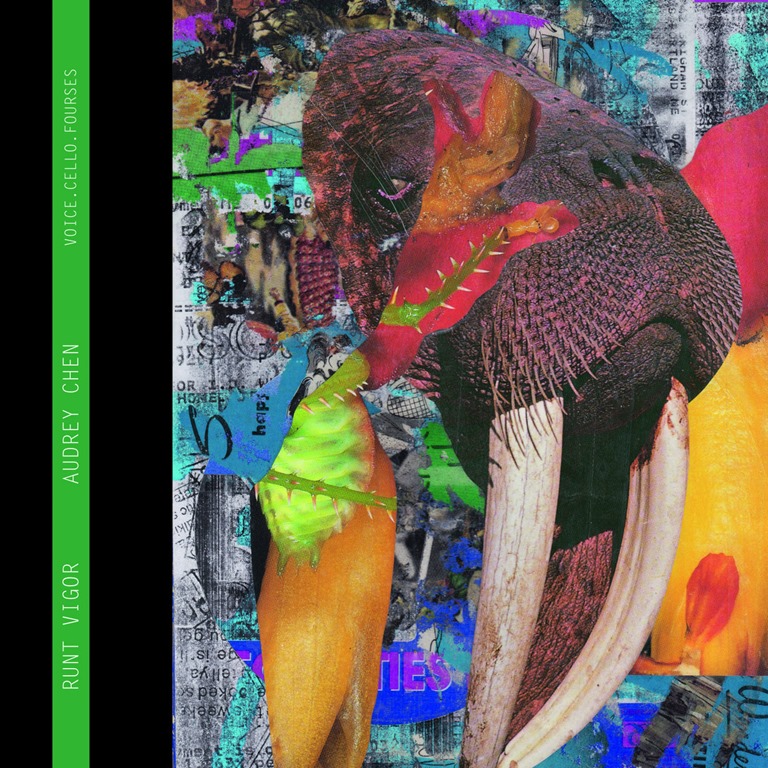
There’s nothing like an intriguing title, or one which ignites the imagination to generate interest in an album – or maybe it’s just me. And so the curious selection of the pairing of ‘runt’ with ‘vigor’ piqued my interest: the idea and image of a runt, smaller and weaker than nature intended, flailing feebly but energetically… Paired with the collage cover art, it all points toward something far-out – and I’m not mistaken or misled.

Now, I’m more accustomed and adjusted to music from the furthest, most extreme fringes, avant-gardism that redefines bizarre, inexplicable, outré. Chen is so outré that she’s bypassed me for all of 30 years, which includes a prodigious solo career punctuated by myriad collaborations that accounts for the last 15.

While much of her output is centred around cello, voice, and analogue electronics, vocal explorations have been at the heart of her most recent works including this four-track offering, which contains forty minutes of gulps, clicks, gargles and hums all emanating from the mouth and throat. Ululations and stuttering glottal stops create the very fabric of the compositions and occupy the foreground, along with asthmatic, gasping breaths, atonal, meandering whistles, and strangulation sounds.

While it’s more overtly ‘musical’ than Mike Patton’s Adult Themes for Voice which stands by way of a relatively obvious comparison, it’s not less disturbing or strange, and it’s impossible to distinguish the origins of all of the sounds here; the whispering hums, drones and wavering gusts of wind are, I would assume, as likely to originate from the artist’s body as from an instrument. It’s the way in which everything is rendered obscure, the voice twisted, pushed, pulled, distorted and disfigured beyond all recognition from the conventional utterances of speech, song, or even flatulence, which is so awestriking.

You may hear albums which share the same sonic territory, but I’d wager none will have been created in the same way.

AA

Audrey Chan

Someone Good – 1st September 2017

Christopher Nosnibor

David Toop enthuses over Haco as ‘weightless, not so much a voice from heaven but a voice that swirls in liquidity, water spirit…’ In this, he probably gets as close to capturing the essence of Haco’s music as its possible. It’s a challenge for any writer when presented with sonic abstraction: how to render the intangible tangible, and at the same time convey the experience of sound in words?

The music on Qoosui is not easy – and in fact almost impossible – to pin down. An analogy to catching a cloud is close, but not right: the seven pieces exist in a state somewhere between liquid and vapour, and flow in multiple directions seemingly simultaneously. Rippling synths slowly bubble as wash aquatically on ‘Kusul’, and paves the way for a sequence of amorphous, drifting compositions which drift and tether. Crystalline shards cut through cloud-like washes on ‘White Letter from Heaven’, and Haco’s voice is seemingly not of the human body, transcendental, and not of this world.

This is, in many respects, the source and heart of Qoosui: inspired by spirit voices, Haco becomes one. The medium is the message on every level.

https://player.vimeo.com/video/224449651

AAA

RM461_2WT1K(125mmX125mm)-1003

Unsounds – 57u – 10th February 2017

Christopher Nosnibor

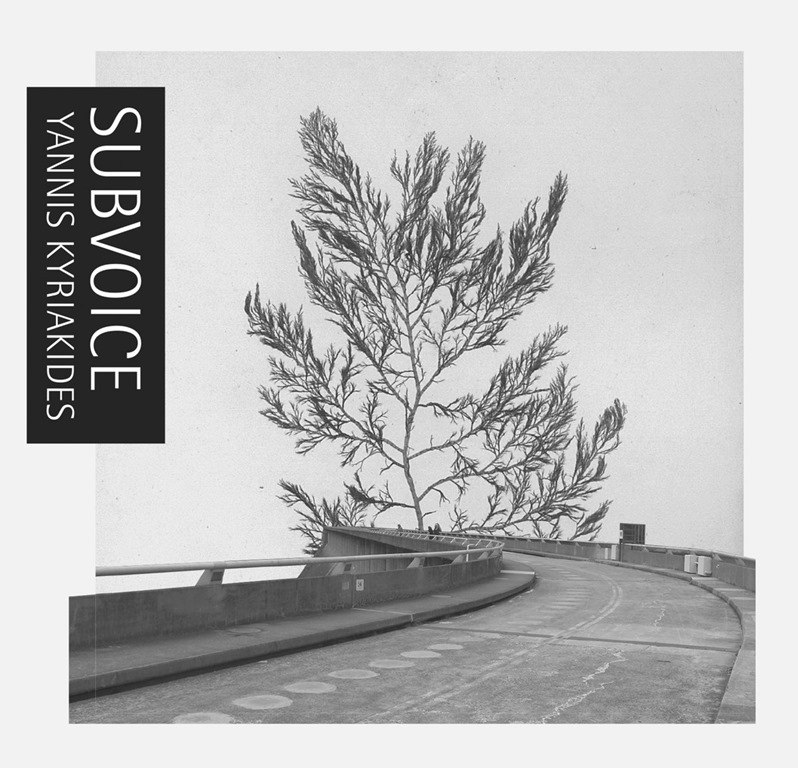
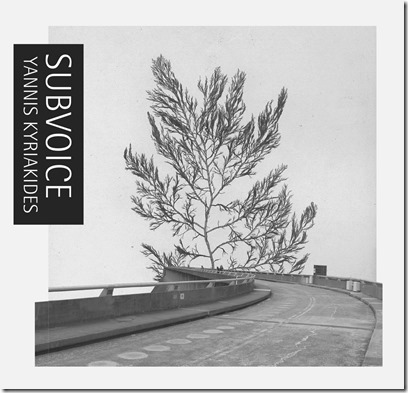
Unsounds have a history of releasing magnificently-packaged albums, and Subvoice by Yannis Kyriakides is up there with the best of them. The double CD is housed in a chunky hardcover book binding, which contains an actual book, some forty pages in span.

My introduction to the concept of the subvoice came via William Burroughs, who, around the time he was exploring the myriad potentials of the cut-up technique, made innumerable audio experiments. While most of these involved tape splicing, dropping in and cutting out, some investigated the subvoice in a most literal fashion. Some of these barely audible and even more barely listenable recordings appeared on Nothing Here Now But the Recrdings on Industrial records, with the liner notes describing ‘Throat Microphone Experiment’ – if memory serves – as a not entirely successful attempt to capture subvocal speech.

The definition of ‘subvocal’ is ‘relating to or denoting an unarticulated level of speech comparable to thought’. Kyriakides describes the works in the collection as ‘an investigation into ideas of voice and language [which] range from works in which text is directly encoded into music… to ones in which the voice is examined, dissected and pulled apart’. He explains that ‘in both approaches the underlying idea is to explore what happens when material has a clear semantic form, whether communicated in text or speech, is translated into musical structure’.

While thematically and theoretically linked, the nine pieces – which have a combined running time of almost two and a half hours – are from quite distinct and separate collaborative projects Kyriakides was involved in between 2010 and 2015.

The first piece on disc one, ‘Words and Song Without Words’ is the shortest work, being a couple of seconds under ten minutes, but appropriately introduces the kind of sonic palette Kyriakides and his collaborators – in this instance, Francesco Dillon, who contributes cello – work from. ‘Paramyth’ is eerie, disconsolate, the cracked ramblings splayed in all directions over tense piano and uncomfortable strings, but ultimately peters out into something softer. Skittering strings scurry busily in brief and disjointed flurries, hectically flying here and there, on ‘Toponymy’. Muffed voices bring a discomforting sense of the unheimlich, a sense of the intangible and of something just out of the reach of understanding.

Ominous notes hover and ring on the last piece on the first disc, ‘Circadian Surveillance,’ a twenty-five minute exercise in haunting atmospherics, where distant voices are barely audible under a rumble of turning static and hovering notes which resonate into dead air.

Onto disc two, ‘Der Komponist’ – a composition for orchestra and computer – begins quietly, ominously, with protracted near-silences between delicate, low, slow builds, before horns begin to add cinematic drama. It’s very filmic, very – for wont of a better word – soundtracky, and is reminiscent of some of JG Thirlwell’s more recent orchestral works. The climax is a slow, swelling succession of surging brass, underscored by a rippling digital churn.

‘Politicus (Dawn in the Giardini’ is perhaps the lightest and most playful composition of the nine, and utilises the variability and versatility of the prepared disklavier. The original work was a twelve-hour sound installation. The booklet explains the technical aspects in great detail, and Kyriakides outlines the way in which algorithms based on speech drive the formulation of the piece, here in an abridged fourteen-minute segment. The immense complexities behind the composition are completely hidden from the listener, with the surface completely masking the mechanical depths.

The final piece, ‘Oneiricon’ is a work for ensemble and computers. It’s an exploration of dreams, and is often subtle to the point of subliminality. And because Subvoice is very much a ‘background’ work, while it often drifts for significant stretches without really pulling particularly hard on the attention, it does mean that its immense duration is not an issue. Equally, because Subvoice is a collection rather than a work conceived as a single continuous whole, it’s possible to listen and appreciate in segments, without absolute commitment. And it is an album to listen to and appreciate: Kyriakides’ compositions are varied and textured and demonstrate an attention to form and sonic detail which extends far beyond the basic premise of ‘the voice.’
a0933203676_10