Posts Tagged ‘travel’

Mortality Tables – 29th November 2024

Christopher Nosnibor

Because life experience creates linguistic associations, for me, it’s impossible to see or hear the word ‘interzone’ without immediately thinking of William S. Burroughs. The title of a collection of short stories and ‘routines’ penned in the mid-1950s, Interzone was the working title of the seminal breakthrough novel Naked Lunch (1959), and the collection, published in 1990 consists of segments which failed to make the final cut. The pieces were written while Burroughs was living in Tangier, something of a haven for expat writers, including, perhaps most notably, Paul Bowles, but also polyartist and true inventor of the cut-up method, Brion Gyson. Burroughs described the city as an ‘interzone’, and it was indeed both an ‘international zone’, as the portmanteau implies, and a space between zones, outside of any single culture or jurisdiction, its administration divided between the US, French, Spanish, and English sectors, where ‘nothing is true, everything is permitted’. Of course, there are numerous other connotations, but this is what I’m bringing in terms of prececeptional baggage to this.

The accompanying notes certainly indicate that the album’s content holds up to these parallel positions: ‘Like its name implies, these are place of transiency. Intermediate places. In-between locations. Melting pots of different people and different ideas, constantly evolving as one thing collides with another, and another, and another.’

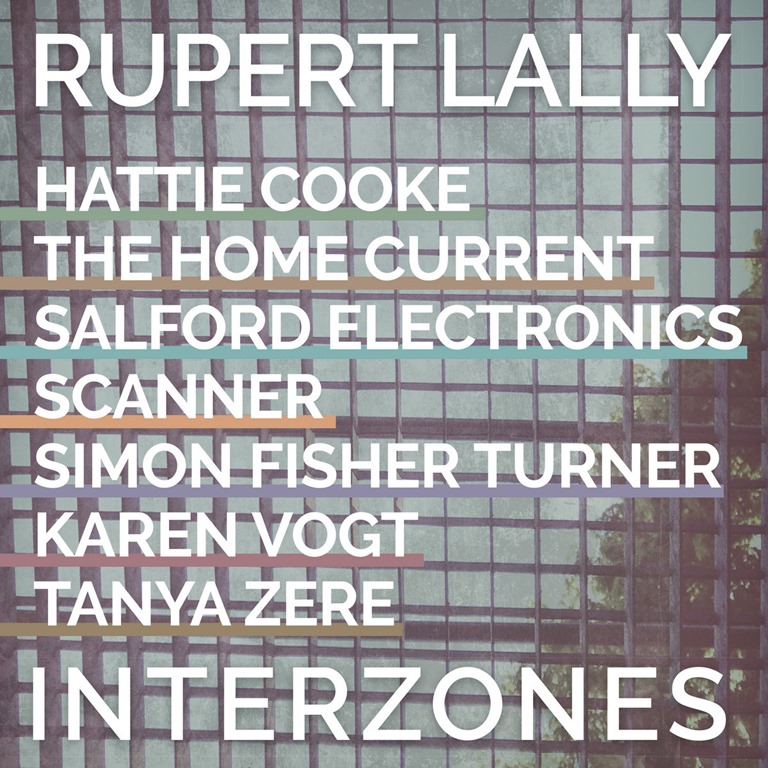
The album was initially recorded in 2022 as a solo work, but subsequently scrapped and rerecorded with a different collaborator on each composition. Collaborations do tend to bring out different aspects of an artist, and it should therefore be of no surprise that this suite of nine pieces, recorded between 2022 and 2024 in Switzerland, England, Luxembourg, France and Zimbabwe, is eclectic in its take on electronica.

As the bookending pieces, ‘Entry Visa’ and ‘Exit Visa’ indicate, travel, movement, and transition, are the key themes here. But this is not some pan-cultural pick ‘n’ mix grab-bag, and instead creates an experience which replicates the disorientation of travel. It’s difficult to articulate just how this sonic patchwork works, or quite how the experience feels. It’s not as if it lurches from techno to grunge, to opera, to thrash, and in this respect Lally’s works represent his ‘two inches of ivory’, so to speak. But within the realm of electronica, Interzones covers substantial ground.

‘Play Position’, featuring Salford Electronics, is a sample-packed exploratory work with a prominent beat, which contrasts considerably with the near-ambience of ‘A Stealth Approach’, featuring Scanner; contrasting further, Simon Fisher Turner brings a sort of drawling space-age country aspect to ‘Calmer’, before things take a spin toward out-and-out trance on the title track, and Karen Vogt’s airy, soft vocals on ‘Running Circles’ pull the album gently into hypnotic shoegaze territory. The album continues on this trajectory, sliding deeper into dark, gothy electropop with ‘Ripples’.

The insistent beat and overtly dance style of ‘Exit Visa’ makes for an unexpected change in direction – despite the fact that, by this point, nothing should be truly unexpected. The effect, however, is disorientating, and you find yourself wondering how you came from A to B over the duration of the album. It’s testament to both Lally’s compositional skills and his selection of contributors – as well as the album’s sequencing – that somehow, it flows and the transitions themselves are seamless, which only heightens the sense of moving between spaces with no real sense of how it came to pass. Vitally, Interzones is a subtly detailed work, with hidden depths and moments of genuine beauty.

AA
a2037434320_10

Northern Spy – 24th February 2023

Christopher Nosnibor

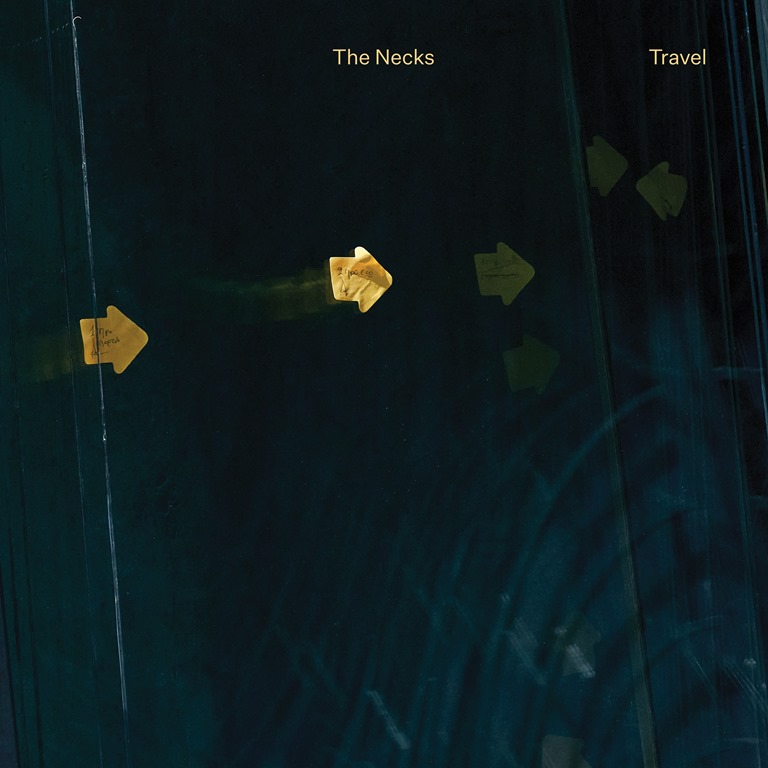
The Necks are never dull: an act that can be depended upon to deliver something different, which is no small feat for a band who’ve been going for more than thirty years. Travel sees them revisit the fundamental methodologies of Unfold, released in 2017 on Stephen O’Malley’s Ideologic Organ label. Admittedly, it’s not an album I’ve revisited all that many times since I wrote about it, but then, that’s true of many records I’ve appreciated. Some of it’s a time thing, but some of it’s an instrumental / jazz thing. I prefer to engage in the moment – and then the moment passes, and I too move on.

Where this album different from the majority of their others is that the format was integral to the form of the content, as the accompanying blurb points out, proving ‘four sub-20-minute pieces – instead of the typical 60+ minute arc for which the band is known – along with an obfuscated track list which leaves play order to the listener’s hand.’

Travel isn’t quite a straight live improv set, but does, they feel, come closest to recreating the live experience, and was recorded – save for some light overdubs and post- production – primarily live. And it’s very much oriented towards slow grooves and rhythmic repetitions. It’s hazy, mellow, almost sultry.

Side one is occupied by the twenty-one-minute ‘Signal’, built around a repetitive bass cycle and some rolling piano that brings with it a classical element, and, propelled by some busy hand drumming which transports the composition some way from what one would ordinarily expect off jazz-orientated works and into the realms of ‘world’ music (a term I try to avoid, with its connotations of western superiority and self-centredness, but sometimes short-cuts are necessary).

On side two, ‘Forming’, which again stretches languorously past the twenty-minute mark, is led by ripping piano, underpinned by some crunching bass stutters and rumbling groans. It’s jazzy in a psychedelic, Doorsy sort of a way. In this sense, it feels more like an extended mid-song workout than a piece in its own right, but it’s both pleasant and tense at the same time as it builds to a crescendo that never fully materialises.

‘Imprinting’, the album’s shortest cut at just over seventeen minutes, brings the multi-layered percussion to a more prominent position, and clanks and trembles along with almost hesitant-sounding keys and twanging strings drift in and out. It’s also perhaps the most overtly ‘jazz’ piece on the album, although it feels stretched out, the pieces pulled apart and as three instruments drift along together on a steady way, the sensation is quite hypnotic.

Organs always create a sense of grand scale and space, and the heavy drone and trill of ‘Bloodstream’ is utterly mesmerising. The piano is soft and ripples along atop the sustained mid-range drone as ethereal notes drift in and out. Part,

The album feels like a moment in time, somehow transient, and yet also something more. Travel may not really go anywhere, but it very much captures a mood – which is, for the most part, whatever mood you project onto it.

AA

Print

Not Applicable – 25th June 2021

Christopher Nosnibor

Chris Sharkey’s first album released under his own name is what I suppose one might call an ‘environmental’ album. Not an album about the environment in the broader sense, or the ecological sense, but in the sense of having been inspired by the artist’s surroundings, and the music herein is a direct response to that in many ways. While so many releases from the last year have been environmental in the context of creative responses to lockdown and a shrunken vista consisting of four walls and the view from the window, paired with a pervading anxiety on account of the 24/7 news media and social media doomscrolling, Presets comes from a very different perspective. First and foremost, its inspiration is travel.

“I had been touring and travelling a lot. Lots of long car journeys, the M1, driving between shows in Europe. Long waits in airports. The occasional long-haul flight to play farther field. Throughout this period my relationship to music changed. I found that listening to songs or short pieces would leave me agitated and frustrated. I’d been listening a lot to Actress, particularly ‘Ghettoville’ and ‘Hazyville’ which really worked for me on the road. I wanted a music that develops slowly over time, drawing you in, making you forget about the clock. Music that has so much grain and texture that you could almost pick it up and turn it around in your hands, examining from all sides. Like a physical object. Music that resembles something you might see out of the window of a plane, high above the clouds, a meteorological event or a storm on distant mountains from the back seat of a car.”

I can certainly relate to the agitational effects of listening to certain musical forms while in transit: I always had to stop music and be on full sensory alert on arriving at a train station and walking through an unfamiliar city, for example, and since lockdown, I’ve not been able to listen to my MP3 player at all while walking around anywhere.

The physical setup for the album’s production was minimal, and Presets is the product of two months’ intensive recording, producing hours of material. But this was only the start of a protracted second stage, which Sharkey details as follows: “As the process continued, I would select my favourite parts and create playlists just for myself. By the end I had over 4 hours of music that lived on my phone and whenever I would travel, I’d listen. Over the course of the next 5 years: touring, travelling, listening, I slowly whittled it down to what you hear on Presets.”

In short, Presets is the product of many years’ work – not just the five years in post-recording evolution, but the years of experience and observation that preceded its creation also. It was, unquestionably, time well spent: while many of the individual segments are quite short – mere fragments – the album as a whole sees them sequenced and segued so as to feel like one continuous piece that gradually transitions between tones and shades. It’s also an immense work, clocking in around the eighty-five minute mark. It’s very much a good thing that it’s intended as a background work, because it’s practically impossible to sustain focus for that kind of time. But Presets is about not focusing, about disruptions and interruptions, about life.

It begins with quavering, key-ranging notes that do, at least vaguely, sound like guitar, before layers of processing build, before the source instrument becomes lost, evolving to conjure organ -like drones and entirely abstract washes. Before long, particularly over the course of the eighteen-minute second track, ‘the sharecropper’s daughter’, you find yourself not so much listening as floating along with the sounds as they slowly creep and shift.

The titles are sparsely descriptive and evocative at the same time: from ‘blue cloud, red fog’, to ‘scorpion bowl’ via ‘detained at the border’, there are hints of mini-narratives attached to each piece, and the sense of travel and movement does come across through the difficult drones and scrapes of feedback that build and buzz through the foggy murk.

It’s an epic work, and a major achievement.

Chris Sharkey Presets cover 3000px