Posts Tagged ‘theory’

Crónica – 1st July 2025

Christopher Nosnibor

Only yesterday, I expended considerable contemplation – and verbiage – on the matter of press releases, and the level of detail they contain nowadays compared to the old A4 1-sheet – which sometimes contained just a few lines under the heading and the logo. It’s wasn’t really a complaint, as much as an observation, although there is, sometimes at least, a sense that most of the reviewer’s job has been done for them in advance.

However, there are other ways in which the detailed press release can prove to be a double-edged sword, and this is one of them. And so it is that I’m plunging into unknown territory with this release. Not in that I haven’t spent many hours immersed in ambient recordings, and not that I’m unaccustomed to postmodernism, in theory and its application, how it applies to the world as we experience it. But sometimes, a work is so inspired and invested in something specific, specialised, and conceptually-focused that it feels like I’m not fully qualified to approach it, much less critique it.

Before I do dive in, this is the context. Are you sitting comfortably?

At the end of the 1990s, Hakim Bey wrote a book about the then-emerging possibility of the virtual. With the lucidity for which he is known, he recognized at the time that the virtual was nothing more than a new avenue for the expansion of capitalism. He introduced the concept of temporary autonomous zones as a kind of Foucauldian heterotopia — spaces that existed only for as long as they could evade capture. Today’s reality reflects a radical intensification of what Bey was referring to in the 1990s. Temporalities have changed completely. We are now almost overwhelmed by an incessant pursuit of instantaneity, accompanied by the mounting impatience it inevitably breeds.

The temporalities of sound, therefore, are naturally different too.

Time must be disobeyed.

The sounds of our autonomous zones aim to be the opposite of what technology offers us today: fascination and dazzle through excess — more buttons, more effects, louder… AI. These are bare sounds, defiantly rejecting the paraphernalia that surrounds them. They are simple yet perhaps carry the greatest complexity of all: turning their backs on spectacle and presenting themselves as they are: unmasked.

This work is the outcome of a series of studio sessions recorded during the summer and autumn of 2024. We followed an exploratory approach grounded in clearly defined premises and a pre-conceived compositional outline shaped by three key notions that are central to us: repetition, silence, and duration.

There is no post-production manipulation. What you hear is what was played. Inactual by conviction, this represents an utterly contemporary mode of being. These are sounds that seek to endure as a resistant, autonomous possibility — even if only fleetingly. Suspended between silences. Those marvelous, singular, sounds that Cage taught us to hear. They are there to last for as long as they can.

The title Horizons of Suspended Zones is inspired by a book from Hakin Bey.

I find that I’m sitting rather less comfortably now than I was a few minutes ago. I’ve never read a word by Hakim Bay. I’m aware of him and his work, but have never got as far as investigating. Therefore, I’m deficient. And so, in my head-swimming uncertainty, bewilderment and state of flaking confidence, I arrive at this fifty-five minute articulation of time-challenging theory/practice feeling weak, overwhelmed. Where do I even begin? Can I relate it to my own lived experience?

I struggle, because it doesn’t communicate that postmodern overlapping and disruption of the time / space continuum in a way that I can relate. For me, cut-ups and collage works convey how I experience life: the eternal babble of chatter and time experienced in terms of simultaneity rather than in linear terms.

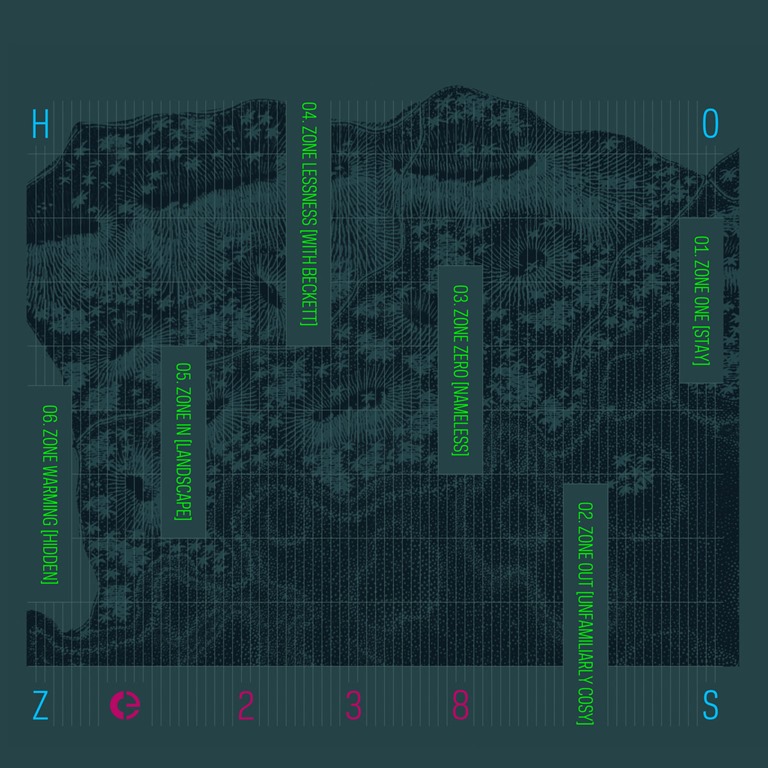
‘Zone One [stay]’ is a drifting, abstract, ethereal ambient work, and while over ten and a half minutes in duration, the time simply evaporates. It drifts into ‘Zone Out [unfamiliarly cosy]’, which is appropriately titled, and I find that I do as instructed, as the slow chimes and resonant tones hover in the air like bated breath. There’s a sense of suspense, that something will happen… but of course, it doesn’t.

For all of the detail around the concept, there’s very little around the construction by comparison. But perhaps a bell chime is simply a bell chime and an echo simply an echo. But those echoes matter. I find myself wading through the echoes of time, how it passes, how we lose time. How did we get to August? How did we – my friends and I – get so old? How, how, how is the world so utterly fucked up right now?

Each extended abstraction turns into the next, and so ‘Zone Zero [nameless]’ arrives unushered, unannounced, and unnoticed. There are whispers, the sound of the wind through rushes, and there’s something dark in the atmosphere. It’s only on returning to this after some time to reflect that I come to note the squared brackets in the titles. It’s an unusual application of this punctuation, which is more commonly found in academic work, and which I assume isn’t accidental – but why?

Anyone who’s read Beckett will know how painful and challenging, and, above all, how his work can be, and so ‘Zone Lessness [with Beckett]’ certainly reflects the emptiness of many of Becket’s works – the sprawling nothing where there are no events, no… nothing, and how life itself bypasses us as we wait. Life, indeed, it what happens while we’re making plans. It has a painful habit of passing us by. Life is not the Instagram shots or ‘making memories’ moments. It’s the trip to the supermarket, it’s endlessly checking your bank balance, it’s the dayjob and the cooking and washing up. It’s the dead moments that count for nothing. Those moments occupy the majority of time. And on this track, a low laser drone slowly undulates throughout, and over time, fades in and out, along with incidentals which allude to lighter shades, and ultimately, the nine minutes it occupies simply slip away.

‘Zone In [landscape]’ is sparse but dense, moody and atmospheric in its rumbling minimalism, and the last cut, ‘Zone Warming [hidden]’ chimes and echoes, bells ringing out into endless silence, without response, before tapering contrails of sound slowly and subtly weave their ways in and out. There are spells of silence, and the silence casts spells, and the spells float upwards in suspension.

Perhaps an appreciation of the context and theoretical framing of Horizons of Suspended Zones is advantageous, but it remains accessible as an abstract ambient work without that deeper comprehension. And it still feels as if there’s a sadness which permeates the entirety of the album. It’s by no means heavy, but it does have an emotional weight that drags the listener in, and then drags the listener down. And then leaves them… simply nowhere. Caught with their thoughts, and nowhere to take them.

AA

AA
a4170718585_10

Mille Plateaux – 22nd March 2024

Christopher Nosnibor

What’s often fascinating to me as someone who writes about music quite extensively, is to observe the avenues other writers explore, particularly when engaging with music that’s ambient, obscure, or otherwise difficult to take a hold of and to pin down. This fascination is amplified when the music, either by its inherent nature, or by virtue of explanatory words from the artist, has a foundations in a theoretical or conceptual context.

Achim Szepanski has been tasked with a challenge when it comes to the notes to accompany

Oolong: Ambient Works, which is the 17th studio album from multi disciplinary artist Ran Slavin, which is pitched as ‘a 74 min drone-ambient-minimal-symphonic infused LP that takes after various teas in the far east.’ To heighten the experience, each track is accompanied by ‘a slow and atmospheric visual journey shot by RS in East Asia and the total can be experienced in total and joined as an immersive 74 minute journey.’

Szepanski helpfully explains the layered meanings in the translations of the word ‘oolong’, and expounds the complex interconnections of tea and dragons through a filter of Felix Guattari (which isn’t entirely surprising, given the label releasing it). He grapples with ‘the minimalist concept of tea architecture’ and the way in which ‘Not only the centripetal, but also the centrifugal orientation of the sound is imaginary.’

While the visuals clearly form an integral pat of the project overall, I shall preserve my focus exclusively on the audio release, and in advance of this draw the distinction between audio created to provide a soundtrack, and visuals created to accompany an audio work, because while Szepanski discusses at length the relationship between the visuals and the tea path and the simultaneous limitations placed on the work by the visuals and their capacity to enhance the experience, Oolong: Ambient Works is an audio release or an ambient persuasion, as the title suggests.

The seventy-four minutes is divided into eight individual pieces, with titles such as ‘Grand Jasmin’ and ‘Assam Jungle; as well as others which are less overtly tea-derived, like the first composition, ‘Time Regained’. It’s fifteen minutes of slow-simmering ambience, the levels of which fluctuate and catch, the glitches rupturing the smooth surface of the soft sonic fabric.

Szepanski makes an important point when he writes ‘It is impossible to know exactly what the individual sounds signify. Sometimes it might be the intention to hear the sounds of nature. But it’s not a question of identifying its source and its effect.’ And so we come to what is, for me, the crux of the ambient listening experience, whereby the source of the sounds is far less significant than what the listener hears. Not even what I hear as a listener, although I can only speak and interpret for myself, and the beauty of this experience is that however much Slavin strives to imbue this work with meaning, it cannot be imposed. Slow pulses bring a rhythmic element to this otherwise abstract piece, which is deeply calming, but occasional warps jolt the listener from their state of tranquillity like a prod.

‘Butterfly of Ninh Binh’ flits by with crackles and scratches by way of disturbance, and the introduction of static and ersatz surface noise to recordings is a curious one, as something which only became a feature with the advent off digital audio. Those who have come to vinyl since the renaissance are less likely to relate, since vinyl is now a plush commodity and not something people leavy lying around or use as a coaster or whatever as was commonplace in the sixties, seventies, eighties. But such interference is integral here: Slavin’s approach to ambience on Oolong is subtly different, and introduces just enough dissonance and discomfort for it to be not entirely comfortable.

The ten-minute ‘Ruby Ceylan’ is soft and ripping repetitive and hypnotic, but something – perhaps the abstract moans, perhaps something else – is just off.

Iroh, in Avatar: The Last Airbender, is a keen advocate of the calming properties of Jasmine tea, and I get a far stronger Jasmine connection from this – the original animates series, that is – than from ‘Grand Jasmin’ here – the album’s shortest track is subtle and soothing, but also marks a change of texture with a thumping beat which echoes away hard and fast beneath its slow-swelling outer layers.

‘Himalayan Flower’ unfurls slowly and with pronounced percussion, before the ten-minute ‘Summer Monsoon’ brings the album’s conclusion. A slow, mesmeric, soporific cloud of ambience passing by, with occasional clangs and abstract interruptions which echo through the drift, this is a real; eyelid-drooper which suggests it’s time to sleep, or time for a coffee.

AA

MP69_front

Dret Skivor – DRET008 – 6th August 2021

Christopher Nosnibor

The latest offering from Dret Skivor, a Swedish tape label specialising in drone and various shades of experimental noise, is the new album from Danish maker of electronic noise Thomas Li, who, as Li, has self-released almost a dozen works digitally. Biographical details are less than minimal, and that’s cool. Why do we need to know about the artist, their background or their back catalogue? Do we really need to know the context or the intent, the theory behind a work? Sometimes, when it’s an experimental work informed by theory or a certain concept, it helps, because the concept and theory are integral to both the process and the end product. Then again, there’s a danger that sometimes said theory or concept can impinge on one’s appreciation of the work. Sometimes, it’s best to just be able to listen, and allow oneself to be immersed in the sound, without pouring over lengthy liner notes, researching myriad avenues presented by the references, and straining one’s brain over concepts. This is particularly true of many works of a more ambient persuasion. I’m not remotely anti-academic or anti-intellectual – quite the opposite. But sometimes, you just need a break, and music can be the perfect conduit to vital headspace. An overemphasis on context can detract from the often underrated pleasure of simply listening, and enjoying.

Admittedly, enjoyment of an album like this is the preserve of a small minority: it doesn’t contain any ‘tunes’, it’s beatless, and it’s not always entirely mellow either. But it does have a great deal of texture, and this is something you can really lose yourself in.

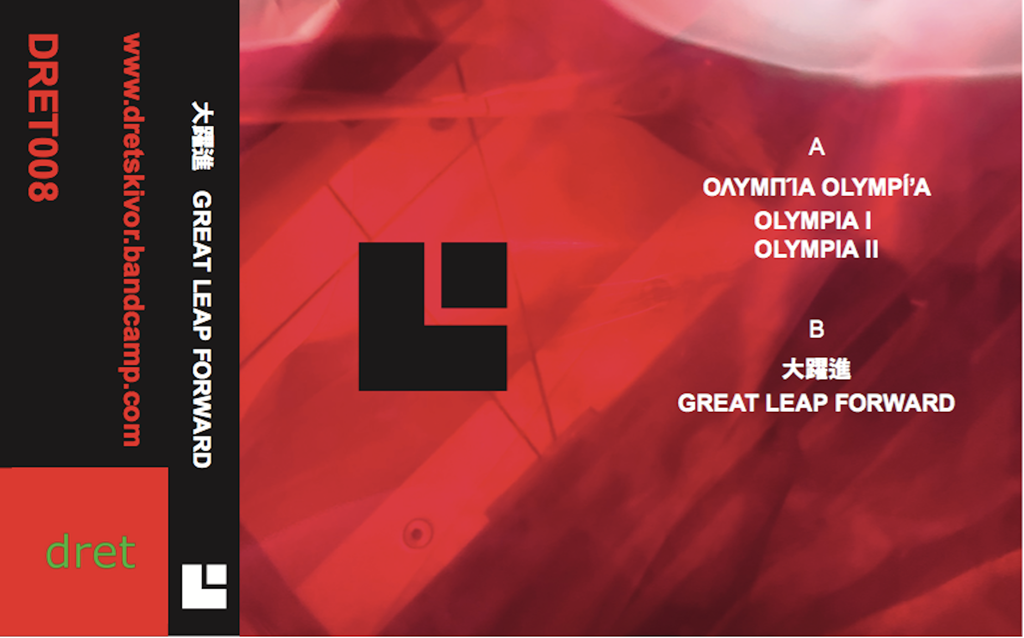
Great Leap Forward contains three tracks, with side one occupied with the two-part ‘Olympia’ and the second side containing the eighteen-minute monster title track.

‘Olympia I’ is nine minutes of dense, churning drones, billowing sonic clouds that choke and smother, while counterpart ‘Olympia II’ gurgles and churns a dark whirling cyclone of sound. The latter is more interesting, sonically, with a lot more going on – meaning it’s also more challenging and more tense, as crackles and hums fizz and spin from the dank depths of bubbling noise.

The title track is altogether less tumultuous and more background ambient by comparison. Being eighteen minutes in duration, on the face of it, not a lot happens: there are no climactic blasts of noise, there’s nothing explosive or even overtly disruptive. And yet for all its subtlety, it is engaging, and there is movement, there are shifts and distract and divert. Howling winds blast over barren landscapes of drifting sand and strains of treble and whines of feedback emerge from the eternal mid-range rumble that drones on, and on, and on.

In the context of his output to date, this may not really be quite such a great leap forward, but it does clearly mark an evolution and an expansion on the soundscapes sculpted on previous works. And, played with the accompaniment of a candle and some CBD-infused beer, Great Leap Forward is a well-executed soundtrack to mental recuperation.

AA

tape label grab for bandcamp

Mille Plateaux – 6th February 2020

Christopher Nosnibor

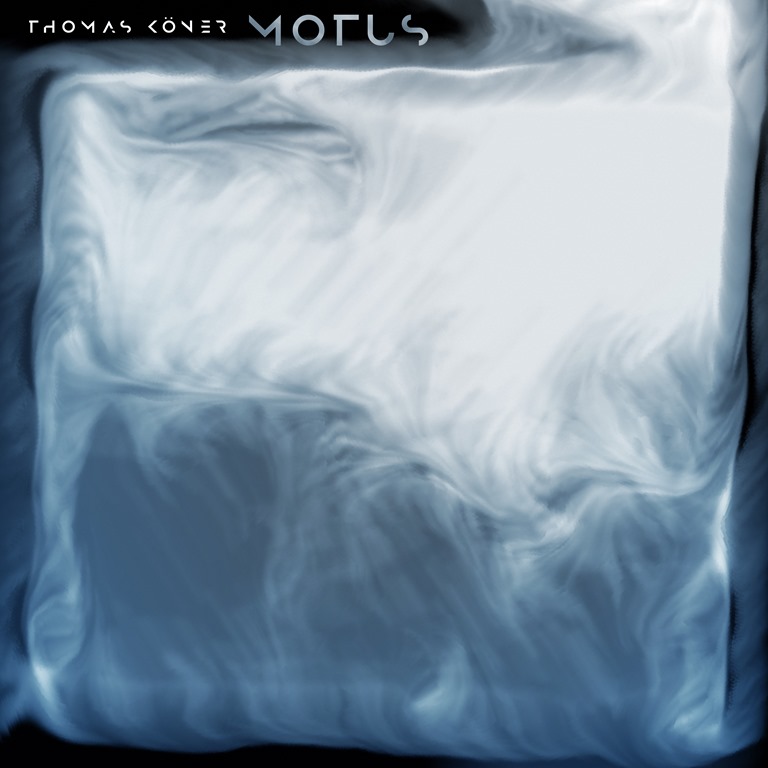
Motus is one of those albums that spreads eight pieces across four sides of vinyl. Most of these pieces are around seven minutes in duration, and manifest as grumbling, low-end analogue electronic instrumentals. Indulgent? Depends on your position, maybe. Audiophile quality? Vinyl addiction? While the pieces which make up Motus don’t immediately intimate a need for attention to detail and there’s no scope for the listener to bask in hearing the rich production values optimally through the medium of vinyl, the frequencies and tones that Köner explores probably do benefit from that full-spectrum vinyl sound, the audio uncompressed and benefitting from the full dynamic range, particularly those low-end sounds, some of which are so low as to almost disappear beneath the average listener’s hearing range.

Motus is steeped in theory, which is fitting given its release on Mille Plateaux, which takes t name – and also its ideologies from radical theorists Gilles Deleuze and Félix Guattari, after whose 1980 text Achim Szepanski’s Frankfurt label devoted to minimal techno, glitch, and other various other experimental electronic forms takes its name.

Köner says of the album that ‘Motus is more (to me) than just music made with analogue synthesizers, it is about attitude, a way of relating to sound and the (e)motion it affects. A lifestyle, where movement, being moved and moving become one. My practice is vibrational, about the skin, touch and surfaces and the gaseous medium in between.

Vibrational it is: these pieces tremble and quiver and grate and grind and shudder and shake and judder and growl.

The first piece, ‘EXTENSION (Attack)’ is a low, glutinous throb, a gelatinous bellyache of a pulsation, rent with crackling, grating treble spurs that scrape at the walls of the cerebellum and scratch the lining of the gut. It’s unsettling, and marks the start of the album’s trajectory, which is unexpectedly linear, and follows a slow descent towards sluggish sludge that’s barely a muddy bubble by the end.

Along the way, ‘SUBSTRATE (Binaural)’ is a low, oscillating throb that expands and resonates over seven brain-bending minutes: there’s something about the more subtle of variations having the most torturous effect, especially when there’s a metronomic pulsing beat lurking beneath, while ‘OSCILLATOR (Luminous)’ reduces everything to an ambulating low-end slip and slide, a muddy melt of trudging bumps. The final cut, ‘SYNTHESIS (Carnal)’, takes things lower and slower still, to the point of near subliminality, slowly winding and grinding into the ground.

Motus is an odd one, an album that undermines itself as it evolves, reducing itself to a lesser sonic amount with each piece. And yet, as the sounds shrinks to little more than a gloopy brown puddle, the effect grows.

AA

MP6_front