29th November 2025
Christopher Nosnibor
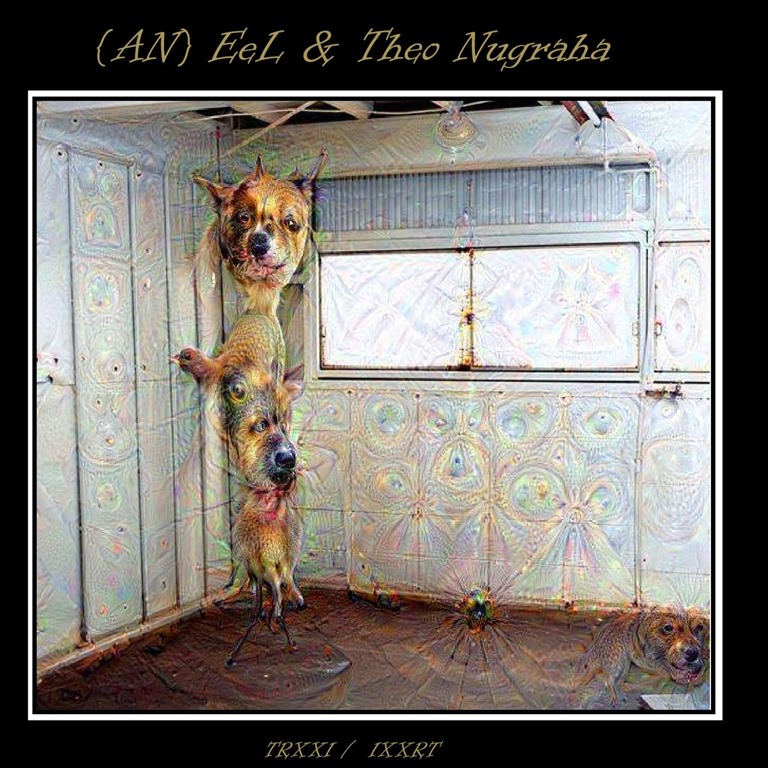
It’s not a good thing to feel nostalgia for something from the recent past which wasn’t even any good to begin with. But on seeing the cover for this split release by Theo Nugraha and {AN} EeL, I’m reminded that Google DeepDream was actually quite fun for about five minutes in 2015. Ah, hindsight… The results DeepDream produced were weird, psychedelic, trippy, and resembled no dream or subconscious thoughts I’ve ever known, its hallucinatory aspects were oft said to share qualities with LSD. But this was part of the appeal: it was novel, silly, with dog faces emerging from inanimate objects, whappy wallpaper, and the like. How many of us knew that it would be a precursor to the AI hell we now find ourselves in? Ten years is not such a long time in the scheme of things, but in the context of the now, it feels like another lifetime. A lifetime when doing daft stuff with digital tools wasn’t annihilating the environment, when it wasn’t stealing the work of writers and artists, when it wasn’t rendering jobs obsolete while creating billionaires at the expense of those losing their livelihood. Arguably, the golden age of The Internet was in the first years post-millennium, when applet-based chatrooms first made it possible to connect in real-time with people around the globe and MySpace was a wild melting pot where people came together through shared interest and communities evolved. This isn’t just some nostalgia wank: these were exciting times, and the world truly began to open up in ways hitherto unseen. These were times when The Internet offered freedom, where, as Warren Ellis’ novel Crooked Little Vein expounded, anything goes and if you could imagine it, you’d find it online. Godzilla Bukkake? You got it.
Everything changed when major corporations realised that they could really, really make on this. But major corporations being major corporations, they didn’t want to participate – they wanted to take over and own it, to wring every penny of profit from every last keystroke. And so now, while Napster and Soulseek were the equivalent of home taping, which didn’t kill music, Spotify and most other major streaming services really are damaging artists’ livelihoods – because unlike small-time peer-to-peer file sharing, this is a multi-billion dollar industry which siphons off pretty much all of the money for owners and shareholders rather than artist – and then you have scums like Daniel Ek using those proceeds to fund war. Something has gone seriously wrong.
Theo Nugraha’s contribution, 1XXTR is a longform work – seconds short of thirty minutes – and while it’s perhaps not quite Harsh Noise Wall, it’s most definitely harsh noise, and there’s not a lot of variation. It may even be that any variation is in the imagination as the mind struggles to process the relentless barrage of sound and seeks tonal changes, details within the texture. It doesn’t so much sound like a cement mixer – more like being in a cement mixer with half a ton of rocks, at the heart of an atomic blast. There are squalls of feedback and mutterings beneath the blitzkrieg, and around ten minutes in, the tempest suddenly begins to rage even harder and it’s like being hit by a train. Twenty minutes in, the relentless roar drops to merely the blast of a jet engine and the sensation is like huge pressure drop, or a fall. It’s impossible to discern what’s going on inside this swirling vortex of noise (there does sound like a vast amount of collaging and random things floating in and out), but it’s a full-on physical assault that vibrates every cell in the body. By the end of this most brutal half hour, you feel battered, bruised, damaged.
‘TRXX1’ by {AN} EeL, which runs for a second over the half-hour mark, is altogether less abrasive, but it’s no more comfortable. At first, it’s a clattering, metallic rattle, like an aluminium dustbin rolling down the street in a gale, accompanied by rattles and chimes. Extraneous noises – twangs and scrapes – enter the mix, and the sound starts to build, like the wind growing stronger at the front-end of a storm. But soon, from nowhere, a squall of static – or rainfall – begins to swell and while off-tune notes reverberate in the background, and a scan of radio stations yields alternately cut-up fragments and random noise, and while it may not possess the same physical force as Nugraha’s piece, ‘TRXX1’presents a disturbing array of frequencies and makes for a particularly tense listen. There’s a thunderous ripple like a freight train a mile long barrelling along, while disjointed voices echo here and there, and as bhangra and old-time brass fade in and out, the collage approach to the track’s creation, harking back to William Burroughs’ tape experiments, and early Throbbing Gristle become increasingly apparent. The Police’s ‘Can’t Stand Losing You’ cuts through what sounds like a snippet from lecture or interview. The repetition of the same fragments becomes difficult to deal with after a time, and you begin to feel like you’re cracking up. The it’s back to the sound of metal buckets being dragged down a cobbled street, with random busts of discordant noise jabbing in for extra discomfort. The final segment is a cacophony of abstract drones and crashing, calamitous racketry – a combination which is uncomfortable and unsettling.
The two pieces are quite different, but equally difficult in their own ways, and as such compliment one another. And if you’re seeking an album that really tests your capacity for abrasion and nauseating noise, 1XXTR / TRXX1 hits the spot like a fist to the stomach.
AA
 Aural Aggravation