10th October 2025
Christopher Nosnibor
This one’s been out for a while now, but some releases simply have a slow diffusion. And Fini Tribe’s career was one of slow diffusion and… and what, really? Certain corners of the press dug them. Me, I was a bit too young at the time to appreciate them, and never felt compelled to delve into them retrospectively… until now. Chris Connelley, of course, went on to find fame and (mis)fortune with The Revolting Cocks, and also stepping up to the ranks of Ministry. His autobiography, Concrete, Bulletproof, Invisible & Fried: My Life as a Revolting Cock (2008) might not be the best-written book ever and might have benefitted from some finer editing, but it’s a wild ride, and it’s a fair analogue for his recorded output, too. A bit variable, but when it’s good, it’s off the scale. That they would change their approach in the mid-late 80s means that this compilation spans their initial phase
Whatever happened to Revolting Cocks in the later years, where they became a touring tribute act is a topic for another time, but the fact Connelley’s legacy includes Murder Inc. and contributions to KMFDM and one-off single projects like PTP and Acid Horse (a collaboration between Ministry and Cabaret Voltaire) is worthy of reverence.
But before he jetted off to the USA for that pivotal meeting with Big Al, there was Fini Tribe, and they produced a veritable shedload of material in five-year spell.
As the accompanying notes detail, ‘Fini Tribe was born into the cash-poor but culturally-wealthy environs of post-punk Edinburgh in the very early 80s – 1980 to be precise. A tiny three-piece with no drummer would soon swell into a muscular six-piece with inherited or cheaply-purchased instruments. Band members Chris Connelly, Simon McGlynn, Andy McGregor, Davie Miller, Philip Pinsky, and John Vick haunted the cold, damp warrens of the Niddry Street and Blair Street rehearsal rooms, just off the high street in Old Town Edinburgh. Drawing on the influences of everything from Throbbing Gristle, Wire, Can, Captain Beefheart, and numerous angular funk bands that were spewing out of the John Peel Show at the time, they also drew from the seemingly bottomless well of modern film, writing, and art that was abundant in the festival city.’
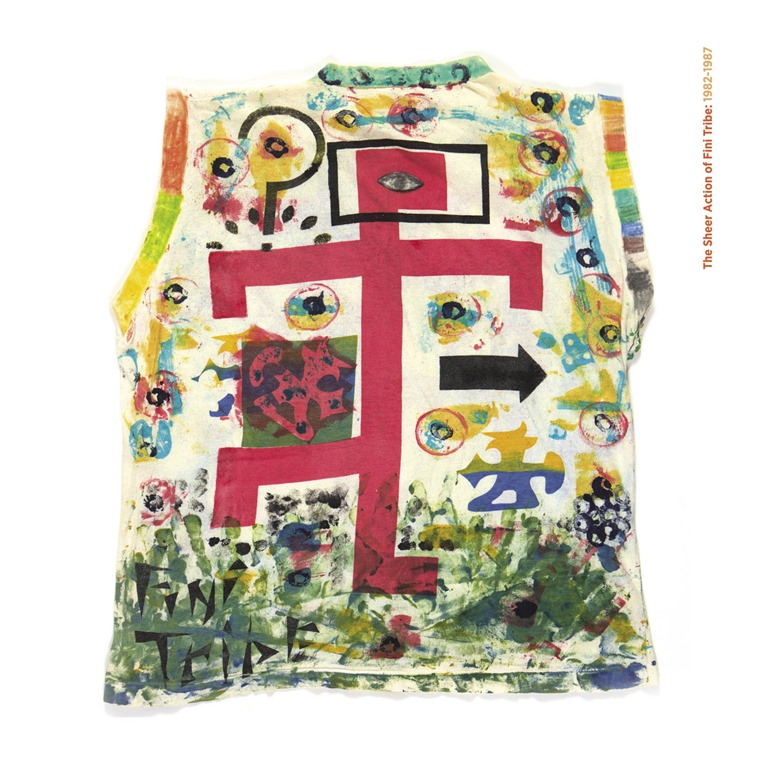
The result? Everything including the kitchen sink. And here we have a forty-seven track document of that career, with singles, Peel Sessions, live cuts, remasters, remixes, you name it. It’s all there, from the earliest works, like the tracks from the scratchy post-punk debut 12” Curling And Stretching (1984) are present in remastered form, and they sound stark and magnificently angular and challenging.
AA
There must have been something in the water – or maybe it was the Irn Bru or Buckfast – in Scotland around this time, since it yielded The Jesus and Mary Chain, Primal Scream, Altered Images, and laid the foundations of the JAMMS / KLF – although at this time Bill Drummond was doing mental shit plotting rabbit-shaped tours for Echo and the Bunnymen.
The first EP is spikey and angular and vaguely jazzy, and brings in elements of post-punk and what would become aligned with mathy post-rock in years to come. It’s aged well, for sure, and the same is true of the second EP, Let The Tribe Grow, released in October 1986. Combining warped synths and jittery guitars to conjure an air of tense paranoia, this is tense listening. ‘All Fours’ deploys thunderous percussion that’s pure Test Dept, and ‘Detestimony’, too, is dominated by relentless crashing beats. The EP’s last track, ‘Monomil.’ is murky, doom-laden ambient and fairly disturbing
Their cover of Can’s ‘I Want More’ saw the band move to Wax Trax! and perhaps not entirely coincidentally cement a more pumping dance style – that is to say, an industrial dance party style that was very much the sound of WT circa ’87 and shares considerable common ground with early RevCo – but at the same time, they still sound unmistakably Scottish, and not solely on account of Connelley’s vocals. ‘Idiot Strength’ (the B-side of ‘I Want More’) could be an outtake from Big Sexy Land. The same is true of the drum—dominated ‘Make it Internal’, which now sounds like a rehearsal for ‘Beers, Steers, and Queers’. In some ways, it probably was.
After the early EPs and Peel Sessions, there’s a host of material hauled from the dark depths of the back catalogue, much of which is of a rare quality.
On ‘An Evening with Clavichords’ and ‘Goode Duplicates’ they sound more like a frantic 80s pop band wrestling with jazz elements and slap bass, and there’s a whole lot happening on ‘Bye Bye to the October Sky’, which straddles goth, electro, industrial, and all kinds of post-punk experimentalism. ‘Throttlehearts’ lands like a Scottish Scott Walker, and is pretty mad but also compelling.
The live material – four tracks from ’87 and five from ’83 – both from sets performed in Edinburgh, are illustrative of a band unyielding in their desire to challenge. The later recording is reminiscent not only of RevCo, particularly in the grinding bass grooves and messy confrontational stylings, but the live albums of Foetus on their Thaw tours of ’88 and ’89. The set from ’83 is rougher rawer, in terms of performance and sound quality, but the contrast is telling in that the later recording is more attacking and abrasive. This was not a band that mellowed as they evolved: instead, they grew in ferocity during this time.
The collection winds up with some experimental offcuts, which aren’t the most listenable of pieces, but do provide an insight into their evolutionary workings. The Sheer Action of the Fini Tribe 1982-1987 is a fascinating document, not necessarily a band ahead of its time, but a part of a revolutionary zeitgeist. And while bands like Depeche Mode and Yazoo and The Human League were bringing synths into the mainstream with pop tunes created using emerging technologies, the underground was throwing out bands like this, bands like DAF, bands like Foetus, Meat Beat Manifesto, Test Department. A lot has changed since then – culturally, and musically – change worthy of not simply acknowledgement but an entire thesis. It’s a thesis not for me to write, but The Sheer Action of the Fini Tribe 1982-1987 is a document which needs to be referenced in it.
AA
AA
 Aural Aggravation