Posts Tagged ‘Soundscapes’

Sinners Music – 1st October 2025

Christopher Nosnibor

Sinners Music – the label established by electronic music maestro and one-time music shop owner, Ian J Cole, continues to offer up new music that’s interesting and unusual. There are some context where ‘interesting’ is somewhat dismissive, diminishing, and people of a certain age will remember snooker legend Steve Davis being given the nickname of Steve ‘Interesting’ Davis ironically… although the double irony emerged that he was genuinely interesting, as his work with The Utopia Strong abundantly attests. Here, my use of ‘interesting’ is neither ironic nor dismissive: it’s meant sincerely, as there is no specific ‘house’ style or overt genre specificity evident. This is one of the reasons why boutique microlabels can be worth following – you never know quite what you’re going to get from them, but you can guarantee if won’t be ordinary. And this release by no means ordinary.

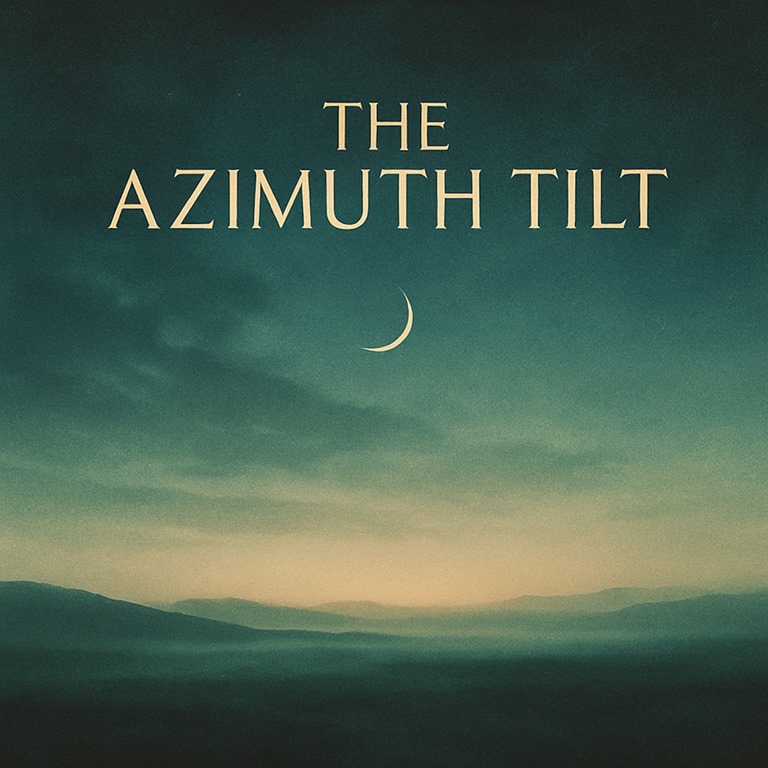
As for The Azimuth Tilt, their bio informs us that this is the work of ‘a solo ambient electronic project exploring the liminal spaces between sound, memory, and landscape. With a name drawn from the alignment of a real to reel tape head, the project orients itself toward the unseen—subtle shifts in perception, emotional resonance, and the hidden geometries of the natural world… Blending atmospheric textures, glacial rhythms, and immersive sound design.’ There are no clues as to who this is the project of, but it matters not, and in fact, the less we know, the better. This is the joy of abstract ambient works: all you need is the sound, and all you need from the sound is to let it drift, to carry you away. And this is what Alignment does.

On a certain level, it does very little. On another, it is a quintessential deep ambient album. Alignment features just six compositions, but has a running time of some fifty-seven minutes. The soundscapes which define it are sonically rich, with soft, drifting, cloudlike contrails merging with lower drones and contrails. In combination, filling the entire sonic spectrum, Alignment does a lot.

From nowhere, halfway through ‘An Unqualified Person’, a raucous sax breaks out.

And the layers build. Against scrawling spacious drift, it’s quite a contrast. And then there’s some subtle piano intervention, and from hereon in, the piano and sax alternate in leading. It’s nice… and not in a turtle-neck top kind of way. It’s nice but… a little strange. But ‘The Exquisite Space’ crackles and swirls abstractedly, with some supple motifs rippling and intertwining with a mellow mood exploration which arrives at more sax. Always more sax.

This seems to be a dictum The Azimuth Tilt are happy to follow, although it’s melted into the echo-soaked atmospherics of the final track, ‘And the Band Played On’. Alignment is not a dark album, but it’s one which feels unsettled, uncomfortable, unsure of its destination – and whatever it may be, the journey is worth the exploration.

AA
a0054555481_10

Seattle turbowave duo, DUAL ANALOG return with ‘Pale Visage,’ a new single and video that signals the dawn of their next era. With the video directed by Skye Wardenm, the clip and song explore transformation and self-recognition through a stark yet ultimately empowering lens.

“It wasn’t really a self-correction so much as it was a survival tactic,” says Chip Roberts of DUAL ANALOG. “We wanted the liberty to explore the expansive soundscapes that make us who we are.”

Reintroducing the world percussion, cinematic guitars, and progressive flourishes that defined DUAL ANALOG’s early sound, "Pale Visage" bridges bleak beauty with renewed color – both visually and sonically. It marks yet another glimpse of the band’s forthcoming 2026 album, Primal Grill, and is a bold declaration that all are welcome in the Temple of DUAL ANALOG.

AA

From the rain-soaked streets of Seattle’s Chinatown, DUAL ANALOG channels desire and distortion into a singular force—turbowave—a fusion of new wave, metal, industrial, and world rhythms. Formed in 2019 by vocalist-guitarist Chip Roberts and multi-instrumentalist Kurtis Skinner, the duo blends sleek futurism with raw emotion, crafting immersive performances where sound and atmosphere collide. Each ritual is a sensory experience—sweat, light, and pulse converging in devotion to rhythm and release. Their 2022 debut, Lust, Worship, and Desire unveiled a lush yet crushing sound—sexy, anthemic, and unapologetically heavy. 2024’s The Wheel descended into colder textures and brooding tones, anchored by extended-range guitars and nihilistic lyricism. Now shaping their third album, Primal Grill, DUAL ANALOG expands the boundaries of turbowave through a series of singles—’Kontrol’, ‘Sacred Sin’, ‘Save Me’, and the latest one, ‘Pale Visage’—each revealing a new facet of the band’s evolution between the sacred and the primal.

AA

e774eb44-89f4-4eb4-06d3-5434c3b502c3

10th January 2025

Christopher Nosnibor

Metlaogue’s Bandcamp pitches the project as ‘Industrial/IDM/breakcore with cinematic tendencies’, while the notes for Apposition Breach note how it ‘explores the threshold of geography and inner world – where landscape becomes the medium for emotion’. This, for me, seems to carry almost Ballardian connotations, the idea of inner geographies, the way in which the geometry of a landscape can slide between the literal and the metaphorical, how one can become an analogue of the other. The inner and outer worlds exist almost separate of one another, and the only point at which they intersect is in the mind as one processes the physical world as experienced through the shading of the emotional state. A sunny day may be a joy to behold, but may not bring joy in the face of a trauma. How we respond to our surroundings is influenced by not only circumstance, but the way we react to it. Yet rarely do we pause to consider these variables. Why did you have a shit day at work? Was the work itself shit, or did you arrive carrying the burden of something else which made something comparatively minor a catastrophe? You may walk the same route daily for a year, but it will never be the quite the same experience. The variables are infinite, and on Apposition Breach, Metalogue interrogates those variables and the reflex of memory and their complex relationship on a nuanced suite of compositions, some six years in the making.

The atmospheric ‘Threshold’ draws the listener into that fluid space, where soft ambience wraps itself around hard mechanical drones, and the percussion shifts in pace and intensity, at first muted, subtle, but firing forth in explosive bursts to become the dominant feature, and in doing so marking a dynamic shift in mood. It’s somewhat akin to climbing a gentle hill and suddenly finding a sharp crag just as the wind picks up and clouds darken the sky. The temperate changes with the change in tone.

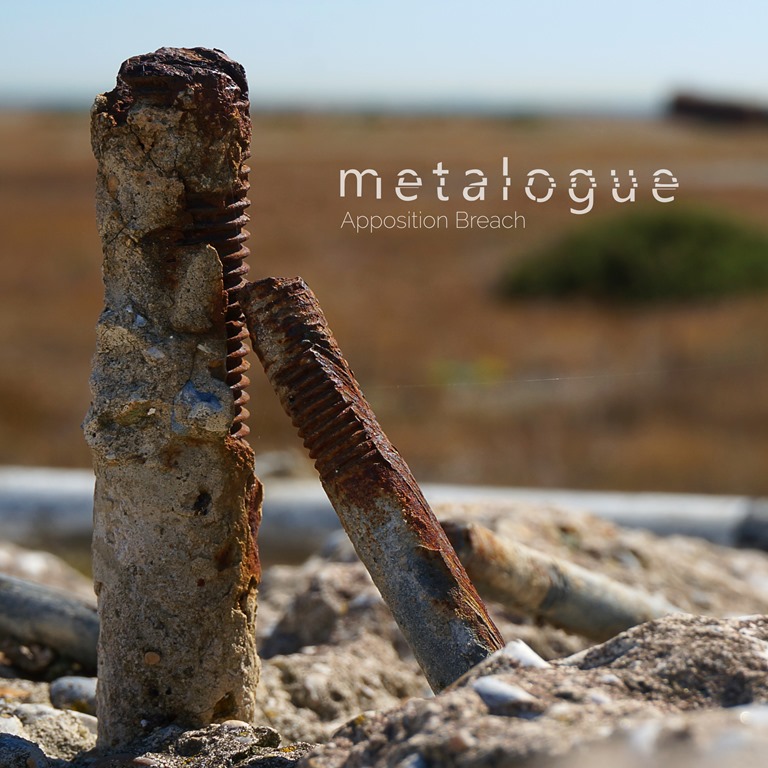
While the images which accompany the release are illustrative, the soundscapes themselves evoke rusted machinery, dilapidated mills and farming equipment gradually yielding to the elements. As much as it’s industrial, Apposition Breach offers haunting echoes of industry, once-thriving communities and factories abandoned – not the collapse of civilisation, but the decline which comes with ‘progress’. Wraith-like synths wisp and envelop pulverising beats on ‘Triangulation’, a composition which builds and transitions through a series of different forms. The pieces tend to be on the longer side, in excess of six minutes and pushing to almost twelve on ‘Outer Margin’. This gives them time and space in which to evolve at a pace which feels natural and necessary.

‘Ilira’ is ominous, scraping drones create an eerie fog of tension which is punctured by hard, violent beats. Between the snarling mechanical grind of ‘Reflection’ and the dark, pulsating title track, Metalogue conjures an array of sonic sceneries which present a journey of sorts. Not a linear journey whereby one travels from A to B, B to C, but one which seers the retinas and scours the mind with a succession of scenes, flashbacks, rapid cuts, with the effect being not dissimilar to the way memory skips here and there in time and space when triggered by seemingly unconnected and unrelated prompts – a word, a sound, a smell, nothing at all – or a dream, in which one suddenly finds themselves in a different location or setting seemingly apropos of nothing. Just as William Burroughs remarked of his discontinuous narratives that he was not concerned with explaining how characters get from one place to the next, so it is that we, as participants in the immersive experience that is Apposition Breach, find ourselves effectively teleported.

There’s the hard attack of ‘Redoubt’ and the echoing mystery of the swampy but hypnotic ‘Day Marker’, and in between, all shades of hefty percussion and cold, razor-edged synths shiver and scrape kneed and throb to render an altogether uncomfortable experience. Apposition Breach is expansive, ambitious, and meticulously realised.

AA

cover

Consouling Sounds – 25th November 2016

Christopher Nosnibor

The title of Barst’s first full-length album is a reference to William Burroughs’ novel of the same title. Of course it is. Burroughs’ influence on music is immense, and where the is no direct absorption of his ideas or methodologies, musicians since the 1960s have been citing him as an influence. He remains, arguably, one of the ultimate countercultural icons of the twentieth century.

While Barst acknowledges ‘the fragmented, the transcendental and the viscerally unsettling imagery of his work’ as an inspiration point for this richly detailed sonic journey of an album, there’s also a nod to the cut-up technique devised and formalised by Burroughs and Brion Gysin in 1959. There’s logic to this. The cut-ups, both on paper and when subsequently applied to audiotape suggested immediate practical applications in the production of music, and if there was a link between the concept of the cut-ups and the work of Throbbing Gristle, it was acts like Cabaret Voltaire and Foetus who really rendered the connection a direct one.

The cut-up intrinsically connotes a hybridity, a drawing together of eclectic sources, a combining and collaging of fragments to forge a multi-layered intertext, while simultaneously providing a creative liberation, in which the creator is subservient to the material.

While Burroughs claimed to have abandoned the cut-up by the time of his final trilogy, which consisted of Cities of the Red Night, The Western Lands and The Place of Dead Roads, there was a certain disingenuousness about this: the cut-ups continued to inform his writing, albeit in a more subtle form, and with the editorial input of James Grauerholz who reshaped the works with an eye to a more commercial text. The result was a more accessible mode of writing, but one which evoked something of a fugue-like state, in contrast to the annihilative cerebral barrage of his works of the 1960s. This is perhaps the point at which Barst most readily intersects with Burroughs, in offering a work which, as the press blurb explains, sees ‘layer upon layer…fitted to build up a work of art… Cutting up sounds, and layering them from very subtle to incredibly huge.’

The album effectively has five tracks, but they’re mastered as two, corresponding with the sides of the vinyl: as such, track one consists not so much of three tracks or chapters (‘The Threshold / The Rite / The Passage’) but three movements segued together to form a longform piece. Likewise side / track two features ‘The Western Lands / The Fields’

Screeding noise fills the spaces in the rich shoegaze swirl of the first movement. The drums are muddy, partly submerged, distant amidst the maelstrom. The whole thing drifts… ‘The Rite’ is built around an insistent beat and pulsating, looped synth motif. It’s perhaps the most overtly structured, and the most overtly electronic track on the album, laying down an expansive desert groove that transports the listener to another space altogether. An immense sonic swell bursts into a multi-layered, infinitely-faceted cathedral of sound, which gives way to engine-like drones. What is this? Where are we? In the afterburn, tectonic thuds shake. A deep, murky bass warps and grinds against a decayed industrial rhythm to create a sinister, post-apocalyptic soundscape.

The moody, dark ambience of the title track melds an almost ritualistic, ceremonial spiritualism to a thumping electronic beat. Low in the mix, the vocals howl out in a barely intelligible expulsion of soul-burning anguish. Part black metal, part Prurient, devastatingly barren, it’s perhaps one of the most innovatively genre-breaking tracks I’ve heard all year. The vastness of ‘The Fields’ is an experience beyond words. The percussion hammers out hard, but low, grinding explosively but largely buried in the immense swathe of layered sound which is totally immersive. But then, the storm is over. The grace and elegance of the piano-led play-out is contrasting in the extreme. But this is beautiful music, and provides welcome respite.

The Western Lands is an accomplished work, and an incredible achievement, both conceptually and sonically. A different kind of epic.


Barst - The Western Lands

Dälek, pioneers of abrasive and distorted hip hop, have teamed up with Swedish music hardware makers Elektron for the Dälek Soundscapes Sound pack. The samples are results and outtakes of the late night studio sessions giving birth to their geniously intense seventh album Asphalt for Eden.

Broken, melodic, beautiful: this is a brutally honest testament of both the creative process and aural aesthetics of the grinding machine known to man as Dälek.

Get your lugs round it here: