Posts Tagged ‘Sly and the Family Drone’

Human Worth – 15th November 2024

Christopher Nosnibor

They’ve been around for a while now, but as yet, there hasn’t been another act quite like Sly and The Family Drone. They’re one of those acts that straddle so many different boundaries and function on so many different levels, they’re impossible to pigeonhole and impossible to pin down. They make serious art delivered with a quirky, tongue-in-cheek sense of humour, and their live performances are celebrations of community and whacky while simultaneously being genius performance art improvisations. I’m by no means being superior when I suggest that a lot of people simply won’t ‘get’ them, and it’s obvious as to why they’re very much a cult thing. But that they’ve managed to sustain a career operating on a DIY basis, booking their own tours, etc., for well over a decade is testament to both the appreciation there is for them on a cult level, and to their sheer persistence and insanity. And their last release was a lathe-cut album containing a single twenty-minute jazz odyssey released via The Quietus.

Moon is Doom Backwards – a wheeze of a title which is factually inaccurate, and of course they know it – is a classic example of the absurd humour which is integral to their being, and it’s a joy to see that they’ve come together with Human Worth, a label I’ve filled many a virtual column inch praising, for this release. And because it’s on Human Worth, a portion of the proceeds from this release are going to charity.

The album, we learn, was recorded ‘exactly three years ago at Larkins Farm’. That’s quite a lag, but this does often seem to be the case when it comes to homing works of avant-jazz noise-drone. They describe it as ‘a patient, stalking, lurking thing. A properly noir thing, as notable for its long stretches of quiet atmosphere as it is for its pummeling skronk. Sly’s is a strange sort of quietude, though. A “drums heard through the wall”, “disquieting electrical hum” kind of quiet. An “eavesdropping PI”, “solo sax on rooftop” sort of quiet. An attention-grabbing kind of quiet so engrossing that, when our fave neo-jazz wrecking crew actually gets to wrecking – and they still wreck real good – we’re caught off guard, wrong-footed, defenseless. We get run the hell over by The Family Drone’s quintet of bulldozers.’

None of this should come as a surprise to anyone who’s been acquainted with them for any period of time. Because whatever one expects from Sly and the Family Drone, they’ll probably deliver, but simply not in the way one expects it.

Containing seven pieces, mostly around the three-to-five-minute mark, Moon is Doom Backwards is more conventionally ‘albumy’ – whatever conventional means when it comes to any format now. And there is, indeed, a lot of quiet on this album, much hush. There are many segments where not a lot happens, or simply a solo sax rings out into a slow-blowing wind of reverb.

‘Glistening Benevolence’ is underpinned by a mesmeric, tribal beat and crooning sax and wiffle of woodwind, at least until the percussion rises into storm-like crashes and the percussion surges around the mid-point, before it tapers, and then splashes to a halt. And then there is quiet, for quite some time, until the drums blast back and there is a sound like an elephant braying in pain. So far, so Sly. It’s pummelling percussion and frenzied honks and toots, parping and tooting in all directions which blast from the speakers on single cut and shortest track ‘Going In’, after which darkness descends. The inexplicably-titled ‘Cuban Funeral Sandwich’ has too much percussion and it too overtly jazzy to be ambient, but it’s a low-key, meandering piece that feels far too improvised to qualify as a composition and it certainly brings the atmosphere – a dark, oppressive one, which gradually builds and horns hoot like ship’s horns and clattering cans rattle with increasing urgency – before another abrupt halt.

If ‘Joyless Austere Post-war Biscuits’ may seemingly allude to some kind of Hovis-like cobbled-street and open-fire nostalgia, the actuality is altogether darker, as more sax flies into the sky on an upward spiral of infinite echo and the drums – building, building, to a crazed frenzy, but at a distance – create a palpitation-inducing tension, before ‘The Relentless Veneration of Bees’ – something which really should be a thing, along with the outlawing of pesticides – wanders absent-mindedly into an arena or ambient jazz, where the drums hang around in the distance somewhere.

There are shooting stars and percussive breakdowns amidst truly tempestuously frenzies jazz experimentation, and ‘Guilty Splinters’ is the perfect soundtrack to this. The closer, ‘Ankle Length Gloves’ is perhaps the most unstructured and uncomfortable of all here: amidst wheezes and drones, it’s the sound of creaking floors and subdued wailing utterances… and nothing but a buffeting breeze.

Moon is Doom Backwards is certainly their sparsest, most atmospheric, and least percussion-heavy album to date, but it really explores in detail and depth the relationship of dynamics, and pushes out into new territories. And while it’s still jazz, it’s jazz exploded, fragmented, dissected, and reimagined.

AA

AA

HW038_Sly&TheFamilyDrone_DigiCoverArtwork

The Quietus

Christopher Nosnibor

It’s not that I like to brag, but I’ve been writing about Sly and the Family Drone since 2012, when they blew me away at the Brudenell in Leeds, with a chaotic, percussion-heavy, audience-participation-led performance (and since when my writing has improved and I’ve become a shade more sensitive, perhaps). Witnessing Matt Cargill standing aloft on a stack of amps while surrounded my members of the crowd battering drums distributed by the band was one of the most exhilarating experiences of my life, and I was an instant convert. In some respects, I was fortunate to witness it: in a recent interview, Cargill was at pains to stress that it’s one of those spontaneous things: “It doesn’t happen at every gig,” he warns. “And I don’t want it to become a thing that people expect or are disappointed when we don’t do it. There are times I’ve seen people write, ‘Bring your drumsticks!’ I’ve never said that and I don’t want you to do that! If we were doing it every night people would be, like, ‘Oh, fuck off! They’re doing their schtick.’”

It’s this spontaneity and true commitment to improvisation that is a significant part of the band’s appeal. You never know quite what you’re going to get, and there’s a sense that nor do they: it all unfolds in real-time.

Their subsequent releases since my introduction in 2012 have never disappointed, and for me, at least, the best thing about Sly is that they embrace the difference between the live and recorded media. As such the recordings are the recordings, the performances are the performances. Explaining the difference to The Quietus, Cargill says “It was nice to be able to do all that spatial and stereo stuff which we wouldn’t be able to do live,” he says. “Because of mics on drums and stuff, it just doesn’t really work in that way. So we were able to spend a bit of time just working on that and doing some quite weird-sounding drum stuff which I’m really happy with.” The same article also explains, ‘The passages of manipulated drumwork are bookended by the band performing together in full skronking and lumbering flow and, in a move that vaguely echoes the ecstasy of their live sets’ endings, it finishes with a warm and symphonic cacophony of horns. “It’s kind of a pieced together track but I think it works as an entire piece,” reflects Cargill.

They have forged a career – or perhaps eked one, on the breadline, with a cult reputation which exceeds the returns a fringe act can attain in this crappy climate, a climate whereby post-Brexit overseas travel is prohibitive and not just financially – from being far out. Embracing elements of jazz and noise and a whole spectrum beyond, it’s fair to say that this is an act who plough their own furrow, and for that, respect is due, and them some.

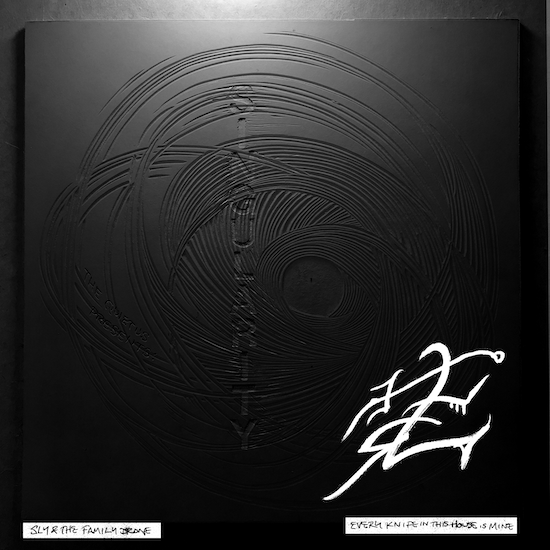
This latest release is – as ever – an interesting one. It’s a limited lathe-cut 12” released via The Quietus, a publication with an immense reputation for its championing of the weird and the wonderful, and which perhaps more than any online publication with a significant readership plugs the gap left when Sounds, and then Melody Maker ceased to be. For non-subscribers, it’s available digitally via the usual platforms.  The ones I don’t use or advocate. But I digress. ‘And Every Knife In This House Is Mine’ is Sly at their best.

As a single track – less a composition than an exploration – with a running time of twenty minutes, it’s an EP or an album by some bands’ standards, but what it ultimately is is an immersive experience which sees them make the most of having access to studio facilities to push their sound further in different directions.

It’s a shrill, rippling wave of feedback that pierces the eardrums in the opening seconds which announces its arrival before a tempest of crashing drums, wayward brass and extraneous noise deluges in, and more happens in the first forty seconds of this tune than the entirety of many albums. Shortly after, it settles into a thunderous groove, the rhythm section grindingly heavy while wild horns – Kaz Buckland’s alto sax and James Allsopp’s baritone sax interplay is a back-and-forth that is timed with perfect precision.

There’s a lot of reverb, and a lot of space here. They pull back from the brink of pure chaos and meander through some expansive gentler passages, before, each time, exploding into a wild crescendo. It’s hard to differentiate snarling electronics from barking vocal yelps , and there isn’t a second where there isn’t something happening. It’s impossible to maintain a commentary on this sequentially.

A tumult of noise, bleeps and glitches, bloops and whirls, all fuse to form a wild cacophony, and it’s pure bliss to yield to this sonic tidal wave. But over the course of the track’s twenty minutes, there are constant ebbs and flows, the lower-level churning swashes rendering the louder segments and extended crescendo’s all the more impactful.

Things get decidedly Throbbing Gristle around the midway point, with swampy electronics and groaning low swoons taking things down, disrupted by random clatterings of percussion, before things take a turn for dark around the fifteen minute mark, with drones that sound like a 747 heading towards the ground in a nosedive… and then the climaxes with an extended jazz frenzy, and… woah.

Running through every form and texture, Every Knife In This House Is Mine is both exhilarating and exhausting… and everything you would expect from Sly and the Family Drone, and all that jazz.

AA

SlyAndTheFamilyDrone_Flat_copy_1669300606_crop_550x550

Hummus Records – 23rd October 2020

Christopher Nosnibor

Well of course my interest was piqued: Convulsif’s fifth album, pitched as a work of ‘self-inventing gloomy rock in the abyss between such subgenres as noise, metal, jazz and grindcore’ likely to appeal to fans of GOD, Godflesh, Swans, Naked City, Napalm Death, Painkiller, Boredoms, and Neurosis. It doesn’t get any more of my noisy industrial-favouring bag than that – not least of all because the referencing of short-lived Godflesh / Techno Animal offshoot GOD seems wilfully perverse. Let’s face it, what is the real scope for techno-hued jazz/grind crossover?

The Swiss quartet eschew conventional rock instrumentation with a lineup featuring bass, drums, bass clarinet and drums, and I can already hear many wailing about the lack of guitars. Hearing the cacophonous freeform racket they conjure, however, would be enough to make even more wail, and certainly not just about their unconventional band makeup, and just to enhance the album’s commercial appeal, the bleak set’s titles are all cut up and mashed up lines of Charles Darwin’s Beagle Diary.

The first cut, the seven-minute ‘Buried Between One’ is dominated by the gut-churning, nausea-inducing rhythm section stylings of Swans circa Filth and Cop – the drums explode like volcanic detonations, slow and sporadic, and the lumbering low end stops and starts and lurches woozily, while everything else on top is just discord, and as the track progresses, it all whips into a hellish maelstrom, a brutally sustained crescendo that leaves you wondering ‘where’s left to go from here?’

The elongated drone, low, sonorous, ominous, that introduces ‘Five Days of Open Bones’ provides some respite, , before dolour bass and brooding violin drift in; the atmosphere is dense and grows from a mist to a fog as the drumming builds… the tension increases… they sustain it, but you now it’s surely a matter of time before something yields… the clarinet ebbs and flows like a layer of synth, but the fact this is organic and orchestral somehow ads something else… and then… and then… Anyone familiar with the last incarnation of SWANS will now what it’s like to endure such a seemingly endless build. It’s exhilarating and torturous in equal measure. Your heart’s palpating and your lungs feel ready to burst and you think you might vomit… and then it all breaks into a frenetically frenzied jazz noise of parping horns and hundred mile-an-hour drumming. No, that’s not right. Surely. But then, this isn’t SWANS, this isn’t your regular avant-industrial: this is the kind of experimental freakout that’s right at home at Café Oto, and ‘Five days’ feels literal in its timespan.

A couple of brief, lurching interludes make for more difficult listening, with ‘Surround the Arms of the Revolution’ sounding like ‘A Screw’ played by a drunk jazz ensemble, paving the way for the fourteen-minute finale that is ‘The Axe Will Break’, which is constructed around a tight, cyclical bass motif, which is again, decidedly jazzy in a Sly and the Family Drone sense. The endless repetition is mesmerising, hypotonic, and the tension builds almost imperceptibly… but build it does. It grinds it way through a merciless squall of noise through which filters mournful woodwind that flickers hints of post-rock reflection before being submerged in the swelling surge of chaos. The final five minutes – an eviscerating sustained crescendo of monolithic proportions – is little short of devastating. Jazz isn’t always nice.

AA

a3431541039_10