Posts Tagged ‘sad’

Neurot Recordings – 16th May 2025

Christopher Nosnibor

Steve Von Till doesn’t really require any introduction or preamble: the chances are, if you’re reading this, you’re already aware of his work, and if not as a solo artist, then as the guitarist / vocalist with Neurosis, active between 1985 and 2019. As much as Neurosis were labelled a post-metal band, they very much forged their own sound, which has, to an extent, become the house style of Neurot Records.

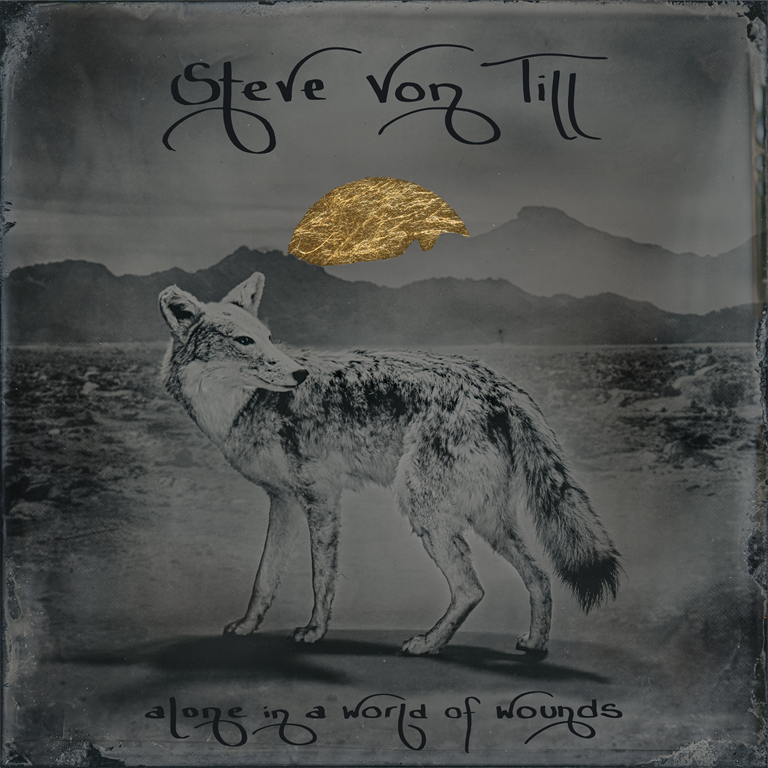
Von Till’s solo works may lean more toward folk and the gentler side of that style, but nevertheless have significant heft, and Alone in a World of Wounds – his seventh solo album, the follow-up to No Wilderness Deep Enough (2020) is no exception (he’s been busy in the intervening years with a trilogy of Harvestman albums, all released in 2024). The heft here comes from a sense of gravitas, rather than volume and distortion, and continues the softer trajectory of its predecessor, an album ‘initially inspired by the harmonic resonance of piano and synths and his long-standing love of ambient music’.

‘The Corpse Road’ sees Von Till croak and croon in a fashion that could me taken for Mark Lanegan in a blind test, against a sparse backdrop of strings which swell and swoon, heavy with sadness and gloom. There is a sense of times past, not just fading memories and bygone days, but a sense of the creak of wood and worn clothing of harder but simpler times. I find myself unexpectedly transported to a walk my daughter and I undertook from Ambleside to Grasmere in the Lake District a year or so back, via the ‘Coffin Route’. It was winding, and wet, and uneven, not to mention long, and it’s billed as a ‘strenuous’ walk, while still suitable for tourists: as the rain battered the hood of my anorak, I found myself contemplating what it must have been like hauling an actual coffin along that four-mile stretch without the benefit of modern hiking gear. Life must have been tough. Von Till taps into the essence of these past times, and a sense of the elemental.

The mood remains lugubrious on ‘Watch Them Fade’, a song redolent with sadness and reflection, weighted down with the reminder that mortality affects us all and is never far. Despite the fact that life’s only certainty is its expiration, we continue to shy away from the topic. While Alone in a World of Wounds does not confront mortality and death head-on, it’s there at every turn. “Keep on diggin’… dig a little deeper” he implores on ‘Horizons Undone’, and while there are psychological connotations here, it’s hard to ignore images of graves.

The eight-minute ‘Calling Down the Darkness’ is a super-sparse piano-led slow-burner, and confounds any expectation for a surging finish by remaining low-key and minimal to the end, ad something about it is so, so achingly sad.

‘The Dawning of the Day (Insomnia)’ is a brief spoken-word interlude with a moody piano accompaniment, while paves the way – or perhaps scatters woodchips – for the arrival of the swirling atmospheric start of ‘Old Bent Pine’, another song which revels in the forces of nature, before the six-minute ‘River of no Return’ flows toward the finish. It has hints of Slowdive about it. Moreover, its superficial ominousness reminds us that rivers only flow in one direction, and as with rivers, so with life: there is no return, no replay, no turning back. there is no undoing mistakes, only not repeating them.

‘Alone in a World of Wounds’ may be a largely acoustic album, but it is still heavy – really heavy – emotionally more than sonically – and consequently not an easy one to process. It would be impossible to deny the album’s quality. But the weight, the sadness…

AA

AA
450947

skoghall rekordings – 19th June 2023

Christopher Nosnibor

This was originally released some time ago, and now it’s getting a digital release and a CD reprint once the last of the old stock is gone, and it’s the first release on Dave Procter’s new label, skoghall rekordings, which he’s set up to home non-noise material which doesn’t sit comfortably with the remit of his Dret Skivor label. If I didn’t know better, I’d think this guy had mastered cloning, given the release and touring schedule of his myriad musical projects, the range of which is vast – although it’s fair to say that anything involving words will be a politically-charged vehicle for reminding us how shit governments, right-wingers and tabloid media are, and how capitalism shafts the workers without whom there would be no wealth for the elite. And so it is with Sounds from Underground.

‘Justice for the 95’ say the notes accompanying this release, some of the proceeds of which are being donated to the Orgreave Truth and Justice Campaign.

Memories are short, even among those who live through momentous events in recent history, and the miner’s strike of 1984-85 was one of those. It wasn’t simply a strike like we’re seeing with… most sectors right now, in what feels almost like a replay off the early 80s… the handling of the strikes was tantamount to civil war, the (Tory) government against the workers and the unions. The 95 then, refers to the 95 arrested at the so-called ‘Battle of Orgreave’ in South Yorkshire in June 1984, but all charges were dropped. As the BBC reports, ‘Police confronted pickets outside a coking plant in Orgreave, South Yorkshire, in what the miners said was a military-style operation to attack them… Former miner Kevin Horne said: “We were only striking for the right to work.”’

This is by no means the first musical work which focuses on the miner’s strikes: Test Department’s 1985 LP Shoulder to Shoulder, with South Wales Striking Miners’ Choir was released as a fundraiser, while ‘Statement’ from 1986’s The Unacceptable Face of Freedom is centred around a recorded statement detailing the brutality of the policing of the picket lines: ‘25 pickets… 150 policemen… I was dragged off to this van… another one had me in a headlock… I thought I was going to black out…’ It’s a harrowing account, and one which seems as relevant now as ever given the current government’s expansion of police powers, promoting greater use of stop and search, and the police’s ‘management’ of events like Sarah Everard’s vigil. It’s all too reminiscent of A Clockwork Orange.

As the accompanying notes outline, ‘This LP documents coal mining in all its forms – the pride of the job, the struggles of the job and the occasional deaths because of the job. A lot of my family were coal miners and most of them died from lung disease before their time.’

Yes, the miners got fucked every which way, and while the twelve acoustic-based songs on Sounds from Underground may not be as visceral or hard-hitting as some of Test Department’s works, they’re truly heartfelt. And that registers, emotionally.

While ‘Fiddler’s Ferry’ is a simple and wistful song that would perhaps class a s a sad protest song, the super-sparse ‘Macgregor th’ butcher’ is heartaching in its mood and the simple narrative. Similarly, ‘At the Face’ is simple and tells of the everyday realities of mining life – and the physical toll on those men who grafted and grafted, until death. It would be easy to romanticise the northern accent and barely-held melodies, but the fact is, it works because it’s real, and ultimately sounds like The Wedding Present covering Billy Bragg, if you need a comparison.

‘Me, A Picket Line’ and ‘Horse’s Arse’ are straight-up spoken word pieces, and perhaps the album’s most affecting tracks, because they’re so direct, the latter in particular, echoing as it does the narrative of Test Department’s ‘Statement’. But ‘Horse’s Arse’ references 2016, and you realise, nothing changes, and while sometimes things are reported and there is outcry and uproar, so often, events are ignored out of existence, and the narrative becomes skewed, rigged. But mention that and you’re a conspiracy nut, of course – more often than not dismissed by the conspiracy nuts. ‘Tory Twat’ is self-explanatory, and getting straight to the point.

And this is perhaps where we can see how Guerrilla Miner and Test Department share common ground, beyond subject matter: as much as they’re both political – because this is political, and it’s impossible to avoid or deny that this has a heavily political aspect – they’re both ultimately concerned with the human aspects of the miners’ strikes, and this in turn reminds us that the current strikes, too, are about people and their livelihoods. You will see reported, time and again, the government vilifying the striking workers for the disruptive impact of their industrial action. But any a striking worker will tell you that striking is a last resort, the only way to be heard when all avenues have failed, and if strikes are disruptive to consumers, they’re even more so to those striking. And it’s rarely simply over pay, but also conditions: and at the heart of it all lies capitalist exploitation, and such exploitation shortens and destroys lives, placing profit before people. And this is what really hurts.

Sounds from Underground is direct, real, human, affecting and ultimately sad. Listen, learn, and do everything within our power to stop history from repeating again, and again.

AA

kents lane 2 - LP art for bandcamp

Bearsuit Records – 12th November 2021

Christopher Nosnibor

It’s unusual to open an album with a B-side from the lead single, but there’s nothing usual about Eamon the Destroyer or Bearsuit Records, and the scratchy soporific drone and distorted / filtered vocals of ‘Silver Shadow’ – which reference the ‘small blue car’ to which the album owes its name – makes for a worthy introduction by means of introverted minimalism. It’s largely representative of an album that’s slow sparse, minimal and somewhat lugubrious.

I take the nom de guerre Eamon the Destroyer ironically. That may be wrong, it may be some unpleasant prejudice, and if so, I do apologise. This isn’t a PC matter or issue. But names come with certain associations, and the connotations of Eamon aren’t particularly warlord, at least to my mind. No diss to any Eamons, but the name is about as warlord as Gavin, Kevin, or Craig. No doubt there are some brutal twats by the name of Kevin, but, well, y’know, it doesn’t evince fear. The concept of ‘the destroyer’ is one of something harsh, brutal, obliterative, too, but that also isn’t the case here. Consider Ah Puch the Destroyer, Mayan god of death and disaster whose coming would mark the end of days. There is nothing explosive or devastating about A Small Blue Car – it is not a violent sonic blast of earth-shattering, annihilative proportions, yet it does, strangely, evoke a sense of near-finality. There is an all-pervading sadness that hangs over the album’s entirety, a sadness that’s slow-creeping and heavy, like a weight that pulls you down, bending your back with the effort

‘Humanity is Coming’ is downbeat, gloomy, and things get particularly dark and dense on the short instrumental ‘The Conjuring Stops’, with a heavily phased synth yielding a pulsating throb in the style of Suicide. ‘The Avalanche’ also brings some weight, with lots of granular sounds and bolds bursts of sweeping synths in the choruses that contrast with the woozy drone and is perhaps how Leonard Cohen might have sounded in the early years of his career if he’s chosen Moods instead of an acoustic guitar. The end result, musically, is like Stereolab on Ketamine.

The slow rasp of single cut ‘My Drive’, with its whistle of feedback and detuned radio in the distance while the picked guitar – spacious and delicate – curls like smoke into the darkness, and it piles on the melancholy.

‘Uledaro’ follows, a dolorous jumble of discord. ‘Nothing Like Anything’ is conspicuous by its near-cheeriness ‘wake up / the sun is out / we’re almost home’, Eamon intones in a rare glimmer of optimism. There’s whistling and levity, and it’s almost, almost a pop song. But of course, it’s not. And perhaps it’s more me feeling autumnal, but the happiness only accentuates the sadness, as if the jollity is a mask to sorrow so inexplicably deep that it has to be covered up. The nights are dark, the world feels a very long way off and a long time ago. It’s time to hibernate, with A Small Blue Car for company.

AA

a2830016479_10

Christopher Nosnibor

Videostore continue to make the most of lockdown, with the pair banging out a second mini-album, comprising three of their recent singles along with three brand new tracks. Does the title have a significance? Does the end of lockdown mark the end of Videostore as Nathan and Lorna return to work and also reconvene with Argonaut? Perhaps time will tell, but for now, this is a document of the effects of life in confinement – or, as they put it, ‘what happens when you are locked down with Disney plus and Taylor Swift and Spacemen 3 CDs for company.’

It’s an interesting blend, but also a hybrid that works and is distinctively Videostore: scuzzed-out lo-fi pop songs that articulate ennui and nostalgia with a rare energy. As ever, it’s the contrast between Nathan’s worldweary monotone baritone and Lorna’s light, lilting, airy tones that really distinguish and define their sound.

It starts off with single cut ‘Superhero Movies’, a lively blast of choppy guitars where they ruminate on the disparity between movies and life, whereby everyone aspires to be a superhero from the comfort of their sofa. Media and unattainable aspiration is also the focus of ‘Your Perfect Life’. ‘Halfway There’ is a middle-aged lament that finds Nathan mulling over the passage of time, and in its downtempo mood and delivery, I’m reminded of The Fall’s ‘Time Enough at Last’, and even the semi-spirited call of ‘techno techno techno techno’ and a swerve into synth territory near the end can’t lift the melancholy mood – that’s a job for the blistering Pixies-like blast of single ‘Your Mind’, which stands out even more in context.

Low-key single ‘Anglepoise’ marks another return to Brix-era fall stylings, and there’s something affectingly sad in the sound of tiredness, of defeat. The last song, ‘Go’ is the biggest surprise of the set. It’s not a cover of the Moby track, but it is an all-out electro dance banger. It’s incongruous, so say the least, but there are some trademark squalls of noise among the trancey synths and insistent beats.

They Closed Down The Videostore may only contain six tracks, but it’s their most diverse work yet – and if the store remains open, the indications are they’ve no shortage of ideas to pursue.

AA

a1198813050_10