Posts Tagged ‘Rupert Lally’

Mortality Tables – 20th June 2025

Christopher Nosnibor

Lunar Forms is Rupert lally’s second release on Milton Keynes label Mortality Tables, following his Interzones album, released in November last year, and forms part of the latest ongoing project by the label, dubbed The Impermanence Project (which so happened to feature a tense but lugubrious ambient work by some guy called Nosnibor a short while ago).

Sometimes, while I try to work through my review pile in a broadly systematic way, I have to reshuffle my priorities according to mood. And right now, my mood is jittery, jumpy, tense, unfocused, meaning that what I need is something fairly gentle, somewhat abstract, if not necessarily ambient. But also something which feels relevant, in some adjacent fashion. And so here we are: bombs are dropping and missiles are flying, and it’s maybe easy to dismiss it as taking place at a safe enough distance away…. But is any distance truly safe enough?

And so, it’s necessary to seek solace in distraction, solace in abstraction, something that offers layers and textures that draw you in, captivate the attention… but at the some time, offers something more to reflect on while listening to the glitches and echoes, woozy, skitty fragments of analogue pull my attention in different directions.

Impermanence… as polyartist and the innovator of the cut-up method, Brion Gysin said, ‘we’re all here to go’. And we are. We fear it, but it’s impossible to escape the inevitable. It’s not a question of if, but when.

Lunar Forms transitions between stuttering, glitching minimal techno and slowcore EDM, and more expensive, cinematic instrumental sounds which are overtly ambient. Electronic fuzzed and buzzes spark over swirling soundscapes, and at times we’re led into Tangerine Dream territory, while at others, we find ourselves adrift. The fact that, including bonus tracks, Lunar Forms features eighteen pieces, and has a running time of some seventy-four minutes, is significant. It’s a vast and expansive work, and one which is easy to get lost in, since the tracks are distinguished only numerically, ad those numerical titles are not tagged sequentially.

There is a lot of dark atmosphere, a lot of rumbling. There is much haunting reverb, considerable space, a great deal of bubbling, blipping, hovering. The deeper it plunges into spacious, cloud-like disturbance, the more immersive and simultaneously the more the power of this work increases. Breathe deep… and feel everything this represents. ‘313’ May be sparse, but it also edges its way into the space between dance music and the BBC Radiophonic Workshop, while ‘325’ pitches jittery microtonal beats against sonorous strong-like sound. It’s simultaneously tense and introverted, and outward-facing through cloud. The beats of ‘303’ are like the dripping of a tap amidst synthesizer drones and swirls. And it goes on. As such, Lunar Forms is more than varied: it straddles boundaries in a way which renders it almost impossible to place.

AA

cover

Mortality Tables – 29th November 2024

Christopher Nosnibor

Because life experience creates linguistic associations, for me, it’s impossible to see or hear the word ‘interzone’ without immediately thinking of William S. Burroughs. The title of a collection of short stories and ‘routines’ penned in the mid-1950s, Interzone was the working title of the seminal breakthrough novel Naked Lunch (1959), and the collection, published in 1990 consists of segments which failed to make the final cut. The pieces were written while Burroughs was living in Tangier, something of a haven for expat writers, including, perhaps most notably, Paul Bowles, but also polyartist and true inventor of the cut-up method, Brion Gyson. Burroughs described the city as an ‘interzone’, and it was indeed both an ‘international zone’, as the portmanteau implies, and a space between zones, outside of any single culture or jurisdiction, its administration divided between the US, French, Spanish, and English sectors, where ‘nothing is true, everything is permitted’. Of course, there are numerous other connotations, but this is what I’m bringing in terms of prececeptional baggage to this.

The accompanying notes certainly indicate that the album’s content holds up to these parallel positions: ‘Like its name implies, these are place of transiency. Intermediate places. In-between locations. Melting pots of different people and different ideas, constantly evolving as one thing collides with another, and another, and another.’

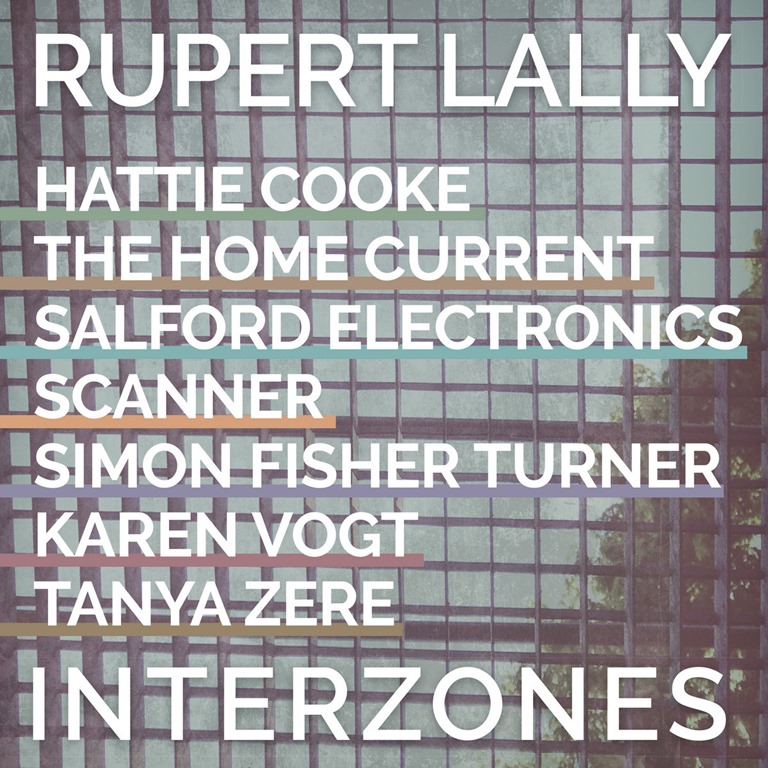
The album was initially recorded in 2022 as a solo work, but subsequently scrapped and rerecorded with a different collaborator on each composition. Collaborations do tend to bring out different aspects of an artist, and it should therefore be of no surprise that this suite of nine pieces, recorded between 2022 and 2024 in Switzerland, England, Luxembourg, France and Zimbabwe, is eclectic in its take on electronica.

As the bookending pieces, ‘Entry Visa’ and ‘Exit Visa’ indicate, travel, movement, and transition, are the key themes here. But this is not some pan-cultural pick ‘n’ mix grab-bag, and instead creates an experience which replicates the disorientation of travel. It’s difficult to articulate just how this sonic patchwork works, or quite how the experience feels. It’s not as if it lurches from techno to grunge, to opera, to thrash, and in this respect Lally’s works represent his ‘two inches of ivory’, so to speak. But within the realm of electronica, Interzones covers substantial ground.

‘Play Position’, featuring Salford Electronics, is a sample-packed exploratory work with a prominent beat, which contrasts considerably with the near-ambience of ‘A Stealth Approach’, featuring Scanner; contrasting further, Simon Fisher Turner brings a sort of drawling space-age country aspect to ‘Calmer’, before things take a spin toward out-and-out trance on the title track, and Karen Vogt’s airy, soft vocals on ‘Running Circles’ pull the album gently into hypnotic shoegaze territory. The album continues on this trajectory, sliding deeper into dark, gothy electropop with ‘Ripples’.

The insistent beat and overtly dance style of ‘Exit Visa’ makes for an unexpected change in direction – despite the fact that, by this point, nothing should be truly unexpected. The effect, however, is disorientating, and you find yourself wondering how you came from A to B over the duration of the album. It’s testament to both Lally’s compositional skills and his selection of contributors – as well as the album’s sequencing – that somehow, it flows and the transitions themselves are seamless, which only heightens the sense of moving between spaces with no real sense of how it came to pass. Vitally, Interzones is a subtly detailed work, with hidden depths and moments of genuine beauty.

AA

a2037434320_10