Posts Tagged ‘prepaired piano’

False Door Records – 5th September 2025

Christopher Nosnibor

More than five years on from the onset of the pandemic, and still pandemic projects are emerging. The arrival of this release provides a timely reminder of a time which already many seem to have moved on from, forgotten. More than likely, there was a collective keenness to return to normal as quickly as possible, to bury the trauma and make like it never happened. There are many, of course, who will never forget, for a host of reasons. Many lost loved ones, but still many more suffered mentally, from isolation, from being trapped in abusive situations, or simply – I say ‘simply’ as if it’s something minor – the fear of the virus and the way the entire situation was managed and messaged by governments and media – not to mention the bewildering effusions of misinformation on social media.

In between home schooling, struggling to work as key workers, or struggling financially due to reduced furlough incomes, the idea that we were all in it together was essentially a myth – but people found ways of coping, and for those of a creative bent, new ways of creating became the focus.

For Johnny Richards and Dave King, this new way of creating involved emailing digital files across the world to one another: as the bio explains, ‘Richards recorded piano parts, some prepared, some using the piano as an explicitly percussive instrument, then sent King the files to the US for him to record his drum parts. Richards would then record further piano parts and overlay them, in response to King’s parts.’

At the time, there was much talk, many virtual column inches, devoted to the discussion of ‘the new normal’. Fleetingly, there was optimism, a hope for a kinder world, a world where we consumed less fossil fuels, where work / life balance was more evenly distributed… but since the end of the pandemic, it’s been hell, as if people pent up all their hatred and fury and have been unleashing it in war and antagonism and making up for lost time.

And so it is that The New Awkward reminds us of that fleeting spell of optimism, and as they reflect, ‘It could have happened at no other time. With its multiple layers percussion and piano, treated and untreated, it would be impossible to recreate live.’

Awkward is an appropriate choice of word for the title of this album. There is something almost feverish about the compositions, which are bursting with complex – and often irregular, contrasting, even conflicting – time signatures. At times, drums and piano happen upon coincidental timing, but for the most part, they seem to be duelling one another – not in an aggressive or antagonistic way, but playfully. On ‘The Chance Would be a Fine Ting’, there are moments where the parts intersect to forge a groove that almost has a swing, a swagger, albeit a slightly off-kilter, drunken one that staggers a little, the tempo changing as if the crank handle of an organ is slowing, then picking up pace again.

It’s a little disorientating, but ultimately fun, as titles like ‘Sleepless in Settle’ suggest – a title which only really makes sense in the context of Johnny’s being based in Leeds, or, more broadly, the north of England. The best jokes are always puns, especially when they’re super niche.

AA

The seven-and-a-half-minute ‘Memory Man’ has something of a vintage film feel to it, as well as a strong swing, and it’s easy to forget that this album features only piano and drums while listening to what, for all intents and purposes, sounds like a busy bassline leading a full band. The title track twists and twangs, is a bit noir, a bit late-night jazz café, but weird and woozy. ‘Gene Heard Wrong’ is another busy piece, the drums, played quietly but shuffling rapidly around the kit, as it twitching with anxiety, while the piano… the piano chinks and rolls with a nervous energy. ‘Darts’ strolls and stutters, while the last track, ‘Climbing on Mirrors’ builds slowly from dark atmospherics through softly loping beats with jarring discordant piano, and it sounds like everything is winding down… down… down.

From my own experience of lockdown – balancing working from home and home schooling a primary-school-aged daughter while my wife also worked from home, converting the living room sideboard into a desk until she installed a desk in our bedroom – devoting time – or stealing time, carving cracks in time late at night – for creative output was about the only thing that kept me even half sane. The fact that The New Awkward is far from straightforward makes sense in this context: I can relate to becoming so immersed, so invested in a project that it becomes its own world, and that its creation closes the door on the madness outside, all the texts and other messages, the screaming social media frenzy.

The New Awkward brings a lot back, and does so with mixed emotions. But throughout, it buzzes with a tense creative energy, urgent but also immersive and upbeat, the sound of unadulterated creative freedom.

AA
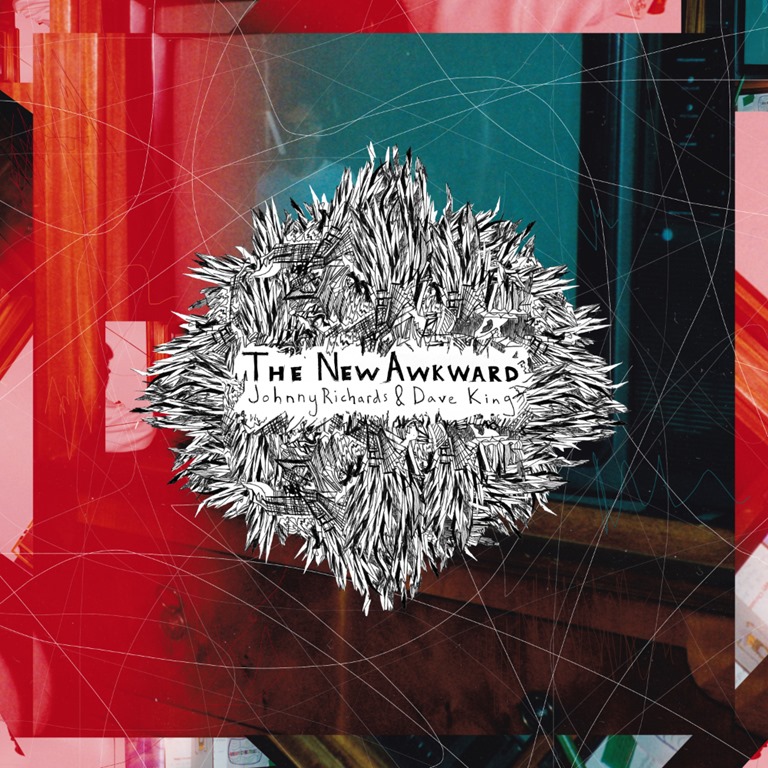
Johnny Richards & Dave King – The New Awkward cover 1000px

ROOM40 – 9th August 2025

Christopher Nosnibor

It’s been some time since I’ve sat down to listen to a work created using prepared piano. It’s been even longer since I spent time with Erik Griswold’s work. Perhaps the two are related, as Griswold’s accompanying notes recount how it’s been a while for him, too:

Under the house again, just me and my very old piano. Have we got anything more to say to each other? Will some new toys spice things up a bit? The creative process seems to swing like a (Foucoult’s?) pendulum, always returning to the same spot again and again, eventually. When I last made short form prepared piano pieces in 2015 (Pain Avoidance Machine) I was “feeling stifled by the negativity of the Australian political discourse, the narcissistic excess of social media, and facing a long summer of migraine-inducing heat.” If only I had known how far we had to go.

To the sounds of my 1885 Lipp and Sohn, prepared with brass bolts, strips of paper and rubber, I’ve added an analogue synthesizer, extending the exploration into the electronic. The tactile quality of both instruments is central to my approach, with small inconsistencies of sound, attack, decay, filtering all foregrounded. It’s a very intimate setting with just two C414 microphones at close distance to capture the granular details of sonic materials. The addition of “frames,” “windows,” and “sonic mirrors” produce a ritualistic aura hovering above and around the music.

I take a moment to reflect on reading this, before I can even bring myself to listen, reflecting on the title. Putting things off is… well, it’s a way of dealing, but it’s not really coping, is it? Not that Griswold hasn’t been making music: he’s maintained a steady flow of releases over the last few years, even during the COVID years – but to return to the piano is a significant step.

The title track raises the curtain here, and at times the tinkling tones are achingly beautiful, graceful, delicate, the most magnificent invocations of neoclassical perfection – albeit alternating with plinking, plonkling randomness which flips between low-end thunder and what, to the untrained ear or anyone unfamiliar with the instrumentation, sounds like clumsy stumbling.

‘Wild West’ isn’t a twanging country tune, and says nothing of the wiki-wiki-wah-wah we know, but a rolling piano piece with the prepared element adding a taut, almost electronic-sounding aspect – like the plucking of an egg-slicer – but also abstract, and strangely evocative. Meanwhile, the gentle, somewhat vague, and perhaps rather progressive-leaning ‘Ghost in the Middle’ radiates a hypnotic beauty.

The album’s mid-section takes on a dreamy, drifting, hazy quality, floating from here to there, with scratches and scrapes, forward and backward providing texture to these ponderous sonic expanses.

‘Uncertainty’ again balances neoclassical magnificence with angular irregularities and some jarring alternative tuning which continues into the trickling ‘Poly cascade’, a stack that’s subtle and in some way grounding.

‘Colours of Summer’ lands as a surprise and completely rips out those roots in an instant, being a throbbing techno track which completely goes against the grain of the album. In complete contrast, ‘Ghost of Ravel’ returns to classical territories, and is nothing short of beautiful, although as the album inches towards its close – the atmospheric bubbler that is ‘X-Mode’ which calls to mind the Krautrock bubbling of Tangerine Dream, and, more contemporaneously perhaps Pye Corner Audio’, find ourselves floating, drifting, unsure of where we are. Next Level Avoidance is full of surprises, and is in essence representative of the prepared piano, in that it’s unpredictable, unstable. Dim the lights, breathe and feel the flow.

AA

a0361562758_10

Reinhold Friedl & Costis Drygianakis – ta amfótera en / two into one

zeitkratzer productions – 28th February 2025

Christopher Nosnibor

Reinhold Friedl has been a significant contributor to the world of avant-garde music for a long time, not only as a leading explorer of the potentials of the prepared piano, as pioneered by John Cage, but in excavating the works of historical composers and reconfiguring those of more contemporary ones, leading the zeitkratzer ensemble through performances of Metal Machine Music and selected cuts from Whitehouse’s catalogue.

This particular collaboration coalesced during the pandemic, after which, as we learn, ‘Costis Drygianakis recorded Reinhold Friedl’s special piano sounds on a Blüthner grand piano with a bunch of extremely diverse microphones, ranging from a beautiful old Neumann U67 to a cheap tape cassette machine and even a Dictaphone. The resulting recordings have been classified, selected and processed at his home studio in Kritharia, Greece. No other sounds have been used.’

ta amfótera en is one continuous piece, just over an hour induration, and it’s a journey, to say the least. By ‘journey’, I mean torturous experience. It’s dark, punishing, pulverising, scraping, nightmarish. The first two minutes alone are a soundtrack to extreme horror – fear shaking amidst tremulous piano, heavy discord rumbling low and disconcerting to the point of spiking anxiety, after which there are protracted warped drones and rumblings which drag on, scraping and twisting, sonorous and uncomfortable. Amidst rolling, swirling, churning ambience and awkward, uncomfortable noise, random piano notes spike, seemingly at random. Gongs chime, crash, and clash.

When I was a child, the warping, discordant intro to ‘Rio’ by Duran Duran intrigued me. It created a palpable tension which affected me inexplicably at the age of nine. Perhaps this brief snippet of sound, dissonant, metallic, paved the way to my later obsession with musical otherness. The specific reason I reference this formative experience is that lengthy segments of two into one sound almost exactly like those opening bars of ‘Rio’ – scraping, discordant, a little like twisting metal.

two into one warps and hums, scrapes and drones, and occasionally plonks and thunks, the sounds rising from a random and seemingly unarranged twisting spill of sonic strangeness. There are chimes, and chsllenges.

There is much space – just as there are whistles and feedback – on two into one. The experience is, perhaps inevitably, disorientating, vaguely bewildering, even. There is something about this work which lifts you off the planet: to attempt to pin it to the particulars of contemporary rock music seems to be missing the point. Explore this release… and discover.

AA

Friedl 2

Karlrecords – 21st January 2024

Christopher Nosnibor

Reinhold Friedl’s career has been long and interesting, and continues to be so. The list of collaborations on his resumé is beyond outstanding, and he has taken the concept of the prepared piano, as first conceived by John Cage, to limits beyond imagination. As such, while the idea may not have been his own, Friedl’s advancement over the last twenty years has been the definition of innovation. But what makes Friedl such a remarkable figure is his capacity to explore so many different and divergent avenues, and to turn his hand to so many different projects – and this latest, with Martin Siewert is exemplary. Siewert’s instrument is the guitar, but his style of playing is far from conventional, tending to conjure atmosphere from feedback and sustain and otherwise working the space between the notes instead of blasting chords. As such, this is an inspired pairing.

Lichtung blasts in with a thick, heavy, grindy drone that almost borders on Sunn O)) territory: the twenty-four-minute first track, ‘Genese’ is a journey, which begins with an all-out assault of thick, gut-twisting drone and shards of shrieking feedback which twist into a maelstrom of chaos before receding to reveal altogether more tranquil shores. From this, it builds, a droning, churning wash, buzzing drones and dramatic crashes. And from the rising tempest, lone piano notes rise… These particular notes are identifiable as a regular piano, rather than a ‘prepared’ one – but that’s the nature of the tweaked instrument: random items on the strings create random sounds. It’s a curious array of sounds, and over the course of the track, the sound rises and falls, ebbs and flows, but the water is always choppy, the storm building and rumbling before it rages its full force. ‘Genese’ feels like it could be an album in its own right, but there’s a whole lot more to come.

‘Gedstade’ is a mere interlude at five minutes in duration: with plinking, plonking random twangs and scrapes and woozy drones, not to mention extraneous noise and crashes and more, it’s strong on atmosphere and oddness.

Often when interacting with music, or when critiquing music – and these are two different, if quite proximate experiences – I will ask myself, or otherwise consider, ‘how does this make me feel?’ Because ultimately, music, like any art, is about the experience of the recipient, and that experience defines its success and / or impact. To expand on that, and to clarify, many may dislike and so decry a great work of art on account of their singular experience, because it’s difficult to rationalise or otherwise quantify said work. As a critic, to baldly declare ‘they’re wrong’ would be a mistaken and to devalue the experience of others. But if others share a very different experience… then that is their experience.

And so we arrive at ‘Gestitche’, the album’s third and final track, a fifteen minute exploratory work which begins with crashes of low-end piano which sound like thunder and shake the ground beneath this exploratory composition. It’s heavy, doomy, dolorous. The scratchy, discordant guitar work only accentuated the album’s immensely broad sonic range. Squalling squealing guitar ruckus and feedback riot tears its way through the tempest of noise and plunging piano and sputtering sparks of wires. As the track progresses, things evolve and escalate, the thunder builds to a tempest, and at times you feel thoroughly assailed.

To my ears, then, Lichtungis a compelling experience. Lichtung is unquestionably niche, like all of Friedl’s but that in no way diminishes its value. And the joy of Friedl’s work is its variety, and the way in which he interacts with his collaborators. To this end, this album is a work which brings joy.

AA

a1344738009_10