Posts Tagged ‘Organ’

Dragon’s Eye Recordings – 7th June 2024

Christopher Nosnibor

There isn’t really anything funny about Yorkshire Modular Society, conceptually or otherwise. But one never really fully appreciates one’s own locale, especially not when it’s in the north of England, a region renowned for its pithy, gritty nature rather than its glamour. People will tell you that Yorkshire folk are welcoming and friendly – and tight – and as a non-native whose lived in Yorkshire the majority of my life now, it’s probably a fair summary. The county boasts some of the most magnificent countryside, and I only need to walk ten minutes from my house to be in woodland or fields – not bad considering I live twenty minutes from the centre of a cathedral city, not to mention twenty minutes from the train station, which will land me in Leeds in under half an hour. But for all that, and despite the huge number of outstanding bands to have emerged from Leeds over the years, mention Yorkshire and people will probably think of brass bands, cobbles, and Hovis, flat caps and equally flat brown beer. People tend not to think ‘Yorkshire, the county of experimental electronica’. They’re missing something significant.

There is a thriving modular / electronic scene in Yorkshire, notably with electronic music open mic (EMOM) nights in Leeds, York, and Halifax, all giving platforms to acts who aren’t necessarily on the main gig circuit, although venues like Wharf Chambers in Leeds and The Fulford Arms in York will often feature weird and wonky stuff from across the electronic spectrum.

Like many electronic experimenters, the YMS BandCamp page presents a prodigious self-released output, so if you’re wondering where to start, a release selected by a label seems like a fair point.

Of this continuous hour-long ambient work, Yorkshire Modular Society says, “As the cityscape pulses with electric fervor, oscillations emerge like whispers in the rain-soaked streets. LFOs, like elusive shadows, guide the listener through a maze of sonic intrigue, each modulation a glimpse into a world of mystery. Within the depths of digital tape modules, time unravels and reconstitutes, casting a veil of uncertainty over the sonic landscape. Reverb and delay wash over the senses like urban decay, adding depth to the sonic architecture that surrounds.”

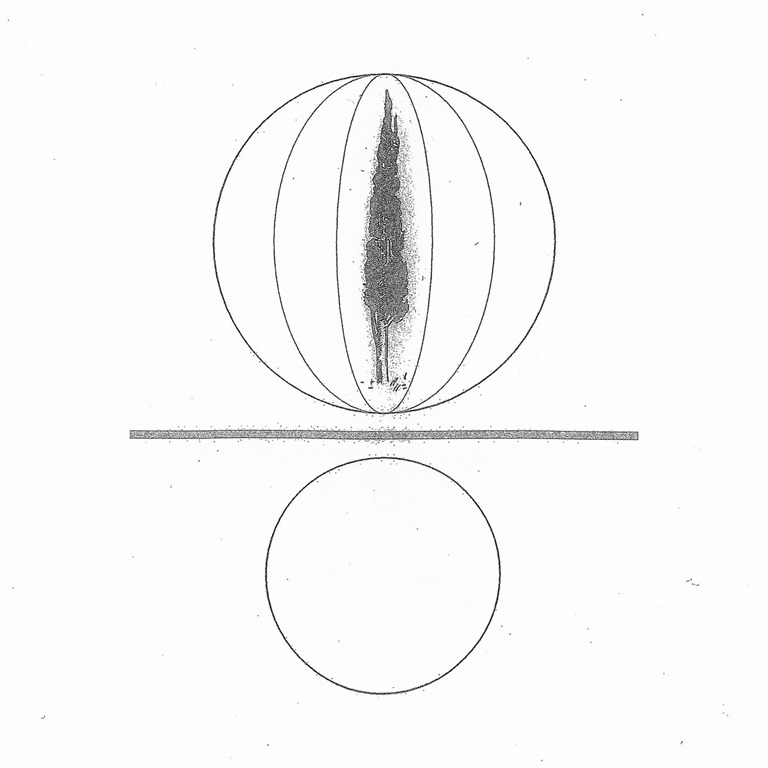
Fiery the Angels Fell is a lot calmer, more soothing, and less apocalyptic than its cover art suggests.

As is often the case with ambient works, I find my mind – like the music – drifting, and my contemplations following divergent trajectories. Here, I found myself wondering what the end would – or will – really look like. Growing up in the 80s, I envisaged the white light of nuclear annihilation, but on recently watching Threads, came to realise that this may not be the spectacular moment of silence prefacing perfect oblivion my younger self had fantasized. But no part of me ever envisaged an globe, or an egg, colliding and splitting in half with molten flames as something I may witness. The cover art, then, harks back to pure 60s / 70s sci-fi vintage. The artwork propagates tension. The sound soothes it.

While there are some billowing clouds along the journey that is Fiery the Angels Fell, this is a delicate, graceful work dominated by organ-like drones and soft sounds which ebb and flow. If this is the soundtrack to the end, I will likely sleep through it, and awake pure nothingness.

AA

de6063_art

Hubro – HUBROCD2573 – 7th October 2016

Christopher Nosnibor

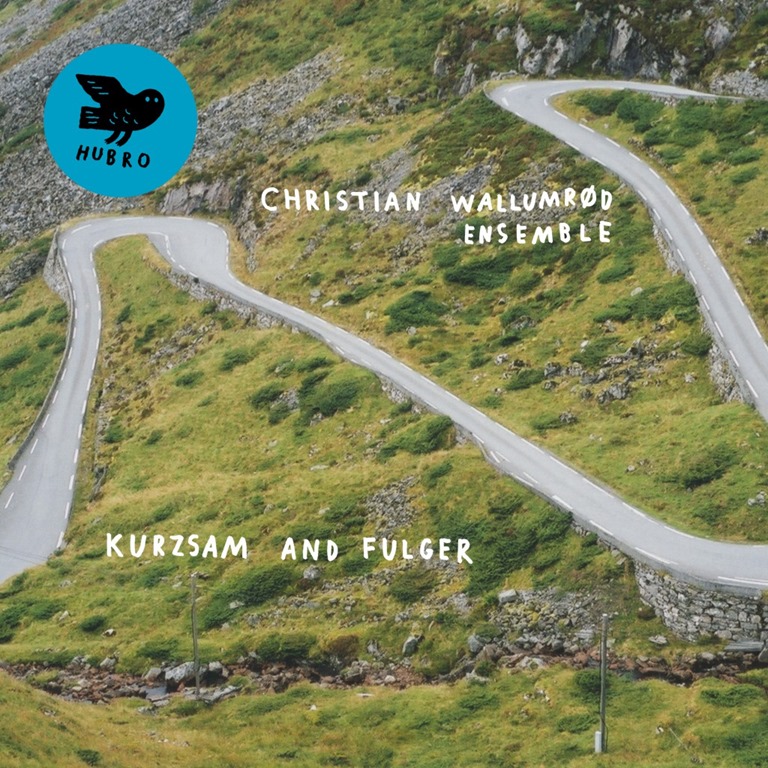
Krautrock country? Opiate-sedated tribal jazz? The seven tracks which comprise Kurzsam and Fulger don’t readily slot into any stylistic field. That’s Christian Wallumrød all over. This previous releases include a solo work and a collaboration with Trondheim Jazz Orchestra. This is an artist who thrives on variety, and one could probably argue with reasonable certainty, a certain sense of artistic perversity. But then, Wallumrød is interested equally in early polyphony and church music and the work of John Cage.

The pieces on Kurzsam and Fulger are sparse, minimal in their arrangements, yet fulsome in sound span. Shuffling drums, strolling, oscillating bass and lead piano that wanders all over, on and off key, along its own path. ‘Langsam’ ventures into mellow jazz territory, while insistent tom beats. The polytonal organ drone of ‘Phoniks’ offers more of an allusion to church music, but distilled to a skeletal frame, revealing the ensemble’s avant-garde orientation If the supremely brief ‘Klafferas’ is little more than a percussive interlude, the protracted meanderings of ‘Arpsam’ are an exploration of space, not least of all the space between notes, and as such, a piece which also interrogates the relationship between sound and not sound and the way the notes slowly decay while their echoes resonate in the mind. As the notes played vary slightly between each repetition of the motif which provides the key part of the track, the sense of disco-ordination increases as the track progresses.

The final track, ‘Kurzsam and Onward’ brings some levity, and its plinking keys call to mind a proliferation of 70s and 80s US sitcoms and I can’t help thinking of Taxi (despite the fact that it sounds nothing like it, and that growing up in the early 80s I never considered the show a comedy of any kind). The spaces between the playing are even longer, and push the parameters of composition and order, as well as the listener’s patience ad perception.

The less there is to hear musically, the more there is going on theoretically, and on Kurzsam and Fulger, Christian Wallumrød and his ensemble really do interrogate a broad range of theoretical positions in order to arrive at the finished work which is Kurzsam and Fulger.


Christian-Wallumrød-Ensemble_2400x2400-1024x1024

Touch – TO:101

James Wells

It’s perhaps due to the formulaic nature of television dramas that a certain type of orchestral music has become almost a signifier for rolling countryside, and people in bouffy dresses and full skirts or frock coats and hats riding horses, brawling in taverns and battling high seas, or otherwise taking the and bidding one another ‘good day’. Such pieces are then played, ad infinitum, on commercial classical radio as exemplars of contemporary classical music. It’s by no means the fault of the composers or musicians: it’s inevitable in the arts that commissions and funded projects will determine the outlets of their work.

The medium isn’t always the message, though, and while the pieces featured here are largely products of specific commissions, Claire M Singer’s work retains a strong focus on her own compositional interests: (quote from press). Imposing strings, bold and evocative sweep and arc through ‘A Different Place,’ as rousing percussion drums a rolling, thunderous tattoo. ‘Ceo’ is an altogether sparser composition which casts a more gloomy atmosphere, and the title track is an extended meditation on the album’s theme (‘Solas’ translates as ‘light’ from the Gaelic) and Singer’s instruments of choice. The organ’s majestic grandeur is very much brought to the fore, and resonates on a deep, subconscious level.

The slow-building sweep of ‘Eilean’ is gentle yet at the same time subtly stirring, flowing into the humming swell of the solo organ piece of ‘Wrangham’. Disc two contains just one track, ‘The Molendiner’, co-commissioned by Glasgow art gallery The Civic Room and Union Chapel, London, which spans twenty-six minutes. Centred around ‘the precise control of wind though the pipes’ of the organ, it utilises various organ types to create a vast sonic expanse, which hangs, drawing out an immense mid-tone humming drone. This probably doesn’t sound like the greatest advocation, but trust me, it’s subtly powerful, and as a whole, Solas is a moving collection of works.


Claire M Singer - Solas