Blaggers Records – 19th October 2023
Christopher Nosnibor
True revolution will come when the workers own the means of production. This is something that’s emerged in music not through an uprising, but a thoroughly screwed-up state of affairs, but one that’s very much a result of a capital-driven model. Major labels, and a fair few indies, don’t exist for the artists: they exist for themselves, for their execs, for the machine, the mechanism which enables them to gouge maximum profit for themselves, the shareholders, the middlemen, hell, anyone in the chain. And, depressingly it looks like even Bandcamp could be going this way before long. Capitalism doesn’t give a shit about art: it cares only about money, and art is simply another commodity, provided it’s got mass appeal. And who generates the profit? The artist, of course. The model is the same in any capitalist structure: without call centre and admin staff, multinational corporations would simply have no business: even banks need staff to manage the money being poured into them (although retail customers get the least service because they may be many, but they’re just your average pleb on the street, so fuck them and their wanting local branches and stuff that eat into the profit margins). But the staff who essentially generate the wealth are at the bottom of the pile with the worst pay and the worst conditions.
Sure, some artists get rich, but how many Coldplays and Ed Sheerans are there in the scheme of things? And there has been a shift since the turn of the millennium. Massive advances – or any advance at all in many cases – are a thing of the past. But labels have always been behind the time, and the concept of A&R is a longstanding joke in that labels aren’t interested in finding the next movement as riding on the coattails of whatever’s breaking in order to milk it.
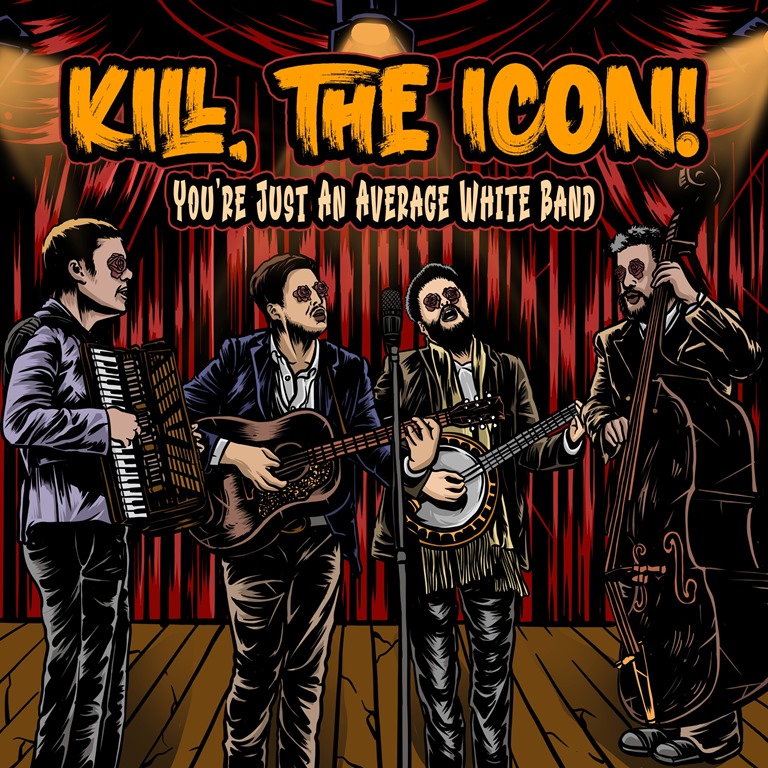
This latest offering from Kill, The Icon! marks something of a stylistic shift, at least superficially: less aggro and overtly confrontational, it’s also less guitar-orientated, built around a simple and unchanging synth loop. Nagging, earwormy, irritating… the repetition does become somewhat numbing after a while, but by the end off its three-and-a-half minute duration, you start to consider playing it again anyway.
Talking to me about the single, Nishant admitted ‘It’s really different and I expect will be polarizing in terms of content.’ He’s right on both counts, in that it’s not only a departure, but also likely to alienate a few fans and critics. But this is to the good: as I’ve written before, and will likely do so again in the future, you can’t please all of the people all of the time, and nor should you aim to do so. If you do, you’re Oasis or Ed Shearan. Punk is an attitude, not a style per se, punk is creating the music and art you believe in and not giving a fuck about the reception. Kill, The Icon! are punk, and this stylistic detour doesn’t see them budge an inch in their message or tame their fury for a second. Yes, true to their credo, Kill, The Icon are calling out institutional racism and general bullshit in society, and here, specifically, the music industry:
Average White Band / For the average white fan / Making average white music for the average white man
Joshi explains: “Mumford and Sons were the archetypal Average White Band. They had the son of a near-billionaire in their midst. And they made a career out of denying their privilege. They were bankrolled from the very start, and so they had a precious resource that’s not afforded to other bands: time. Most artists are told to play more shows, work harder, network harder. But that’s a huge lie that’s perpetuated by the music industry… Everyone involved in the music industry assures us that diversity, inclusion and equality are priorities – it’s written as much on the website of every festival, booking agent, manager, and record label. But the reality is an utter lie. We’re not all running the same race.”
One benefit of being a truly independent act is that the artistic control is not only retained by the artist, so is the scheduling. That means the pokes in ‘Average White Band’ are still contemporary, as Joshi calls it out:
“Once a band has been elevated, It’s fair to ask what they do with their new-found power: are they maintaining the status quo, or are they actively seeking change to make the music industry more equitable? The reality is that the music industry has been fantastic at improving diversity in indie music, but only to the extent that it champions female-led bands who approximate western beauty standards.”
Sitting on your chaise longue / Writing all your new songs / About cliches of cliches of cliches of cliches
It’s not a matter of sour grapes here: there’s no way Kill, The Icon! are jealous, or would want to be in the position of Wet Leg. But given the same elevated platform, Kill, The Icon! would be telling it like it is and making sure their message had maximum reach. But political bands don’t tend to get maximum reach, especially when they’re from minority backgrounds. Benefits are perhaps the most ‘real’ band with a broader reach right now – Sleaford Mods are simply too obvious are more about commentary than promoting change – but while they’re white, they’re too working class to be embraced beyond a certain demographic. In keeping it real, they’re not likely to get much radio airplay – or earn huge radio royalties – any time soon.
 Aural Aggravation