Posts Tagged ‘Marquis de Sade’

Testimony Records – 8th September 2023

Christopher Nosnibor

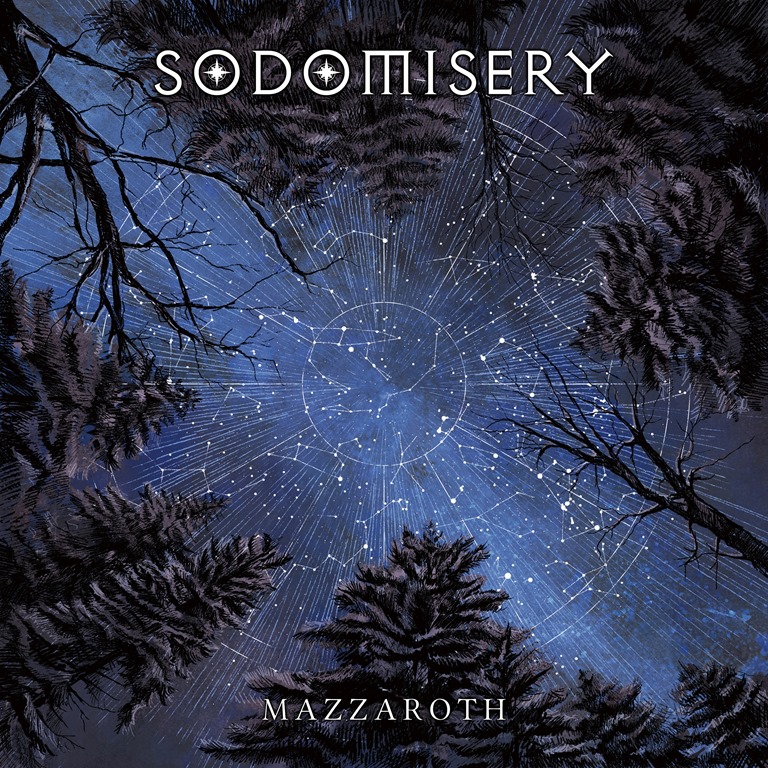
‘We are living in troubled times and it is hardly surprising that this is reflected in any form of art including music. On Mazzaroth, Sodomisery have spun a dark lyrical yarn about mental illness in society, religion, and the struggle of the individual, which is running like a red thread through their sophomore full-length. The Swedish melodic death four-piece are underlining their loosely conceptual approach with a remarkable musical evolution’, says the bio which accompanies this album.

There’s no misery like Sodomisery. At least, that’s what I’ve heard. For reasons I haven’t explored, while society has progressed – and I do mean this broadly and generally, being most aware of the fact that homosexuality and many things more widely accepted remain not only illegal but subject to severe punishments in a large number of countries – the word ‘sodomy’ carries brutal connotations which continue to hold currency in the circles of the

blackest of metal and industrial and power electronics. It’s true that Whitehouse’s Erector (with its blatantly unsubtle ‘cock’ cover) was released in 1981 and things have moved on a bit since then, but how much? Many of these bands are, as far as I can discern, less concerned with contemporary perceptions of anal penetration, whereby in permissive western society, it’s generally accepted regardless of sex or sexuality, and in pornography, it’s more or less considered essential, and more preoccupied with the harsh, perverse connotations of the writings of The Marquis de Sade – one of the few writers whose work still has the capacity to truly shock. And in this context, sodomy connotes the worst of sexual tortures, the infliction of pain, a statement of the ultimate power dynamics. It all seems appropriate given the band’s objectives.

This album had an interesting evolution, too: ‘When all the new tracks were written and pre-produced, SODOMISERY decided to create two versions of the album. One mix included keyboards and orchestration, while the other version had no such additions. After an extensive period of deliberation and many listening sessions, the Swedes decided that the new dimension and cinematic feeling added by the keyboards was exactly what their songs needed.’

Without hearing the two versions side by side, I’m in no position to comment, but the fact of the matter is that the keyboards certainly have not transformed this into some twiddly prog-rock effort: instead said keyboards are low in the mix but serve to fill out the sound with elongated droning tones against the relentless, thunderous fury of frantic fretwork and double-pedal drumwork that’s faster than the eye or ear can process.

There are some moments of such tunefulness that one has to take pause and breathe for a moment. We’re not just talking clean vocals or tuneful; there are moments, albeit brief, of outright pop sandwiched between the furious rage and overloading distortion. But rather than diminish the album’s power, I find myself respecting the band all the more. To have a softer breakdown in a song is one thing: to be so unashamedly clean and crisp and tuneful is bold.

‘Delusion’ balances all of the various elements nicely, coming together to forge a blasting yet grand and graceful dirty monster of a track which even packs in a heroic guitar solo near the end. Juvenile snickering ensues here with ‘A Storm Without Wind’, and I know it’s not funny and the delivery is entirely serious. Not least of all the lung-ripping bass that prefaces the throat-ripping vocals which snarl over guitars which alternate between old samples and snippets stolen from the present.

It feels scary, like being left alone on a platform and staring into the abyss. Any minute and it could retreat, and leave you falling into the void, and on the evidence here, you’d incinerate in seconds. Ultimately, we’re all scared. Mazzaroth is a worthy soundtrack to that fear.

AA
406169

Unsounds – 60U – 1st June 2018

Christopher Nosnibor

Tout ce que je sais is the second part of Chaton and Moor’s ‘Heretics’ series, which, according to the blurb, sees the duo ‘revive the most obscure, violent, erotic passions, summoning the great gures of their personal mythologies. In the company of Caravaggio, Marquis de Sade, William Burroughs and gures such as Jose Mujica, the duo immerses the listener in another world history peopled by radical thinkers’. ‘Heretics’ pays homage to those heroes who have used transgression and excess as a necessary means for creation. In this new album, recorded live at the Carreau du Temple in Paris on the occasion of Périphérie du 35e Marché de la Poésie (2017), Anne-James Chaton and Andy Moor deliver a radical work at the confines of literary and musical creation.’ The first release came in a giant matchbox, complete with textured side and a huge matchstick. No, I haven’t burned my copy. Yet.

The fact it is a live recording creates a certain degree of difficulty in terms of how to weigh its realisation. Granted, there’s an immediacy to the stuttering, fractured ruptures of dissonance what scratch through at forty-five degree angles to the rhythms and overall shapes of the compositions. But to doesn’t feel like a definitive document: something is missing.

‘Casino rabelaisien’ is a stark, minimalist grind, throbbing and churning away at a short, repetitious sonic loop of bass and extraneous discord reminiscent of Suicide and with cluttering, scratchy guitars that call to mind The Fall pre-1980. The murky sound accentuates the claustrophobic atmosphere, and Moor’s monotone delivery. The words being spoken in French mean I’m excluded from their meaning and from their sense. Oftentimes, the language of sound is enough to transcend linguistic barriers. But with the musical aspect so minimal and the vocal aspect so much to the fore on this work, I fear that much of the significance – and quite simply much of the content – is lost. Burroughs et al – this is my field, so to speak. But I simply don’t recognise it, let alone connect on a level where I can engage critically in terms of its conceptual content. Nothing about Tout ce que je sais conveys the brutal perversion of de Sade on a sonic level, for example, and there’s nothing that brings the bewildering explosion of ideas or the narrative fragmentation of Burroughs’ writing here.

‘Conquins coquettes at cocus’ jolts and jars, the crunching guitars choppy over a haltering, stuttering rhythm worthy of Shellac. It’s sparse in instrumentation, but it’s intense, and Moor’s dry, almost inflection-free delivery provides a counterpoint and contrast.

There’s something deep and haunting in the very notes of ‘Clair Obscur’, but the limited instrumentation means it feels somehow incomplete, unfinished. And then here’s the applause and the shouting from the audience immediately after; while being there would have almost doubtless have been a quite remarkable experience, the material would equally doubtless benefit from a proper studio realisation in order to capture the nuance and the detail of the compositions and their arrangements.

‘The Things That Belong to William’ closes the set; a slowed-down, opium-slurred Burroughs drawl creaks through the jolting, jarring spasmic guitar chords. It’s interesting and uncomfortable, but doesn’t go any real distance to create the same kind of temporal dislocation of Naked Lunch or any of Burroughs’ cut-up works. Is this a failing? Probably not in real terms. We land, then, at a place where we’re faced with the disunion between expectation and actuality.

AA

Anne-James Chaton & Andy Moor – Tout ce que je sais

Unsounds – 54U

Christopher Nosnibor

This is one of many releases I’ve been sitting on – figuratively speaking – for a long time without getting round to playing. I tend to listen to CDs while at work in my day-job, and digital promos at home (because I can’t stream or download on work systems), and while I can stuff a bunch of regular CDs into a jiffy and carry them to and from the office, the packaging of this release made it simply impractical. That, and the fact I had to battle long and hard with myself to resist the urge to burn the thing.

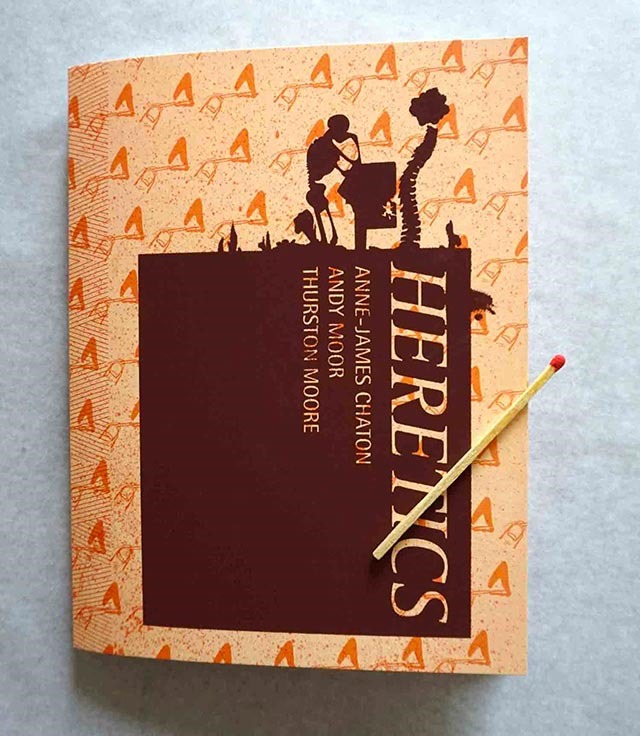
It’s not that I have any kind of objection to any of the artists in this three-way collaboration, or take issue with its premise, namely a series of portraits of radical heretical figures from across history, spanning Caravaggio and the Marquis de Sade, to William Burroughs and Johnny Rotten. In fact, it’s a concept I can get on board with, and for months I’ve looked at the magnificent packaging, a box-type affair which folds out to reveal a CD, a DVD and a book containing all of the words to the tracks – some in French, some in English, some in a combination of the two – forming a rich linguistic tapestry. Published in an edition of just 1,000 copies, including 26 lettered copies, it’s a work of art, not a disposable piece of trash. But the box is a giant flip-front matchbook. The front cover is made of fine sandpaper, and glued inside the flap, on its own, stark and inviting is a match, a full fore inches long. What would be more in keeping with the spirit of the project than burning it without hearing so much as a note, and reviewing the sound of the fire taking hold and the rustle of art burning, the colour of the dancing flames and the texture of the ash? It would hardly be Watch the KLF Burn a Million Quid, but nevertheless… I’m a pussy. I was also too curious to explore the contents of the package. And having heard the album and watched the film, there was no way I could even pretend to burn it. I’m weak. I’m no heretic.

Chaton, Moor and Moore are no heretics, either: they’re artists who appreciate heretics. It’s not always obvious to whom each piece relates, and perhaps a priori knowledge of the individual heretical figures is beneficial, as is an ability to translate French. ‘The Things that belong to William’ does not mention Burroughs by name. However, the bilingual text, in referencing ‘a Paregoric Kid’, ‘Pontopon Rose’, ‘Joselito’, ‘Bradley the Buyer’ and a host of characters and scenes from Naked Lunch and beyond, the connection is clear – to those versed in the author’s work. ‘Poetry Must Me Made By All’ is, then, presumably, a dedication to Comte de Lautreamont, pro-plagiaristic precursor of the Surrealists, Situationists and Neoists, as well as the cut-up technique of Burroughs and Gysin.

Textually – these are texts and not lyrics, delivered in a spoken word / narrative form – it’s an erudite work, researched, intertextual, referential. Sonically, it’s no more immediate. Oblique, obtuse, challenging: these are the first descriptors which volunteer their services in untangling Heretics.

‘Casino Rabelaisien’ is a tense effort, with angular guitar clanging perpendicular to a gritty, awkward bass grind. Chatton remains nonchalant and monotone amidst the chaotic no-wave cacophony. ‘Dull Jack’ begins with Thurston’s voice alone, before churning guitars slither in. There are no regular rhythmic signatures here, no ‘tunes’, no hooks or melodies: instead, this is a set which uses instruments in a more abstract way, conjuring uneasy atmosphere and often simply attacking the senses.

With the guitars of Moor and Moore duelling, playing across one another as much as with one another, the effect is jarring, uncomfortable. Both players employ atonality and discord within their performances, and when discordant passages collide, it’s a brain-bending experience.

Heretics is a work which delivers on its promise and conveys the spirit of the outré, unconventional artists who inspired it. It is, in addition, a true work of art. Don’t burn it.

Heretics