Posts Tagged ‘Kristof Hahn’

Christopher Nosnibor

The last tour of Swans’ current iteration, drawing the curtain on a succession of albums – and tours – which have been truly immense in every way: the build-up felt like the end of an era. The event itself, perhaps less so. At one point, someone calls out a request. “We don’t do that,” Gira explains, in a kindly manner. He seems pretty relaxed tonight, and smiles a fair bit. No-one in the band gets bollocked or scowled at, and they all seem to be having a pretty good time.

But no, they certainly don’t do ‘that’. You don’t go to see Swans expecting to hear choice guts from their extensive back catalogue. You don’t even go expecting to hear songs, at least not in any recognisable form. The versions of recorded songs bear only limited resemblance to their studio counterparts, twisted, stretched, and otherwise evolved while on the road to a point whereby they’re almost new songs entirely. Recent shows have seen the band playing sets spanning a full two and a half hours, while only featuring six songs.

Before we come to Swans, Jessica Moss, who, amidst an extensive catalogue of work over the course of a lengthy career, is best known for her contribution to Thee Silver Mt. Zion Memorial Orchestra and being part of the whole Godspeed You! Black Emperor milieu. Tonight, she plays a rendition of her latest album, An Unfolding, in its entirety, and it’s breathtaking. Her nuanced violin and vocal work is augmented with booming, resonant bass tones. There’s a lot of yakking at the bar and further back in the 1,000 capacity, sold-out venue, where the house light stay up toward the rear of the room for the duration of the night, but for those of us in the front two-thirds, it’s a spellbinding experience, which perfectly sets the tone for the main event.

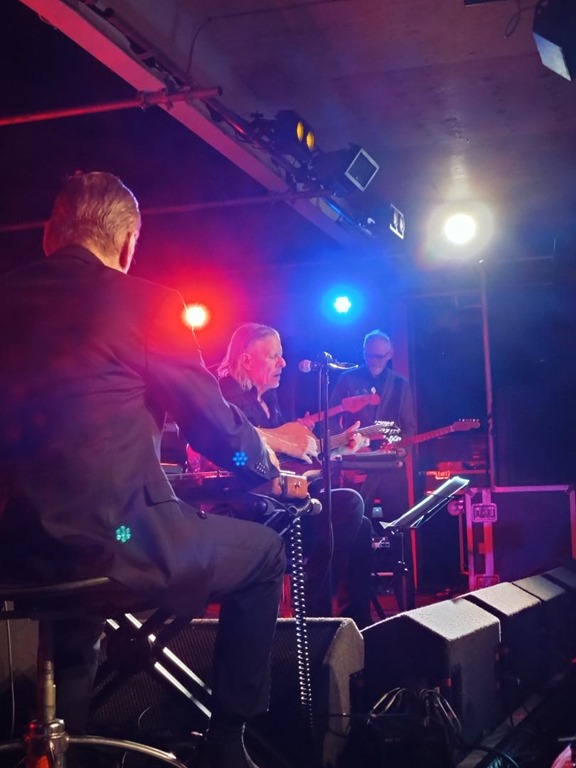
Moss’ half-hour set is over by around 8:40, and Swans, after a few brief checks, take to the stage around ten minutes later. Gira politely asks that there are no cell phones – “at least not where I can see them”, before he begins strumming a monotonous at two strings. He does so for what feels like an eternity. Or perhaps not. When Swans play, time takes on a different meaning, and it’s been a feature of this current iteration that the songs evolve and elongate over the course of the extensive tours, transforming and transmogrifying over the weeks and months on the road. They’ve been touring Birthing and this ‘farewell’ for a fair while now, although the set on the most recent leg has only featured ‘The Merge’ from said album. With ‘Paradise is Mine’, from The Beggar, and ‘A Little God in My Hands’, from To Be Kind, this is as close to a retrospective set as you’re likely to get, but none of these songs much like the studio versions, and half the set therefore features material which is either new or so far removed that it’s been retitled as well as restructured. But as I say, you don’t come to a Swans show for the songs. You come for the experience. And what an experience it is.
S1

It’s fair to say that there is simply no other band like Swans. Their reputation for extreme volume is only part of the story, a piece of the equation. Older fans who saw them in the 80s love to regale with tales of people throwing up, passing out, and so on, and that they’re pretty tame these days, and I have no reason to believe that these are purely apocryphal. Gira just can’t do quiet: even his solo acoustic sets playing smaller venues circa 2003 / 2004 were fucking punishing.

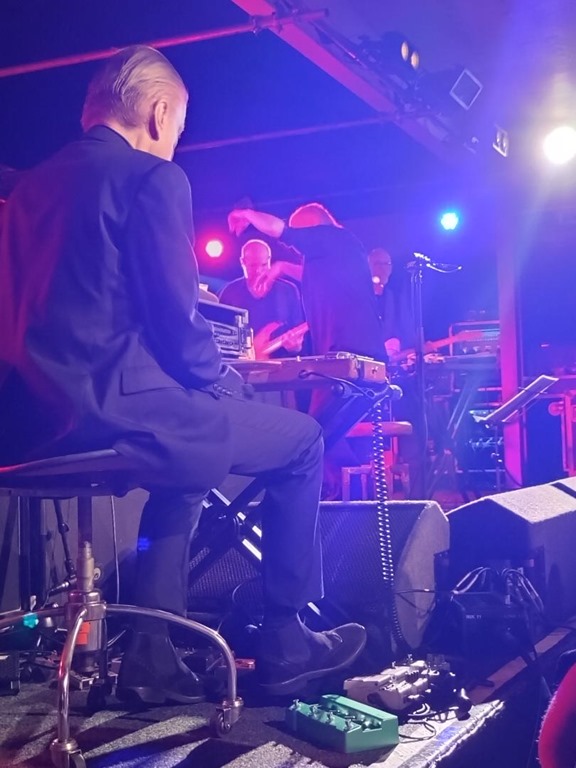
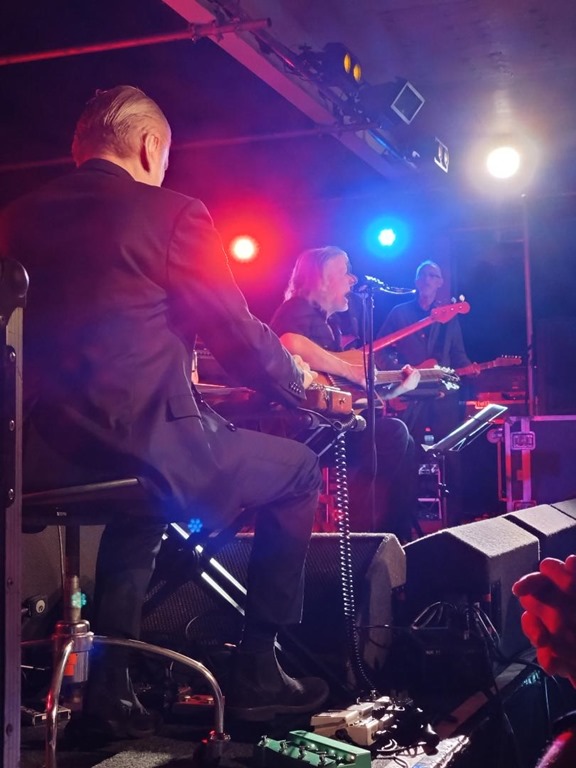
Some time in, Gira downs his guitar and stands up, turning to face the band, and flails his arms as if experiencing some kind of rapture or episode. But every gesture is a signal, from which the band members – there are six of them, plus Gira – and his near-psychotic choreography guides them through ebbs and flows, to ever greater, more intense crescendos. It’s maybe half an hour before the full drum kit kicks in, and I feel my nostrils vibrate with the sheer quantity of air displaced from the speakers. It’s transcendental, euphoric.
S2S3

A number of people who had started the set near me in the front row dissolved. I didn’t really notice when: like almost everyone else, I was simply transfixed. And yet, this was by no means loud by Swans standards: while I can’t claim to have witnessed the nauseating brutality of their early years, or the notorious punishment of the Burning World tour (ironic that their gentlest album, released on a major label, should have been served by a tour of such infamous volume… or perhaps not, perhaps it was a statement to prove that they hadn’t sold out), their shows at Leeds Stylus in 2016 and 2017 were something else – something so intensely physical, it hard to find the words. Then again, on their last visit to Leeds, playing at The Belgrave, I found myself thinking ‘this isn’t so loud’ but before long finding myself dizzy and wondering quitter where that immense noise had grown from. And this is perhaps an indication of how they’ve evolved. The bludgeoning force is still very much present, not least of all with two basses and the return of Norman Westberg to the lineup – surely one of the world’s most patient and understated guitarists, content to stand, not playing for ten to fifteen minutes, before battering away at one or two chords and thirty BPM for the next fifteen minutes, creating noise and texture rather than doing the conventional ‘guitarist’ thing – but now it’s more subtle, growing building, slowly, so slowly. A tweak here and there, another player adds a later, and while you’ve been watching the dynamics of the two bassist and Gira’s windmilling, the volume has increased threefold and your ribcage is rattling and your brain is slowly scrambling. Kristof Hahn does things with lap-steel that is beyond comprehension, cranking out squalling, screaming walls of noise – but there isn’t a weak element in the lineup. They each bring something unique, and the collective output is something else.

If this is the end of Swans doing big band, big noise stuff, then they have certainly delivered a finale of spectacular proportions. And whatever comes next, we look forward with bated breath.

Erototox Decodings

Christopher Nosnibor

Internationally, Kristof Hahn is best known as a member of Swans since their return in 2010, contributing electric guitar to My Father Will Guide Me up a Rope to the Sky and everything since (he was briefly a Swan in the late 80s and early 90s, becoming a touring member for The Burning World and appearing on White Light from the Mouth of Infinity and subsequently joining Gira’s Angels of Light. A lot has happened since then: My Father Will Guide Me was only forty-four minutes in total, whereas now they’ve evolved to have single tracks of that duration, and Hahn’s contribution on recent albums and tours has been lap steel. Witnessing his action on the last tour, while standing so close to him I could actually see the mud spattered around the ankles of his jeans, the significance of his contribution to the immense walls of noise the band create is clearly apparent. I’ve also been vaguely amuse by just how neat and dapper his presentation is, producing a comb to slick his hair back following particularly strenuous crescendos – although I also witnessed him taking said comb to the strings of his instrument in Leeds to yield some particularly unholy noise from an instrument more commonly associated with laid-back twangin’ country tunes.

What’s perhaps less widely known is that Kristof has enjoyed a lengthy career in music before joining Swans, as both a solo artist and a member of rockabilly garage acts The Legendary Golden Vampires, founded in 1981, and The Nirvana Devils (circa 1984). It’s with the former he’s back flexing his creative muscles despite an intense touring schedule with Swans.

Here, the Berlin-based core duo of filmmaker Olaf Kraemer (vox) and Kristof Hahn (guitars, organ, harmonica), reunited for the first time in many years, are joined by Thomas Wydler (drums), Achim Färber (also drums), and Chandra Shukla (sitar), to cook up a collection of ten songs.

The style is understated, country-leaning, occasionally folksy, with an underlying melancholy hue, with ‘Wohin Du Gehst’ crossing the language barrier to convey a low-level ache of sadness in its tone. Kraemer’s vocals are husky, almost croony, with hints of Mark Lanegan, and suit the low-key compositions well, conveying emotion and world-wearinness and a certain sense of sagacity, which is nowhere more apparent than on ‘White Horse Blues’.

If the reverby guitars of their Husker Dü’s ‘She Floated Away’ channels Chris Isaak, the song’s incongruously jaunty twist is in the vein of fellow German duo St Michael Front, while ‘The Rain’ is sparse and hypnotic and wouldn’t sound out of place on True Detective. The melancholy Leonard Cohen-esque ‘Sad Song’ speaks for itself, quite literally, self-referentially returning to the hook ‘this is such a sad song / and I sing it just for you’.

Discussing the songwriting ‘craft’ on an album feels pretentious and a bit wanky, but making songs this sparse – but also this layered – is a true example of crafting. Having mentioned Leonard Cohen previously, one thing that’s often overlooked is just how many incidental details there are on many of Cohen’s songs: The Songs of Leonard Cohen in particular is , on the face of it, acoustic guitar and voice, but there’s much more happening in the background, coming in and out of the mix, and this is something that comes through in attentive listening to Polaris. It’s subtle, keeping the overall sound quite minimal, but the attention to detail is what really makes it special.

AA

a3829215066_10

Young God / Mute 25th October 2019

Christopher Nosnibor

On receipt of the new Swans album, I posted on Facebook that I was ‘too excited to download it.’ This wasn’t sarcasm or bathos. The arrival of a new Swans album is always an event of no small magnitude, and with a certain sense of duty to deliver a review of a band I’ve revered my entire adult life comes a certain weight of responsibility to do justice. Swans have always been more than merely a band, standing as a sonic entity with almost infinite capacity to overwhelm. And they haven’t lost that.

Their last three studio albums, The Seer (2012), To Be Kind (2014) and The Glowing Man (2016) redefined epic and over their course took extended improvisational forms to a logical conclusion, each with a duration in the region of two hours.

Given the tone of Michael Gira’s statement about the end of the iteration of the band who produced these albums, Leaving Meaning brings two substantial surprises, the first being that many of the personnel from the previous incarnation remain present, and the second being the speed of its arrival. Kristof Hahn remains in the latest lineup, which also features eternal mainstay Norman Westberg – arguably as integral to the band as Gira himself – albeit only on some tracks, and Thor Harris, Phil Puleo, and Christopher Pravdica. They’re joined by an immense cast of contributors including The Necks, Baby Dee, Anna and Maria von Hausswolff, and Larry Mullins.

Leaving Meaning sees Gira take a slightly different and more openly collaborative approach to the realisation of his ideas, and it’s a more concise record in comparison to its predecessors. It’s all relative, of course, but in context, ninety-three minutes is concise.

Because of its sheer enormity, Leaving Meaning isn’t an album it’s entirely appropriate to dissect, and it’s constructed in such a way that it is very much best experienced as an album rather than dipped into. That means its effect is optimal when experienced in a single session, but that also means – as was the case to an even greater extent with its predecessors – that it requires a significant commitment of time in a time-pressured world. But then, Swans’ music has the capacity to lift the listener out of time and into another zone altogether.

The longer tracks are considerably shorter than even most off the shorter tracks on the last three albums, with the twelve-minute ‘The Nub’ being the album’s longest track.

Intro segment ‘Hums’ is appropriately-titled, consisting of just two minutes of cascading, hovering drones interwoven for create a soft ambience. ‘The Hanging Man’ revisits the nagging, dizzying cyclical bass motifs of numerous extended workouts from the last trilogy, and grinds it out for ten minutes. Anyone who’s familiar with the band’s extensive back-catalogue will be aware that this style of composition harks back to the band’s dawning and has remained a trademark of theirs, as well as Gira’s solo work. Paired with Gira’s vocal delivery, which switches from a monotone drone to a maniacal holler of elongated vowels and jabbering ululations and monosyllabic barks and yelps, it’s vintage Swans that threatens a climax around the mid-point but saves the real intensity for the finish. It’s less about volume than plain, bludgeoning repetition.

‘Amnesia’ is not the same ‘Amnesia’ as on 1992’s Love of Life. Perhaps Gira’s forgotten about it. It is, however, a brooding acoustic-led folk song. At heart. One of the things that constitutes a significant point of departure on Leaving Meaning is the return to sparser structures: gone are the immense sustained crescendos and pulverising explosions of discordant noise. There’s an altogether more mellow feel about Leaving Meaning. That said, there are orchestral and choral surges which punctuate both here and elsewhere.

A

‘Sunfucker’ is another classic Swans composition built around endless repetition, and with its backing vocal chants serves as an apocalyptic counterpart to ‘I Am the Sun’ from The Great Annihilator. Tapering off to drones in the mid-section, it suddenly explodes into a stomping glam bash. It’s bewildering, unexpected, everything all at once and probably the most daring and adventurous thing Swans have recorded in their entire career.

‘The Nub’ is gloomily funeral. Ethereal, haunting, but ultimately bleak in mood; ‘Some New Things’ is mantric, looping, hypnotic, while ‘My Phantom Limb’, one of the album’s standouts, has stronger echoes of Greed-era’s tortured pounding. It sits at odds with the rest of the album, but then so much of the album sits at odds with itself it feels right in a perverse way.

So what do we take from this? More or less what we’ve take from Swans over the last thirty years: with their ever-shifting parameters but constant core focus and the creative vision of Michael Gira always the driving force, Swans never cease to evolve, but never cease to be Swans, and are immediately identifiable as Swans, however far out they go.

swans-leaving-meaning

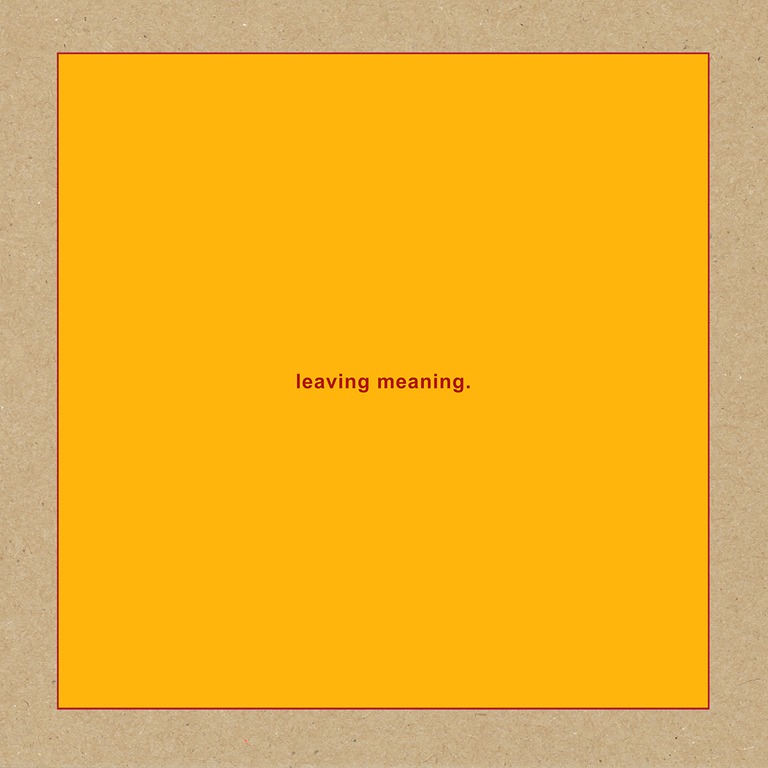
Leaving Meaning is the fifteenth studio album for SWANS, the follow up to 2016’s The Glowing Man, and is due for release by Mute / Young God Records (N America) on 25th October 2019. Leaving Meaning will be released on double vinyl in a brown chipboard sleeve, double CD in a brown chipboard digipack and digitally.

Written and produced by Michael Gira, the album features contributions from recent and former Swans, members of Angels of Light as well as Guest Artists Anna and Maria von Hausswolff, Ben Frost, The Necks, Baby Dee, and a Hawk and a Hacksaw,

Michael Gira explains, “Leaving Meaning is the first Swans album to be released since I dissolved the lineup of musicians that constituted Swans from 2010 – 2017. Swans is now comprised of a revolving cast of musicians, selected for both their musical and personal character, chosen according to what I intuit best suits the atmosphere in which I’d like to see the songs I’ve written presented. In collaboration with me, the musicians, through their personality, skill and taste, contribute greatly to the arrangement of the material. They’re all people whose work I admire and whose company I personally enjoy”.

Listen to the first track from the album, ‘It’s Coming It’s Real’ here:

In autumn, Michael Gira will be touring select cities on a solo tour with Norman Westberg. Swans will tour in the spring of 2020.

11 Oct – Skanu Mezs Festival – Riga, Latvia

13 Oct – Saint Petersburg, Russia

15 Oct – Moskva, Russia

18 Oct – Athina, Greece

19 Oct – Thessaloniki, Greece

23 Oct – Ljubljana, Slovenia

25 Oct – Bucharest, Romania

26 Oct – Cluj-napoca, Romania

28 Oct – Warsaw, Poland

29 Oct – Warsaw, Poland

31 Oct – Kyiv, Ukraine

1 Nov – Vilnius, Lithuania

2 Nov – Helsinki, Finland