Posts Tagged ‘horns’

Dimple Discs – 22nd August 2025

Christopher Nosnibor

Weird shit is welcome here at Aural Aggravation. It was a part of the ethos of my starting this site back in 2015. Yes, it’s been that long since I decided that I wanted to strike out alone with a view to creating a platform devoted essentially to stuff that appealed to me and exploring them with more long-form, discursive essay-type writing. This of course completely went against the grain of where most media, in particular music media, is at now, and this has only become more pronounced over the last decade, in which time attention spans have largely been reduced to circa 120 characters or simply .GIFs and memes. But – presumably because my focus is on rather niche music which doesn’t always receive a wealth of coverage, rather than because of my propensity for divergence into the personal or the political – Aural Aggravation now attracts a respectable readership. I don’t feel any desire to celebrate 10 years of doing this: to do so would really be to celebrate a decade in a lifetime of stubbornness, a compulsion to write, and a musical obsession which I choose to inflict upon the world, but I do suppose, on reflection, that the rarity of the format, occasionally touching on theory, but – hopefully –without too much hypotactic wankery.

And so we arrive at XiX by Kev Hopper, who despite fourteen solo albums, and despite co-founding electronic act Ticklish in the late ‘90s, and was composer/bassist with Prescott in the 2010s, and working as a visual artist by the medium of painting for a good number of years, is still probably best known for being the bassist in Stump between 1983 and 1988. Despite only releasing one album proper, their output of singles and EPs was solid, they were all over the music press at the time, and they were championed by John Peel. This potted history throws into sharp relief just how times – and the face of the music industry, particularly outside the mainstream – have changed.

Hopper’s second album on Dimple Discs is a collection of quirky, whimsical electronic experiments. Skittery, light, and lively, there’s a playfulness which defines the pieces, even when sliding into low-end notes and minor chords. ‘Vector Prodder’ plunks and plonks, twangs and reverberates, and slides into spooky but fun territory, and in some respects it’s got 1960s Addams Family vibes. ‘Gruntian Forbes’ twists and spins strangeness into a sunny calypso groove, and this, in many ways, encapsulates Hoppers’ approach to composition on the twelve tracks on offer here – namely taking a comfortable form, and rendering it uncomfortable by warping, twisting, and distorting it in some way or another, tossing in some ethereal haze and a bucketload of l’aissez-faire oddball elements. And why not?

XiX fully embraces the spirit of experimentalism – the idea of simply trying things out and seeing what happens, and not even being hugely concerned if it’s only half-successful. That isn’t to say there are any semi-successes or borderline failures on XiX: what I’m driving at is the spirit of creative freedom which pervades. When cut free of the constraints of commercial concerns, when liberated from self-censorship, and simply creating for the sake of creating, for the joy that experimentation and making sound can bring, a work takes on a level of buoyancy. XiX is the sound of creative freedom. ‘Devils’ may be dolorous, with hints of Tom Waits, but ‘Lance The Prawn’ is an exercise in gurling synth and ridiculously OTT vocal processing (half-burying absurd couplets like ‘lance the prawn / on the lawn’) amidst bleeps and wiffles and space-age throbs and pulsations.

It’s sci-fi in its influences, but it’s Douglas Adams on the serious scale. While I’m no fan of Adams myself – I find the humour simply too cheesy, but worse than that, I find the fans of his works, who insist on referencing him relentlessly beyond irritating, I would like to think that this scaling works in context. The album’s material is not irritating or nerdy, but it is, at times, overtly strange, and nowhere more so than on ‘Brand Street Psychodrama’. It may be but a brief interlude, but it’s all the disorientation. ‘Window Seat’ brings all the chimes and gentle brass, evoking that mythological bygone age crossed with intimations of ‘made in China’, in the brittle 80s plastic sense.

Having just written about Eamon the Destroyer’s new release, it seems that this belongs in the same field, but represents an altogether different face of the experimental dice.

And this is a good thing, in that we are able to wander through very different corridors while stroking our chins and pondering the work emerging from the field of ‘experimental music’. Towards the end, there’s an urgency that builds to XiX. Or perhaps it’s just my anxiety rising as midnight draws closer.

Either way, this is a supple work, which ventures across a range of styles and forms, with the chiming, tinkling nine-minute closer, ‘The Cucurella Problem’, with its whimsical , warping lead lines and tentative, wandering bass being truly exemplary. It bends the brain, but slowly, gently, softly, and it’s kinda nice.

AA

a0361012740_10

Room40 – 22nd August 2025

Christopher Nosnibor

Sometimes, I will encounter a release, and while knowing that I need to cover it, I find myself paralysed by the discovery that I am completely out of my depth. This is never more common when presented with works which represent cultures from beyond my – embarrassingly small – sphere of knowledge. And embarrassing is the word. Doubtless some would steam in and opinion with an overflowing confidence which presents itself in perfect disproportion to their knowledge, but bluffers inevitably come unstuck sooner or later, and are shown up as the arrogant cocks they are. I’ve always been of the opinion it’s better to be open about those gaps in knowledge, accept that no-one can know everything, and take the opportunities which present themselves to gain some education.

During my first or second year as an undergraduate studying for a degree in English, one tutor commented that I had squandered almost half of the first page on ‘rhetorical throat clearing’ – a magnificent and amusing turn of phrase, which summarises something I’m still guilty of some thirty years later.

Anyway: the point is, when presented with Ŋurru Wäŋa, the new album by Hand To Earth, I find myself swimming – or somewhat sinking – at first. The accompanying notes set out how ‘A search for a sense of belonging is at the heart of what drives Hand to Earth, a group of five people, who come together from different backgrounds, different birthplaces, and different musical approaches to share their songs, and by doing that to create something new.’

Peter Knight (trumpet, electronics, synthesisers, bass guitar) goes on to explain that ‘Ŋurru Wäŋa traces notions of home, belonging, and displacement. In the two parts of the title track, Sunny Kim intones the words of Korean poet Yoon Dong Ju’s poem, Another Home, in counterpoint to Daniel Wilfred’s song, sung in the Wáglilak language. Ŋurru Wäŋa (pronounced Wooroo Wanga), translates as ‘the scent of home’, and as we travel we long for that fragrance, passing the bee, guku, making the bush honey while the crow circles calling overhead.’

The notes add that ‘The music Hand To Earth creates collisions between the ancient and the contemporary; between the ambient and the visceral.’

And indeed it does. Listening to Ŋurru Wäŋa is a transportation, and transformative experience, not entirely similar from watching a documentary soundtracked by the sounds of the peoples being documented. From the very first minutes of the spacious whispers and slow, elongated notes of ‘buish honey (guku)’ the lister finds themselves in another place, another space, another mind. It feels, in ways which are hard to pinpoint, let alone articulate, spiritual, beyond the body, but at the same time closer to the earth – closer to the earth than I have ever been or even understand how to become. I realise I have been, and become so conditioned that such senses are beyond me, likely eternally, but on listening to the ringing sounds – not unlike the droning hum of a singing bowl – and breathy incantations of ‘Ŋurru Wäŋa Part I’ and revisited in the dark, sonorous rumbling of ‘Ŋurru Wäŋa Part II’ which brings the album to a close.

In between, swerving drones and impenetrable utterances evoke another time, another place, far removed, something mystical. It’s the sound of nature, of forests, of grass, of sky, as well as of soul, of heart, exultation, of but also the sound of humanity in a form so many of us have lost, and lost our capacity to connect to. This is the music of life, and it swells and surges, it’s the sound of being alive, and celebrating its magnificence.

Under capitalism, we forget that we’re alive, we trudge along, under duress, hating every day. Making it through a day is the goal for the most part, our ambitions are tied to capital, to the drudge, to the eye on the promotion, but, mostly on the commute, the team meeting, to clocking in and out, to the wage, to the 9-5, the confines of the shift, the need to pay the rent… We are all so numb, so desensitised. We’re not even living, but merely existing. With Ŋurru Wäŋa, Hand To Earth sing of another life – and it’s another world, and one we should all aspire to.

AA

AA

a1662627484_10

1st November 2024

Christopher Nosnibor

Imagine having your album release scheduled many months in advance only to find the release date crashed by The Cure’s first album in sixteen years. Imagine you’re not only an act likely to appeal to Cure fans, but your act features a former long-serving member of The Cure. This is the true story of Vamberator, the duo consisting of Jem Tayle, formerly of Shelleyan Orphan, and Boris Williams, Cure drummer from 1984 to 1994, and sometime contributor also to Shelleyan Orphan.

The album’s title is telling and possesses a certain resonance. Much has already been written on the contradictory impact of social media, and the idea that while we’ve never been more connected, we’ve never felt more isolated. Scrolling through endless snaps of people’s holidays, parties, nights out is a hollowing experience, and one that’s anything but inclusive. Of course, you want to be pleased and happy for these people sharing their experiences as they live their best lives, as is the parlance, but inside, you’re being eaten away as you’re confronted with your own mundane, grey existence.

If anything, the pandemic heightened the agony for many: half the population was basking in being work-free, spending days baking bread and discovering new hobbies and bingeing on Netflix, while the other half was battling their way into work, or juggling work and home schooling, or simply trapped indoors on their own – or worse. Virtual drinks via webcam and group WhatsApps and streaming gigs were poor substitutes for the real thing.

And now we’re supposedly back to normal, but it feels as if something has been lost, and possibly lost forever. Our lives have become more distant, more disparate. In my own experience, it simply seems harder to co-ordinate meeting with people, and while some people seem to be so busy with their social lives it’s a wonder they can remember what the interiors of their own homes look like, their busyness leaves some off us at home, disconnected for weeks at a time. I am not alone in being alone: for many, the creeping sense if isolation and loneliness weighs heavier than ever before. This is truly The Age of Loneliness.

I’ve begin with the digression in order to contextualise the point at which I arrive at this album, having spent the last few days – like a lot of people – immersed in the melancholia of the new Cure album, having not seen proper daylight for the best part of a week and struggling against the urge to hibernate.

The single release ‘Sleep the Giant of Sleeps’, which came out in the summer, showcased an energetic embracing of myriad firms, and I myself described it as ‘a mega-hybrid of alt-rock, post-punk, and psyche.’ It set a level of expectation for the album and despite being born from a place of comparative darkness, the spark of experimentation and joy of creating illuminates the recesses of Age of Loneliness.

‘I Used to be Lou Reed’ kicks the album off in a flurry of strings and takes flight with a quite poppy flavour. It’s got horns and string and synths bursting all over, and there’s a slick funk groove which emerges after a minute or so… but despite being there, there, and everywhere, from James Bond to crooning 90s indie all in the space of five minutes, nothing feels forced or corny. Wish-era Cure meets Pulp might not sound like the ultimate pitch, but prepare to be pleasantly surprised.

Shades of negativity colour songs with titles like ‘I Need Contact’ and the title track, as well as ‘I Don’t Want to Cut the Grass’, a paean to lethargy which drifts and lilts like a Kraftwerk piece, but with the drollness of late Sparks. ‘Pilgrim’ brings tints of Beatles-esque twanging and some Eastern shades alongside elements of psychedelia. With loping rhythms and layered instrumentation, the title track slips into a groove worthy of late 80s Wax Trax releases then swerves unexpectedly. ‘I Need Contact’ is a sparse piano-led ballad, and its simplicity in itself is affecting. ‘Creature in My House’ begins haunting and ominous, before swinging into an electropop glam stomp which shouldn’t work, but does. This is true of much of Age of Loneliness.

Being predictable is not an accusation one could level at Vamberator: Age of Loneliness is ambitious, and bold. Sometimes it goes over the top, but it’s forgivable, because instead of playing it safe, as musicians of their experience often do, Tayle and Williams have tested their limits here, and they’ve emerged victorious.

AA

AA

a0433341087_10

Christopher Nosnibor

My openness to different genres has expanded substantially in the fifteen years since I began reviewing as a ‘proper’ thing fifteen years ago, although it’s perhaps only more recently that I’ve come to truly be accommodating of, and even appreciate, overtly jazz works. It’s been quite a journey. But I still very much have limits of what I can handle, meaning I can dig Cinema Cinema’s free jazz period and the warped rackets of The Necks and Sly and the Family Drone, and recently, I’ve dug the new album by Anna von Hausswolff, but not Trondheim Jazz Orchestra & The MaXx. But I haven’t witnessed this kind of stuff live, really.

Presented with a rare opportunity to get out for some beer and live music, and with travel options rather limited, I found Leeds and York offering slim pickings for tonight, and since I wasn’t on the market for third-generation ‘nu’ metal, I elected to make a trip to Hyde park Book Club, a venue I know and like, despite the long hike from (and back to) the train station, and haven’t visited since August 2020, when Talkboy played an acoustic set. Those inter-lockdown socially-distanced seated gigs where going to the bar was against the rules were strange and feel like another lifetime now.

It’s also been a long time since I spent any real time in Leeds, with recent trips being confined to car / train – gig – home: today, I got to spend an afternoon wandering between pubs, and sitting and reading and people watching over a few leisurely pints. Living in the rather conservative, white, middle-class and socially un-diverse York, I’d forgotten about Leeds, fashion… There are still hipsters, lot of hipsters… and beards, lot of beards… and also mullets… Above ankle drainpipes… Cropped vests… Flat caps… and moustaches: lots of moustaches.

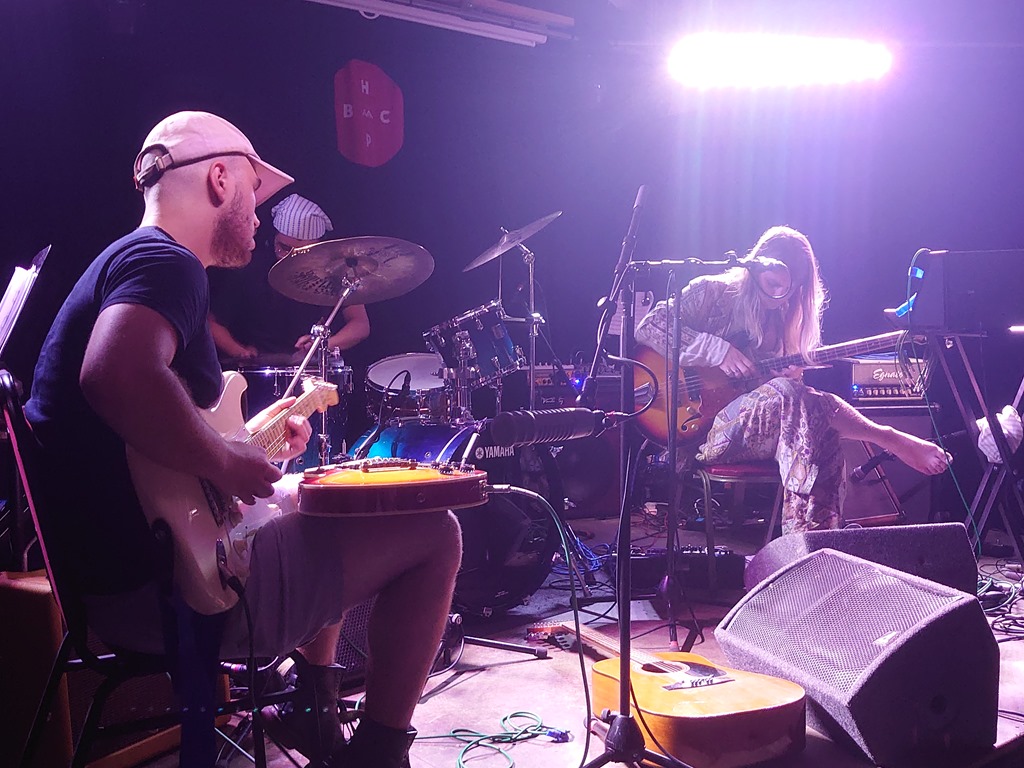
Leeds trio Slozbo Kollektiv are first up, and they serve up a set of the kind of clean, crisp, technical noodling that never really seems to get going or take form. or find a groove… Initially, I’m struck that the drumming is as tight as fuck and the way he handles his sticks is something worth watching. He uses an array of broken cymbals to create a whole host of far-out percussive effects, laying one atop the snare to create a different kind of clatter… But then how tight is the playing when there are no rhythms to speak of, only rattles and bursts of percussion? The set is defined by so much discord and busyness… I find my thoughts becoming as fractured as the compositions. There are, it would seem, extremely tight structures here, but they’re chaotic, esoteric, and non-linear…. Playing two guitars and a horn simultaneously… How many notes can they fit into a bar? Vocals seem fairly redundant, and I come to thinking that they sound like shit musicians pretending to be good ones by playing as many notes as fast as possible and not knowing when to stop. It made for the longest 40 minutes ever.

IMG_20230711_201549

Slozbo Kollektiv

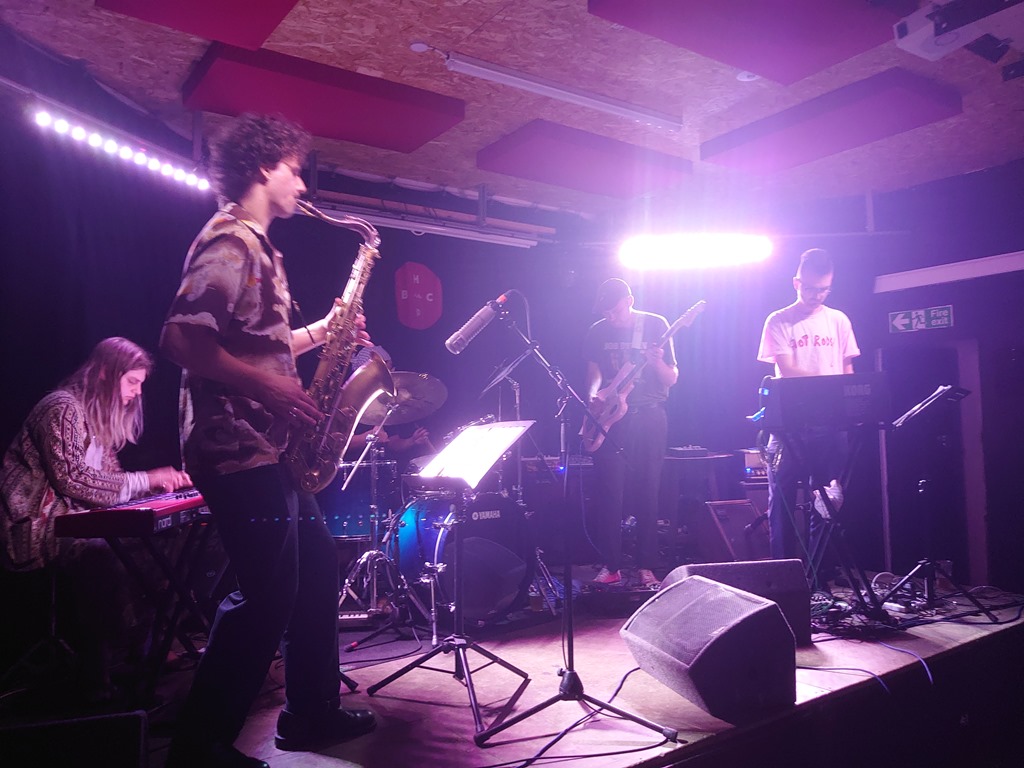
Fergus Quill’s ensemble features the same fascinating drummer, and the bassist from Slozbo Kollektiv is the keyboardist, and again he removes his sandals to play. Compared to Slozbo Kollektiv, this lineup brings more groove, more noise, and a bit of space rock, but still a lot of wanking with the added ‘bonus’ of some big ska overtones. No. Just no. And using your thigh as a mute for a sax? Also no. It does kinda work, but looks ridiculous. Fergus’ counting on of not only the tracks, but each section after a meandering detour gets tiresome and predictable, too.

IMG_20230711_210034

Fergus Quill

Selecting lineups for gigs is not easy: a little bit of range can make for great energy and an interesting night, but too diverse and it simply doesn’t work. A lineup of similar bands is sure to draw punters who will likely appreciate all the bands on the bill, but can lead to a surfeit of sameness, something which can happen in any genre, but was particularly prevalent during the post-rock explosion circa 2004. By the time you’ve stood through three instrumental post-rock acts with their extended passages of chiming guitar interspersed with crescendos, you’re weary of it all by the time the headliners take the stage.

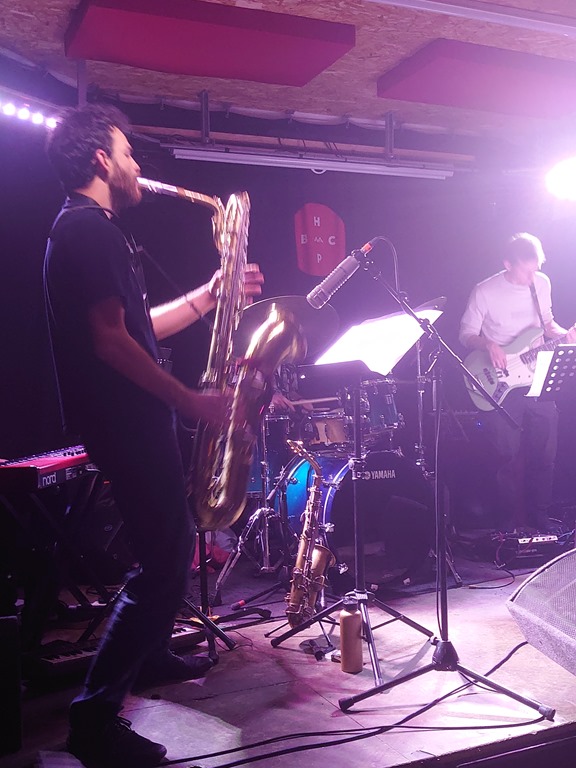
And so it is when Shatner’s Bassoon take the stage. I’m flagging, all jazzed out. Their material – and tonight they’re airing new material ahead of recording it for their forthcoming album – is more structured, atmospheric, building and forming shapes. There are some solid rhythms, moments where they actually settle into something for a time, instead of a constant explosion of sound in all directions all at once. They’ve clearly put the rehearsal time in, and there are all the tempo changes, enough to give you whiplash as they leap and lurch from one segment to another. People are really wigging out down the front, albeit mostly members of the support acts. It all starts to get a bit much after a time: they deal in discord, and the guitar sounds like twanging elastic bands. It’s when I see a guy nonchalantly bopping along from one space to another while clicking his fingers by way of applause I decide I’ve had enough.

IMG_20230711_220713

Shatner’s Bassoon

There’s no knocking their musical proficiency or adeptness in their field, but there’s noise and there’s noise, and it’s just how I’m wired that once thrills me and the other bewilders, and when you’ve got a bunch of people on stage all playing as hard and loud as they can but not, seemingly, all playing the same tune, I find it hard to dig. For all that, it was good to get out, and they definitely put on a show.

limitedNOISE – 10th July 2020

Christopher Nosnibor

Eleven whole years on from Third One Rises, World Sanguine Report crawl bloodied and bruised from a dark, dingy back alley to stagger into the light and toss down onto the rain-soaked, blood-spattered concrete their new album, Skeleton Blush. It’s a haggard, battered beast, a collection of songs that wheeze and puff pain from every pore. Whether it’s whisky-soaked introspection of staggering, brawling bleariness, it’s grainy, gritty, and often bleak, dredging emotions from the pits of the city’s sewers.

The various members have been keeping busy in the meantime, with various projects, notably with vocalist / guitarist Andrew Plummer having detoured for a few years with the grizzled no-wave racket of Snack Family. The various projects are clearly different, but at the same time their creative roots are abundantly clear.

Across the spread of the album, the band swing psychotically, schizophrenically, between dirty jazz-tinged blues that draws together The Doors and Tom Waits in a deliriously drunken swagger of swinging rhythms (you could never call it an elevated or euphoric mood – more an upswing in a maniacally volatile moodset) and boozy, brawling horns, and seedy, low-down lugubriosity.

The title track is as close as thing get to flamboyant, with a flamboyant jazz cacophony delivered with a Beefheartian mania and taste for dissonance, and ‘Drip Driven’ is similarly crazed in his riot of jolting, discordant horns that spirt every whichway over a low-slung stop-start funk groove, while ‘Aou’ trudges through dark, soup waters of brass-tinged gloom, sounding like Gallon Drunk on Ketamine.

Skeleton Blush brings derangement to a big band setting: it’s absolutely wild, and also low-down and seedy – and absolutely fucking ace.

AA

a1615459512_10