Posts Tagged ‘format’

1st May 2023

Christopher Nosnibor

Argonaut are a band who have certainly embraced the potentials of the Internet, making the most of the ability to take ownership of their release schedule and optimising the possibilities for their DIY aesthetic, not limited to home recordings released within a week via Bandcamp and no-fi videos posted to YouTube.

Nathan and Lorna kept things flowing through lockdown with their homespun ‘Videostore’ project, and now they’ve reconvened, the band are making the absolute most of the limitless options of streaming formats.

Historically, an album had to be no more than around forty-five minutes to fit on a 33rpm record: CDs expanded it to seventy-two minutes, which was probably the length of most double albums, only much cheaper. Tapes provided greater duration but less durability, especially over longer formats: the old C120s were dangerously fine, meaning double-play cassettes were things to be handled with care (as the three copies of The Cure’s Concert and Curiosity I lost proved, although however carefully you might handle a cassette, the heads on your tape deck just stropped and chewed stuff out of spite). More recently, CD capacity has expanded to eighty minutes. Every medium has its limitations: digital streaming has limits to quality and you never know if a track or site will remain, and streaming when your Internet connection drops every three minutes is a massive pain the fucking arse. And it perhaps goes without saying that downloading a track just doesn’t have the same buzz as owning something physical like a 7” or even a CD. That’s something that’s difficult to explain to anyone under thirty, who considers physical ‘stuff’ just so much clutter and the prospect of going to a shop an inconvenience. I get it, but I guess it’s hard to feel you’re missing out on something you’ve never experienced.

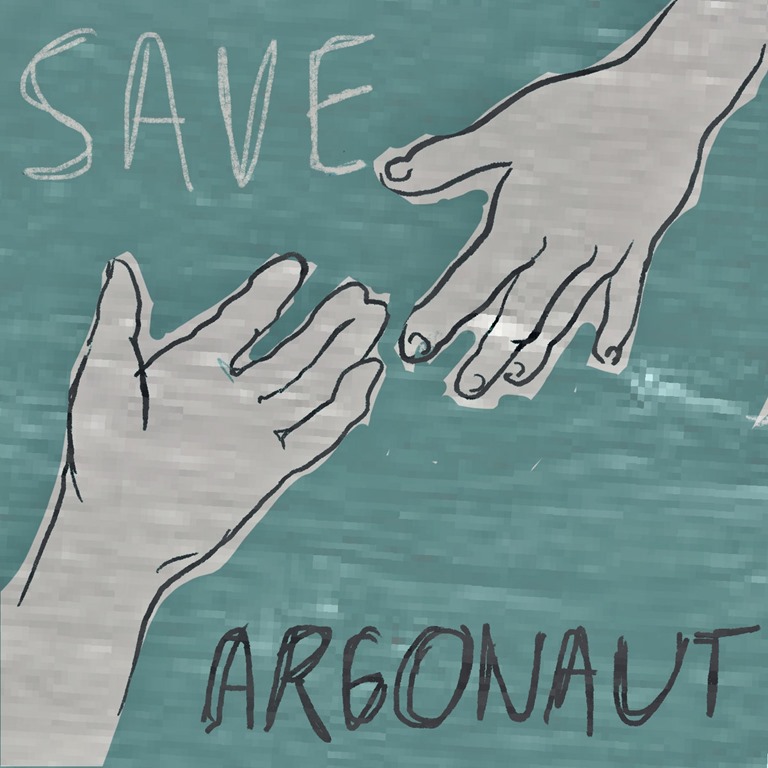
But what Argonaut have realised is that an album doesn’t have to be a completed article on release, and this is where their latest project is really interesting. Songs from the Black Hat is probably the first ‘open-ended’ album, whereby they just keep adding songs to it with a new song released on the first of each month. Whereas The Wedding Present’s ‘Hit Parade’ project also saw the release of a new single each month, it had a fixed end, on the premise of there being a 7” single released each month – the album, a compilation, was seemingly an afterthought and its parameters were always going to be finite. Songs from the Black Hat as it stands has no parameters, and ‘Save’ is the sixth song and something of a departure, not just in terms of the album, but for Argonaut more broadly.

They’ve built a career on punchy post-punk tunes which are often concise to the sub-three-minute mark. But as they write of ‘Save’, ‘Clocking in at six and a half minutes, ‘Save’ is Argonaut chanelling [sic] nineties indie anthem 12 inch remixes a la MBV and the Telescopes.’ And it is indeed a beast. As they also explain, ‘The lyrics were inspired by the Thai cave rescue and a genuine primary school comprehension test answer to the question ‘why didn’t Grace Darling save everyone at the same time?’

It’s a reverb-soaked behemoth where the echoing drums soon become overtaken by a chubby bass and a yawning synth drone, with multi-layered bubble-gum pop vocals, reminding us that ‘You can’t save everyone’. No doubt our government will be playing this at the airport in Sudan as they turn away citizens with work visas and the like but no physical passport. But facetiousness aside, this is a beautiful and sad song that also bursts with fuzz and reverb, and spins vintage and contemporary together with a rare deftness of craft.

Let’s see what they pull out of the hat next month…

AA
a0955958083_10

Christopher Nosnibor

Coldwell’s own notes which accompany this – truly epic – album explains and articulates it best, when he writes ‘This new retrospective is certainly not your typical album. Each track is almost an album in its own right! The material sees CC at his most experimental, stripped back, noisy and immersive. Following on from last year’s Music for Documentary Film, this collection gathers together some of Michael C Coldwell’s sound art work and music written for exhibition and gallery contexts.’

This is very much one of the benefits of the digital format: there is no restriction of duration on account of data capacity. Time was when physical formats restricted the running time of a release, with a vinyl LP optimally running for around forty-five minutes but having the capacity to squeeze in about an hour, with CDs being able to hold seventy-two minutes and while a cassette could – precariously – take two hours, no-one released a two-hour single cassette.

Conflux Coldwell’s collection of installation works is immense, and with a running time of around two-and-a-quarter hours, it’s in the realms of recent Swans albums. While it’s by no means a brag, I’ve endured longer, notably Frank Rothkamm’s twenty-four-disc, twenty-four-hour Werner Process, and am also aware of Throbbing Gristle’s legendary 24 Hours cassette box set, but the point is, Coldwell has really made the most of the space available to him here.

I sometimes differentiate albums as being foreground or background, and Music for Installation is very much background, the very definition of ambient. That isn’t to say it’s uninteresting or unengaging. It’s simply a vast set of field recordings and sound collages that make you feel as if you’re in a certain environment. Unlike the aforementioned Swans albums, which I find are difficult to listen to because they require a commitment of time to sit with them and focus, to actively listen, Music for Installation is a very different beast which works while rumbling on while you’re doing other things. And as an experience, this very much works.

The fifty-five minutes excerpt (!) of Remote Viewer is exemplary. Passing cars, scrapes, drones, the sound of metal on metal, clanking, indistinguishable muttered dialogue, and extraneous sounds that range from – possibly – the rush of wind to the sound of feet gently passing on creaking timbers, all sit side by side and overlap in various shapes to create a latticework of real-life founds the likes of which you probably would ignore if you even noticed them at all under normal circumstances. Of course, if this is an excerpt, where’s the rest? It’s the kind of immersive soundwork that could run for hours and that would be perfectly fine.

The live performance of ‘Dead Air’, which runs for an album-length headline performance is superb. It’s testing, but it’s also magnificently executed. The sounds and textures are balanced, but the overall sound is gloopy. The result is a piece that’s creepy, evocative, and dissonant, and built around wailing whistles and pulsating drones that coalesce intro their own organic rhythms, drawing together elements of Kraftwerk and Throbbing Gristle to conjure a dark, dingy soundscape.

‘Dismantle the Sun’, running for fourteen minutes feels concise in comparison. It’s barely there for the most part, the most ambient of field recordings. It’s hard to identify any of the individual sources, but again, there are rhythms that emerge from the rumble off passing cars and the whisper of the wind, and the piece transitions both sonically and spatially as it progresses, at times evolving from a whisper to a howl. One feels a sense of movement, which in turn creates a sense of disorientation, although the voiceover detailing ‘solar oscillations’ in the closing minutes provides a certain grounding.

The final brace of compositions, ‘Alternating Current’ and ‘The Specious Present (How Long is Now?), which have a combined time of around ten minutes feel like barely snippets or sketches in comparison to the other three immense pieces, but what they lack in duration, they compensate in depth, being richly textured and showcasing some interesting beats and conjuring some dark, confined spaces. And for all its vastness, Music for Installation is quite a dense, claustrophobic experience at times – and it’s a quite remarkable experience, too.

AA

cover