Telephone Records – 8th July 2016
Christopher Nosnibor
Wakefield-born and Glasgow-raised Martin Creed probably has a fair few detractors. The Turner Prize has a peculiar tendency to wind people up, art fans and critics and the general populace alike And so, while in art circles he’s known as a self-effacing, playfully provocative artist, to many, he is known as being the 2001 winner of the Turner Prize-Winner, who became infamous overnight for his installation piece, Work no. 227: the lights going on and off.
For many, such a work would be an unbearable albatross, but Creed is one of those people who’s always onto the next thing before the dust has settled around the thing before, and he’s a true polyartist, who has, seemingly, no fixed medium of choice, instead preferring to let his creative impulses flow through whatever medium he feels fits best. And throughout his career, the ever-idiosyncratic Creed has made music, with Thoughts Lined Up representing the latest in a long line of releases.
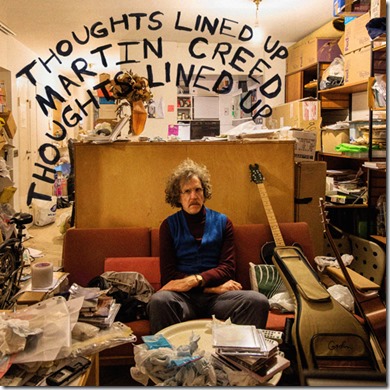
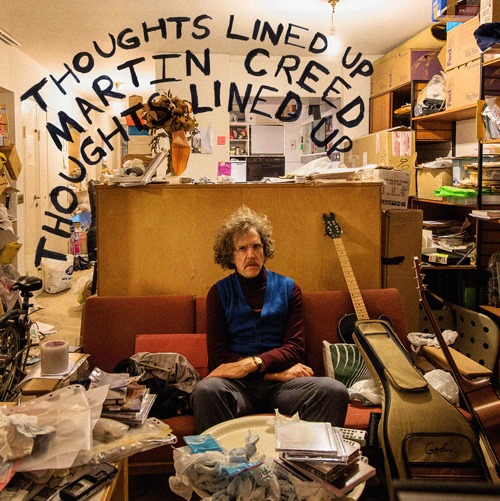
Judging by the cover image, and Creed’s spectacularly diffuse output, the title seems rather incredible. By which I mean, it’s hard to believe he could line up his thoughts in a queue for the checkout: this is a man who thrives on chaos, disorder, who eschews organisation and conformity in favour of free-flowing creativity, anarchy and all things random.
The title makes more sense in light of the artist’s own explanation of its meaning, which is refreshing in its simplicity: “It’s called Thoughts Lined Up because that is literally what it is,”, he says, “just all these bits – these thoughts – put in a row one after the other, trying not to worry about what they add up to. Most of it started as audio notes recorded on the Tube or in the street – just little everyday mantras that you say to yourself as you go along; things that come up in your head, and that help keep you going, or that sometimes you want to go away…”
And so, the end product is an album that in many respect is a one-stop compilation, a work which wouldn’t be much further from a concept album if it tried – unless that concept was a haphazard collection of songs thrown together and sequenced one to twenty-four out of conventional and commercial necessity. One kind of gets the impression that if all of the album’s songs could have been arranged to play simultaneously, then that’s how they would have been presented. The thoughts are lined up, in a sequence, but this isn’t a linear album or a collection of songs unified by anything beyond the mind from which they emerged.
According to the blurb, the album was Recorded at ArtSpace, Brixton, and mixed by Liam Watson at Toe Rag Studios, the album was recorded to 1-inch tape in one week just before Christmas 2015, and mixed with sonic impresario Liam Watson, in glorious mono, on the ex-Abbey Road EMI desk at Hackney’s legendary, analogue-only Toe Rag Studios. Yes, mixed in glorious mono. On the one hand, given the audio technology we have now, however much one may adore the inimitable sound of analogue, to master an album in mono is simply perverse. On the other, it’s another manifestation of Creed’s rejection of convention, and at the same time can be seen as an observation on the way listeners actually hear music nowadays: just as everyone seems to be obsessed with shooting optimal quality photos with digital SLR cameras only for them to be viewed on piddly mobile phone screens via Facebook, so the idea of superior audio recordings to be consumed through shit iPod phones, laptop and mobile phone speakers seems absurd. And Martin Creed revels in those absurd contradictions, and does so with grace and humour, and not with one eye firmly set on the mass markets.
And so, the songs are amusing, entertaining, whimsical, wonky. Some sound half-finished, many evoke the spirit of the Bonzo Dog Band, while others call on psychedelic folk traditions, and other still call to mind the choppy sound of the early Fall albums, and Creed is unafraid of cumbersome or cliché rhymes. It’s a haphazard, hit-and-miss affair, but it’s zany and it’s fun and Creed’s singularity and disregard for marketability is admirable.
https://player.vimeo.com/video/167247762
Martin Creed Online

 Aural Aggravation