Mamka Records – 15th November 2015
Christopher Nosnibor
It feels like a while since we heard from Maja Osojnik – and, I suppose it has: her debut solo album, Let Them Grow, comprising work composed and recorded between 2013 and 2015, was released in early 2016: we’re now near the end of 2024, and a lot has happened in the last eight years.
Life… and we’ll spare another retread of the pandemic ‘lost years’. Along the way, Maja has founded her own record label, created and exhibited visual artworks, and produced some collaborative audio works, notably DRUCK with Anthony Pateras.
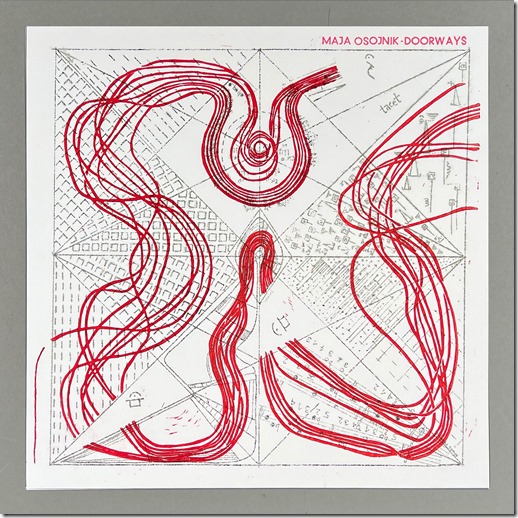
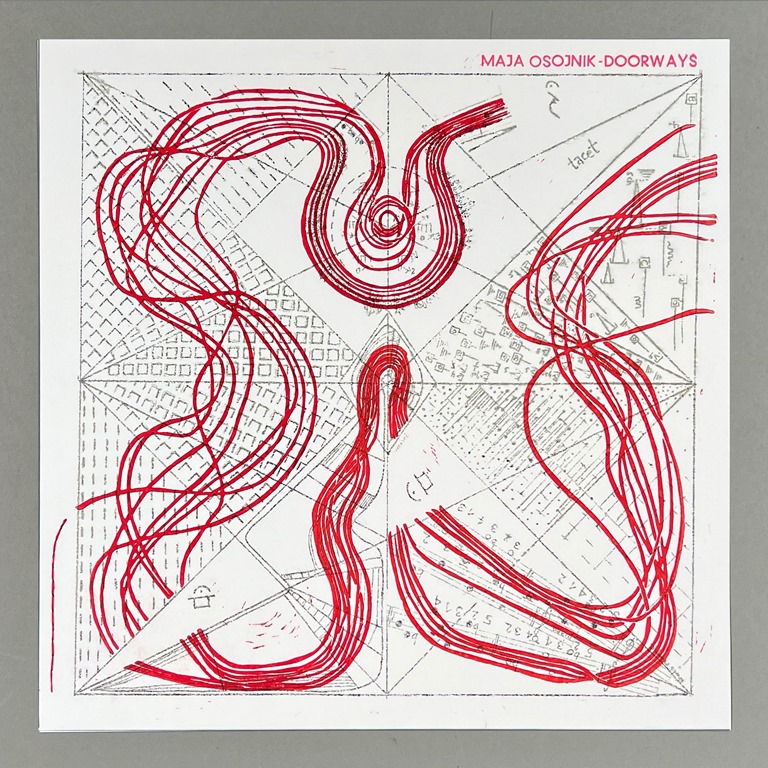
But the time between Let Them Grow and Doorways is significant in terms of the album’s inspiration and purpose. We learn that ‘Doorways was born from a longing to escape the city and everyday life – and the problematically fast pace thereof, a pace of production that accelerates the erosion of attention. In seeking to arrive in a quiet place, to linger there with an observational unprejudiced eros, to become completely aware of being alive. In line with Pauline Oliveros’ practice of deep listening, Maja Osojnik’s album explores the involuntary nature of hearing and the conscious nature of listening. It raises the question: How attentively do we perceive, recognise and internalise the ever-changing (aural) environment?’
It’s a question few likely ponder, although one that I have found myself contemplating in recent years. It began with the first lockdown. I used to travel to work – a twenty-five minute walk, followed by a further half-hour bus journey – with my earphones firmly wedged in my ears, desperate to ensure the noise of everything and everyone was blocked out by music, and I craved my own space. But then, suddenly, I felt the need on my daily hour’s walk, to hear nature – and it’s true, my paranoia peaked to a level that meant I felt the need to have my eyes and ears open and be aware of anyone in the vicinity, when people were much scarcer in the street. But this reconnecting with the sounds of birds, the wind in the trees became more than simply a lockdown hobby. And while, it seems, ‘The Great Pause’ – something only some got to experience or enjoy – gave way to ‘The Great Return’ and ‘The Great Acceleration’ Maja Osojnik has been motivated to seek peace and space, and instead of yielding to any pressures – real or perceived – to produce endlessly, she has chosen to explore time, and space, and allow herself to draw long, slow breaths, and to absorb the details of her surroundings. And it is this different focus which has informed Doorways.
While essentially consisting of two compositions – ‘Doorways #9’ and ‘Blende #1’ – each with a running time of over twenty minutes, and corresponding with a side of an LP, for digital release purposes, each piece has been segmented into five movements or fragmentary length. This may seem to run contra to the idea of reclaiming headspace from the current climate of the truncated attention span endemic in Westers society, but it does reflect the collaging approach to sound Osojnik has taken in assembling a broad range of field recordings, along with the input of woodwind and strings. As the accompanying notes point out, ‘It’s about active listening – what the artist Maja Osojnik calls cinema for the ears – an interactive game with one’s own self. The compositions invite the listener to hear them deeply; they function like a rotary dial, bringing extremely sensitive changes into focus. By constantly readjusting the focal point, they create new relationships between the electronically generated sounds, instruments and field recordings.’
And yes, it’s a timely and necessary reminder not only about the way we close ourselves off to the world, but how music is often something which simply floats around in the background while you’re doing other stuff, and how listening habits have changed: the majority now listen to an endless shuffle stream on Spotify. Simply typing that sentence plunges me into a state of despair.
In its collaging approach to composition, Doorways has, in a sense, inbuilt the shuffle into its structure – but at the same time, it is best experienced as an album, as intended. Doorways is not a bunch of songs, penned as singles, lobbed together to make an ‘album’: Doorways is very much an album album. It’s also a very good one.
‘Doorways #9’ bring with haunting disquiet and glitches and trips, backward surges and traced of feedback. It’s meant to be skin-crawlingly uncomfortable, and it is, as insectoid scrapes and scuttles.
The first five minutes of ‘Doorways #9’, in its cave-dripping tension, builds anxiety, and it’s only when birdsong develops that there evolves a sense of levity. But the tone grows increasingly dark, and there are increasing obtrusive spikes in jarring organ, and a sense of menace hangs heavy in the atmosphere. ‘Doorways #9’ is in some respects a dark ambient work, in that it’s unsettling, uncomfortable and free of percussion, and as such drifts from one moody, uncomfortable segment to the next. Suddenly, unexpectedly, in the last three minutes, things plunge deeper into darkness, as there’s a churning noise and a sense of falling… down… things take on a nightmarish quality, and the experience is dizzying, gut-churning and it would work well as a piece off a horror soundtrack. Perhaps one day it will be incorporated in one.
‘Blende #1’ grinds, scrapes, and skitters through an array of tones and textures. And it goes on… and one, twisting, turning, droning, scraping, and churning. There’s some avant-jazz in the distance. It’s pleasant, but mournful.
This is not an easy, or immediate, album. We all need time, and to take and make time. Along way, Osojnik leaves us haunted an incurring . It’s a spacious, and low—key but cheering experience.
Maja Osojnik has created an album that’s dark, and difficult, but which creates space for slow contemplation and reflection and it’s no vague criticism to report that Doorways is ‘nice’. It’s much more besides: intriguing, it draws you in, and pulls you in different direction. It’s an album, alright.
AA
 Aural Aggravation