Posts Tagged ‘distortion’

Klonosphere Records / Season of Mist – 13th September 2024

Christopher Nosnibor

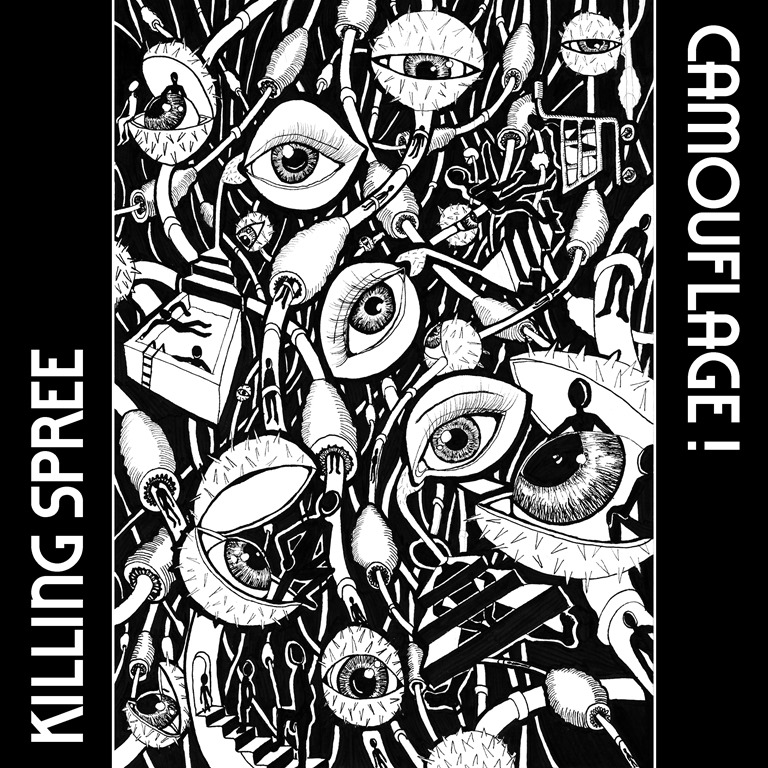
We’re promised ‘an unprecedented auditory experience’ and warn us to ‘Prepare to be engulfed in a sonic journey where brutal rhythms meet wild improvisations, pushing the boundaries of what metal and jazz can achieve together.’ As much as I think ‘unprecedented is a much overused word – and often as spuriously as ‘exponential’, when presented with a work which combines metal and jazz, I have to admit that there’s fairly limited precedent in what is, unquestionably, a very small field. There’s GOD, perhaps, but they were of a more industrial persuasion, in a meat grinder with heavy avant-jazz, whereas Killing Spree are dirty, dark, guttural growly metal. The pitch is that ‘Following the acclaimed release of their EP A Violent Legacy, featuring inventive covers of classics by Death and Meshuggah’, Camouflage ‘continues to showcase their unique blend of death-metal ferocity and electrifying, irreverent free jazz textures’.

Killing Spree is Matthieu Metzger (Klone, National Jazz Orchestra, Louis Sclavis, etc.) and Grégoire Galichet (Deathcode Society, Glaciation, Kwoon, Vent Debout), and it’s Metzger who brings the jazz. As we learn, his sax is heavily treated, ‘manipulated with an array of machines’ and in truth, it doesn’t sound like a saxophone for the most part. In fact, while at times it sounds like an angry three-foot hornet having a fit, it generally sounds like nothing else on earth, at least not that I’ve heard. Consequently, it doesn’t even sound particularly ‘jazz’; it’s an aggressive drone, a buzz, a deep whine.

The title track is a wild ride of what sounds like a combination of technical metal and sludgy, doomy Sabbath-esque metal and blasts its way past the seven and a half minute mark. The drumming is colossal, positively megalithic.

At times, shit gets really weird, and no more weird than on the frenzied thrash of ‘Disposable’, where everything jolts and crashes against everything else: the riff is as relentless as it is chaotic, then from amidst the frenetic cacophony, bold brass bursts forth, and fuck me if it doesn’t border on ska-punk, and it would be quite the knees-up were it not for the fact that everything else in this manic maelstrom is gritty metal and heavy as hell. ‘The Psychopomp’ sounds like a stomping keyboard-led synthy glam stomper , and is perhaps the most overtly prog piece on here. Around the mid-point it hits a heavy groove, overlayed with some agitated-sounding but also absolutely epic brass. These guys certainly get thee way of layering: there is simply so much going on across the span of each song, let along the full expanse of Camouflage that it’s difficult to digest.

The delicate woodwind into on ‘Toute Cette Violence Qui Est En Moi’ gradually evolves into some brazenly meandering jazz, with rattling percussion and a sense of space – space to breathe, space in general. Moments later, ‘All These Bells and Whistles Part I’ piledrives in with a frenzy of horns and percussion and off-the scale discord and crazed incongruity – not to mention thunderous end-of-days power chords which slug their way, low slow, and heavy, to the end. It’s a long four and a half minutes, a crawling trudging grind worthy of early Swans, with the addition of dingy, devastating vocals.

The two-part ‘All These Bells and Whistles’, with a combined running time of almost twelve minutes is truly a monster, and this is a fair description of this genre-smashing effort. I expected to have some pithy summary, but my brain is fried. It’s dark, it’s gnarly, it’s jazzy, it’s heavy… it’s everything all at once.

AA
509094

Industrial band, LIVERNOIS recently unleashed their new EP, :ablation:. The term "ablation", the surgical removal of flesh, serves as a metaphor for closure in the context of the EP’s concept.

:ablation:. as an album, wrestles with the human reaction to trauma. More specifically, the EP addresses the responses that tend to be stigmatized and shunned by an increasingly repressed, and emotionally-paralyzed state.

The intent herein was to walk a fine line between violence and vulnerability. The sounds echo between precision and senselessly screaming into the void.

Check ‘Hekk Closet’ here:

AA

3c63b579-0665-de4d-9946-d980886f794b

Inverted Grim-Mill Recordings – 6th October 2023

Christopher Nosnibor

Yes Grasshopper’s ‘Ghost Dog Pagoda’ is the lead single from the forthcoming album of the same name.

Grasshopper? Yes, grasshopper. Not cricket. While on a recent day trip to Berwick Upon Tweed, my daughter was asking about the sounds of the crickets or grasshoppers, and I had to confess I was unaware of the difference, and had to look up the main visual difference is the length of their antennae, and the main biological difference is how they make that distinctive sound.

While I’m still unsure if we were hearing crickets or grasshoppers, it’s clear that despite being in the north-east, we weren’t hearing Yes Grasshopper, as their most informative biography clarifies: ‘Grasshoppers are among what is possibly the most ancient living group of chewing herbivorous insects, dating back to the early Triassic period around 250 million years ago. Those species that make easily heard noises usually do so by rubbing a row of pegs on the hind legs against the forewings, this is known as stridulation. Yes grasshopper formed in 2020 and make noises with a guitar and some drums. Emerging from England’s unforgiving northern coast, this dynamic duo present a wholly unique take on noise rock, with crushing riffs, white water rhythmic twists and barking intertwined vocals making way for heinously catchy hooks.’

As titles go, ‘Ghost Dog Pagoda’ it’s simultaneously visual and abstract. As songs go, it’s absolutely mighty.

The single starts out with a tight picked guitarline, which nags away, before the bass and drums crash in, hard and with the kind of density that feels like a body blow. There’s a moment of pullback to build the tension further before POW!! Fuck!

This isn’t the sound of innocuous insects: it’s the sound of ground-razing devastation. The distorted vocals are way low in the mix, only adding to the impression of monster volume – those smallish gigs where the backline and guitars are so fucking loud the in-house PA simply cannot compete and so the vocals are lost but somehow cut through and the thrill is just beyond words because the sheer sonic impact is beyond words… If you’ve ever experienced this, you will know, and this is the blistering force of ‘Ghost Dog Pagoda’. If you haven’t experienced it, then you need to get out and witness more small-venue live music.

Back to the single, it’s a mess of noise, a full-tilt, all-out sonic assault. The hooks really come in the respite, where the nagging guitar returns, because the rest… it’s a brain-shredding attack. The vocals aren’t only low in the mix, but they’re a frenzied howl blanketed in distortion, and the song’s structure is a long way from a neat verse/chorus alternation. Fuck, it’s impossible to follow, and I have no idea what’s going on from one second to the next. But herein lies its sheer brilliance: ‘Ghost Dog Pagoda’ isn’t pretty, and makes no concession to commercialism or accessibility – not a single one. It hits you, hard, with a wall of abrasive noise, and it’s a beast alright.

AA

YG

fals.ch – 9th June 2023

Christopher Nosnibor

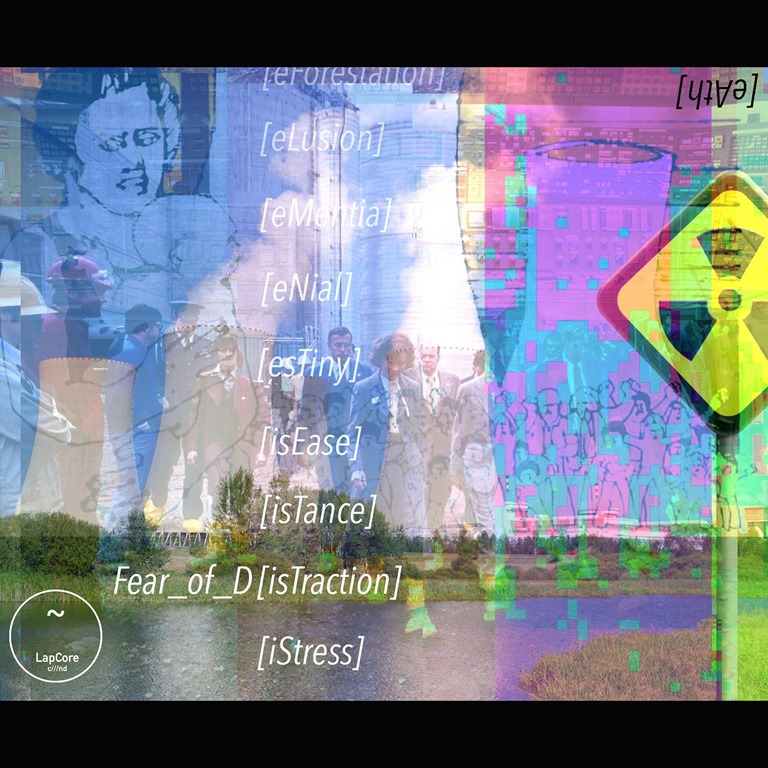
On clocking this in my inbox, I fleetingly felt a flicker of amusement as I recalled a long-lost article I had written over a decade ago about fictitious musical genres, which included LARPcore, where bands inspired by Viking Metal re-enacted historical battles in full costume. (I also mentioned Symphonic Doom before the term appeared as a thing). Then I realised that, as I’m prone to doing when I’m not concentrating, I’d misread, but then on reading the notes which accompany the new album by Kent Clelland, aka LapCore (which makes a lot more sense in context of what he does musically), my amusement was replaced by a certain crackle of excitement.

For this reason, it’s worth quoting: ‘With Fear_of_D[istraction] LapCore continues his exploration of digital audio synthesis and distortion techniques, researching the complex tonal digital structures he affectionately refers to as cTonality. In contrast to the more upbeat and aTonal album LapCore 132 (his 2017 full-length self-published release), Kent Clelland has freed himself to explore the darker, and more cerebral faces of computer music composition. With multi-channel oscillators he brings sonic entrainment into the musical range of frequencies as opposed to the typical sub-audible entrainment frequencies, composing melodic and harmonic parts with the artefacts to create cTonalities.’

But here’s where it gets interesting, and will likely prove divisive:‘Weaving polymetric binaural oscillators with a lopsided bass drum engine, he lulls your senses into a state of receptivity upon which he then sews synthesised tapestries inspired by his hyper-perceptual, cancer-treatment-infuenced dogma adventures in the pre-pandemic delirium. LapCore produces these tracks as an attempt to preserve his brain damaged audio hallucinations, sharing them in a venue larger than the space between his ears.

‘The performance of LapCore’s Fear_of_Di[straction] (2017-2022) is a 48 minute sonic quilt of recordings of AI Musical Agents during training sessions intricately hand-sewn into the fabricated projection of the audio dimension.’

Yes, Fear_of_D[istraction] incorporates elements of AI. ‘Nooo!’ people will likely shriek and no doubt some will be unhappy even with my writing about this album on this basis for propagating the death of the artist. But the death of the artist – if we take ‘the author’ in a broader context – has long been a preoccupation of literary theory and postmodernism, as far back as Roland Barthes’ 1967 essay of the same title. Yet now, as we find ourselves pondering what some are variously referring to as post-postmodernism or metamodernism, there is mass panic over the chimera we have created with speculation that not only artists but most occupations will be obsolete in a matter of years and we will soon be driven to extinction by our errant creation. I’m reminded of numerous sci-fi novels, not least of all Michael Chrichton’s Prey. Published twenty years ago, it feels more relevant now than ever, as is the way with much true science fiction, which takes current science and projects hypothetically forward, but also demonstrates that this fear is nothing new. And yes, of course, we – as a species – have pursued this end. Our demise through AI seems unlikely, but if it does happen, we probably deserve it.

While AI photos and even falsely-attributed Guardian articles are giving great cause for consternation – understandably – overall, it’s still the potential of AI which is scarier than the current capabilities, and this is nowhere more evident in music, where it’s fair to say that most purely AI generated compositions are toss. But also, in more experimental fields, composers have been using algorithms and customised programmes to generate sound since the advent of computers and synths – and I have covered countless of these in the last fifteen years.

LapCore incorporates AI as simply another tool in his kit, and has used this hybrid of man and machine to forge a work that melds Krautrock and minimal techno, microtonal experiments and harsh electronics to eye-opening effect.

The first of the album’s seven compositions, ‘Stuck Like a Magnet in Switzerland’ is built around grating oscillators and some extreme stereo panning, which is well-executed, and immediately grips both sides of your cranium and squeezes. The flow of blooping synthesised rhythms is rent with a buzzing distortion the like of which some of us will remember as the way a mobile phone signal would interfere with the TV – and at three times the volume of the busy bubbling track, it comes as an uncomfortable moment of shock. All kinds of feedback and interference disrupt the musical melange thereafter, dial-up tones and all kinds of electrical chaos collide and crackle unpleasantly. But being unpleasant doesn’t make it bad: this is one of those works that is relentlessly challenging in its pursuit of ‘difficult’ tones, textures, and frequencies, often simultaneously.

‘Microdose’ feels more like an overdose, as an angry hornet the size of a lion takes residence in the space at the front of your skull, right in the sinuses, and vibrates your brain without mercy against a backdrop of disjointed techno. This is some brutal synth torture, and elsewhere, there are drones and whistles reminiscent of early Whitehouse and Throbbing Gristle, atop dome very DAF-like electronica. ‘Americium’ is busy, a constant drip and froth of watery notes bouncing against one another – and it sounds experimental. And this is the key to appreciating Fear_of_D[istraction]: it’s not a work that tries to pretend to be a human creator hiding behind AI for a laugh, and nor is it the sound of AI running wild. Instead, it’s an album which sees its creator consider the challenge ‘how can we use this?’

If it sounds somehow ‘impersonal’, the same is true of much electronica; by the same token, Fear_of_D[istraction] very much sounds like a guy pressing buttons and twiddling knobs and looking to see just how much disruptive, disturbing synthy noise he can throw over a sequenced beat. The artist isn’t dead yet.

Birdfriend – 2nd September 2022

Christopher Nosnibor

Gintas K is at it again! Last year I was compelled to break my vow not to listen to, or write a word about any Christmas-themed releases on account of his album, Christmas Till the End, released on December 25th, and now, just when I’m getting into full foaming at the mouth mode over how there’s Christmas stuff everywhere since the week before Halloween, I discover he dropped an album bearing a title with overly festive connotations, which was, in fact, released at the start of September – and which was recorded in July!

Jingles With Bells was, like a number of other works, recorded live, using computer, midi keyboard, and controller.

Despite the album title being in English, and offering something of a play on words with jingles suggesting advertisements as well as festive chimes, the track titles are in K’s native Lithianian, and I’m not entirely sure I trust Google translate when it tells me that ‘irgi dugnai auksti ir aopacia garsai gerai visai’ is ‘the bottoms are also high and the background sounds are quite good’ – although it is a fair description of the six-and-a-half-minute opener. It begins with sparse drips and drops echoing as if in a giant cave, before Kraptavičius introduces his trademark flickering electrostatic glitches and whirs. The layers build as crunches and crackles clamour into a frenzy of fucked-up robotics.

Stammering, fractured beats collide and disperse in all directions, a wheezing, groaning, creaking array of electronic simulations and rapidfire thumps like hammers and nail guns, jazz percussion and despite the complete absence of any actual percussion, Jingles With Bells is marked by a complete absence of any actual beats, instead being driven by clattering short sounds that resemble beats and even trick the ear and mind with their (ar)rhythmic explosions. The last thirty seconds of the seven-minute ‘is to pacio tesinys geras’ (which may or may not translate as therefore the continuation is good’ is marked by silence, and it’s a welcome reprieve from the blindingly busy blitzkrieg blast.

‘istisinis is to pacio’ is a snarling drilling grind of bass, but also introduces the first jangling treble that might pass at a distance as a jingle, but it more resembles a dentist’s drill than sleigh, and the whole experience is less jingle and more nerve-jangling and uncomfortable.

Echoic droplets and sounds reminiscent of jangling jamjars trickle through the album, and the ten-minute monster that is ‘varpeliai noiz bugn bosas neblogai’ (‘bells noiz bugn boss not bad’ – yeah… nah) begins with what sounds like a bath being run down the plug and a crackling blast of blocks of distortion against – finally – chimes. But against a creaking croaking, cracking low end like the bow of a wooden ship breaking against rocks in a storm, those melodic tinkles soon build to forge an oppressive, head-compressing sonic torture; it’s simply all too much. But too much is never enough, and as such, it all adds up to another album that bears all of Gintas K’s quite unique hallmarks forged from some mangled laptop machinations, manipulated in real time.

AA

cover

Dret Skivor – 1st April 2022

Christopher Nosnibor

Another month, another Dret release, and this one, their fifteenth, is from Dormir, a sound artist who lives on the island of Bornholm, near the Stavehøl Vandfald. It’s no April fool.

‘Under isen’ translates as ‘Under the ice’, and consists of two side-long tracks: ‘under isen ligger noget, du ikke kan lide’ (‘under the ice is something you do not like’, apparently) and ‘min indblanding er din afhængighed’ (‘my interference is your addiction’, according to Google translate. It sounds a little clunky, and is perhaps left in its native form,

‘under isen ligger noget’ is a suitably dark, dense blast sound that arrives on an arctic gust, scouring and scourging the bleakness of a whiteout landscape with a roar that strips away the senses with an elongated scrape of treble and a low, resonant booming like a ship’s horn, the sound lost adrift in a blizzard of impenetrable static. It’s disorientating, bewildering. You do, truly, feel surrounded, encased in sound, and if anything has ever recreated the harrowing experience of the time I was caught in a blizzard on top of a mountain in the Lake District and unable to gain any sense of my location in order to navigate down, it’s this. It was one of the most terrifying and traumatic experiences of my life, so suffice it to say, listening to this is something of a challenge on a personal level. It never ends, and you fear there is absolutely no way out. The tone and pitch has barely any variation over the duration; just additional elements thrown into the blistering vortex. It’s not strictly Harsh Noise Wall, but it is a wall of harsh noise that leaves you feeling buffeted, pulverised, punished.

If you’re hoping for something more gentle on the flipside, ‘min indblanding er din afhængighed’ is likely to disappoint: it’s more noise, only this time louder and denser and dirtier, not so much the sound of a blizzard but a washing machine on a spin cycle as it slowly breaks down, as recorded using a microphone thrown into the drum. It grinds and churns, thrums and throbs and swirls, it clatters, clanks and gurgles and swashes along, everything overloaded and distorted. In contrast to side one, it’s a more overtly rhythmic piece that positively pulsates, a dark heart pulsing beneath the eye-wavering curtain of static that crackles and fizzes. But there’s nothing soothing about this rythmicality, and you sure as hell can’t dance to it: it’s like having a wire connected to a battery prod your temple twice a second for almost twenty minutes; it leaves you feeling absolutely fucking fried. But it’s worth it.

AA

a4134837373_10

SIGE Records – SIGE103 – 25th June 2021

Christopher Nosnibor

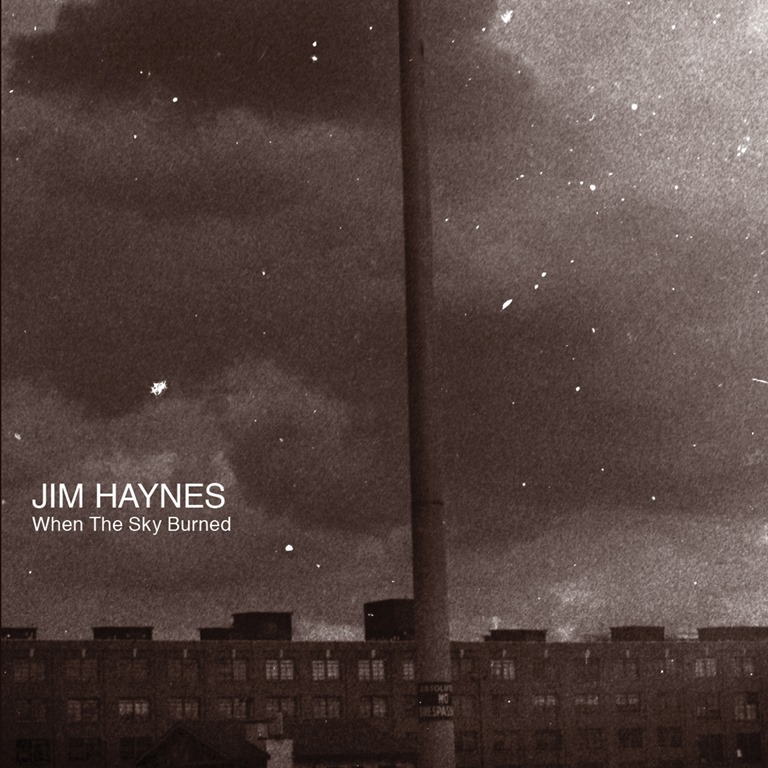
It was The Decline Effect, a full decade ago, which provided my introduction to the work of Jim Haynes. It was an album I described as ‘bleak’, commenting on the way it reminded me of ‘Robert Burton’s 17th Century text The Anatomy of Melancholy, which detailed in the richest language the terrible physical symptoms of melancholy and its effects on the humours of the body. It still stands as a fitting description of a work by an artist whose career is devoted to ‘compositions of corrosion, shortwave radio, and tactile noise’.

Haynes’ inspiration for this latest offering was environmental, circumstantial, situational, as he recounts: “I completed this record in the fall of 2020. Much of the western states of the US was ablaze for months. The anxiety of the collective American psyche was ubiquitous, also due to the Presidential elections in November of that year. And When The Sky Burned became an appropriate title given the environmental and political climate of that particular time.”

But what’s also fascinating is the more subtle use of reference, of intertext: Haynes explains that When The Sky Burned When The Sky Burned is ‘also a reference to Zbigniew Karkowski’ – before going on to explain his ‘complicated, if distant relationship’ and subsequent hostility from both Karkowski and Andrew McKenzie, aka The Hafler Trio, for what appear to be the most disproportionate of reasons.

Haynes dedicates the album to both McKenzie and Karkowski ‘whether they like it or not’, writing on the latter, ‘After his death, I most certainly felt a sorrow that the world has lost this artist, but I was also very conflicted as I wish there could have been a conversation about what happened. I don’t think he was capable of remorse or reconciliation, but I wonder if I was wrong in that analysis. So this album is a tenuous homage to Karkowki’s early works – with the chest, cavity rattling lows and the shrill sustained high frequencies. The title in fact is a direct translation of the opening piece to that aforementioned Silent CD – "Als der Himmel brannte." But of course, I can never leave anything so static alone, and the heaps of noise, junk, and dissonance were required."

Haynes is an absolute master when it comes to noise, junk, and dissonance, and When The Sky Burned is abrim with all three.

As album openings go, the first few seconds of ‘Multiple Gunshots’, are striking, shocking, even, as blasts of percussion – which slam like gunshots – hit the listener without warning. They arrive a succession of hard blasts – some warping backwards, and Haynes manipulates them to forge an erratic but devastatingly heavy beat. I’m reminded of how Swans sampled a nailgun and pitched it up and down for the punishing rhythm on ‘Time is Money (Bastard)’, and this builds a grind of rapidly oscillating drones that flicker and shudder. Seven minutes in, the drones rise to a shriek, before obliterative distortion decimates any semblance of musicality. Everything combines to forge an intense and oppressive eleven minutes where little happens other than the listener suffering a brutal sonic punishment.

Between this, and the ten-minute ‘Appropriate to a Sad, Frightened Time’, Haynes presents a series of compositions that really test the listener’s capacity for noise and overall endurance. ‘Abruptly Scattered’ sounds like an enormous generator’s throb, occasionally rent with blasts of explosive treble noise as if said generator is bursting into flames. The tonal separation is well-defined: the bass sends the most uncomfortable vibrations through the pit of your gut, while the shrill, harsh treble smash makes you clench your teeth and fear for your hearing. You swallow hard, feeling uncomfortable, wondering if you’re going to suffer tinnitus or diarrhoea first, and pray it’s not both simultaneously.

Haynes’ explorations are brutal and harsh, and the set as a whole is truly relentless. Heavy crunches and grinding, gut-churning growls are suddenly ruptured by unexpected thacks and cracks, detonations, and the kind of heavy impact that makes the car-door slams used for punches in films sound like friendly pats on the shoulder. Swirling vortices of noise on noise howl and shriek, violent sonic tornadoes that inflict devastating levels of damage tear from the speakers, and even the moments of calm are unsettling, uneasy.

When The Sky Burned is not a nice album, but it’s a remarkable one, one that quite literally crackles with intensity, and genuinely hurts in places. But while it is relentlessly abrasive and often excruciating, Haynes’ attention to tone and texture, and the way the utilises these elements to forge a work of immense range isn’t only admirable on the technical, sonic, and compositional levels, but also results in an album that has massive impact, and is an outstanding example of well-crafted and intuitive electronic noise.

AA

BSBT_j-cardfront_double