Posts Tagged ‘Cristian Vogel’

Mille Plateaux – 19th May 2023

Christopher Nosnibor

Fase Montuno is the twenty-seventh release by Cristian Vogel. Yes, the twenty-seventh. Depending on which version you get, this one has seven or eight tracks, all reliant on old synth and drum machine sounds, giving it very much a late 70s / early 80s vibe,

As the accompanying notes detail, ‘This highly personal release is a visionary take on the futuristic potential of Latin American electronica, and promises to be a thrilling journey through Vogel’s musical imagination, every track infused with his signature creativity and energy.

Vogel has lingered on the fringes of dance music for the entirety off his career, and Fase Montuno goes very much all out on accentuating the dance elements of the pieces. That doesn’t mean that Fase Montuno is a chart-dance album, not at all. But with its Larin American influences, it’s very much music you can dance to, if you’re that way inclined – and if you’re not, well, it has groove, and that’s something anyone can get into.

The title track is a busy, bleepy six-minute chiptune that builds layers and energy as it progresses. Things get glitchier and gloopier on ‘Temples in the Sky’ with some busy polyrhythms which flicker over pulsing beats and swathes of swashing synths. It’s sparse, but at the same time there is much happening, sometimes incidentally, sometimes simultaneously.

Always, the beats are dominant, even when pitched subtly. ‘Labyrinth and Warrior’ mines a specific seam of techno I find quite oppressive despite its spaciousness, whereby the repetitions are tightly looped and I find myself feeling as if I’m trapped in a nagging glitch of just a second or two and physically can’t move. Ironic, perhaps, that certain dance music should, instead of moving me, render me utterly paralysed and almost suffocating with claustrophobic panic. But there it is. For those reasons, I find this and uncomfortable experience, and difficult to enjoy.

And so it is that the nagging grooves of Fase Montuno lead nowhere other than inside, burrowing into themselves and clanking away hermetically: there is nothing beyond this is and of itself, and while many find release and escape in this form of music, for me, it’s like being zipped up in a bag where I’m unable to move my limbs and then thrown into a darkened room – worse than sensory deprivation, it’s like the drip-drip-drip of water torture.

I can’t blame Cristian Vogel for my extreme and quite irrational reaction to his music: it’s meticulously crafted, and the frequencies, the mix, are magnificent, and evidence – as if more evidence were needed – Vogel’s enduring appeal in his field.

AA

MP60_front

Mille Plateaux – MP40 – 11th March 2022

Christopher Nosnibor

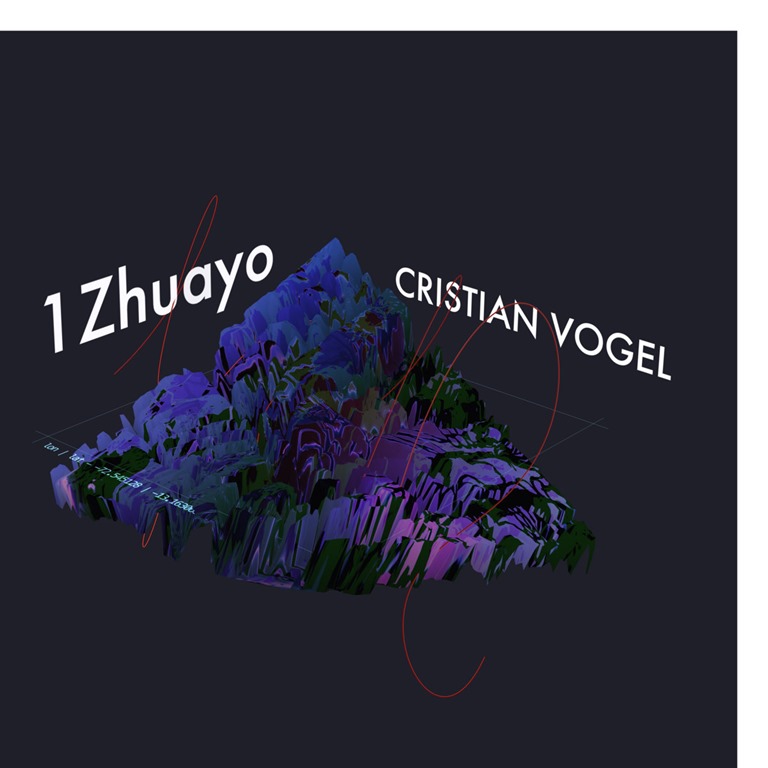
The last time I engaged with the work of Cristian Vogel was when his double-disc compilation, the archly-titled Classics in 2016. This retrospective covered his 90s output, and traced his evolution as an innovator in underground techno and electronica. His catalogue has doubled in size since then, and it’s apparent that Vogel isn’t only prolific, but an artist who doesn’t like to retread old ground, constantly questing and striving to develop and explore new directions. 1Zhuayo explores many new directions, all at once.

Penning notes to accompany the release of this album, Lain Iwakura and Achim Szepanski wrote that ‘The new Cristian Vogel album 1Zhuayo sounds as if non-musicology & ultra-blackness is not an end or a destination to be arrived at, but as if it is the point of departure, much like tomorrow relates to the day after tomorrow. As if we have left the space of certainties and are moving instead into one of manifold possibilities. They are anticipated in the micro-structures of sound, which is the process of playing with and against the software.’

But then I start to get lost when they continue to explain how Vogel ‘creates a rhythmight that is constructed from the anticausality of Rhythm as counter-counted, the tracing of the rhythmicity of Rhythm in the creation-in-Rhythm. Rhythm is foreclosed to hearing. Non-music radicalizes this notion by subtracting hearing from the framework of experimental music, which claims that everything is heard from Rhythm. The material of music is the continious flow itself. Cristian Vogels method for this way of creating sound is called Rhythmics.’

I feel as if I’m wandering through Deleuze and Guatarri’s A Thousand Plateaus while drunk and on drugs. Words lose meaning – as does sound. It’s bewildering, disorientating. 1Zhuayo is, on most levels, a dance album. But it’s not an easy one, and it’s pretty dark and dense in the main.

The album starts as a churning roar, scraping feedback and industrial machinery grinding away like a tumble drier full of broken bricks, before ‘Hyphadelity’ plunges into booming bass groove-orientated dance. But it’s not comfortable or commercial: the vocals are menacing, half-submerged as they are amidst the busy layerings and the surges of extraneous noise. ‘Astrocumbia’ sees things turn nasty: dance music you can’t dance to, a frenzy of distorted beats exploding all over amidst a gruelling churn or super-low, super-hectic bass that pounds at the pit of the stomach and crushes the cranium. ‘Emanations’ slows it down with an almost dubby vibe.

Things unfold differently on ‘S18’. Again, the dance tropes are prominent, but they’re fractured, pulled apart, before a tsunami of solid sound crashes through on ‘1Zhuayo Express’, which swells to immense proportions, like Godzilla rising from the deep, flexing its muscles as a wall of sound, gloopy bass and grating mid-range pulsating in a monstrous behemoth of power electronics.

The Strom Stadt remix of ‘Transferenz’ is a brutal exercise in monster hardfloor techno that makes The Prodigy’s later works sound like bouncy chart pop, while the Disintegration Mix of ‘Angle Phase Life’ is a brutal mesh of noise with mangled beats partially submerged by the successive detonations of low-end. It sounds like an erupting volcano and missiles launching in slow motion. And amidst it all, electronics pop and squelch like fireworks.

‘Cables’ isn’t a cover of the Big Black song: in fact, it’s quite the opposite being stark and minimal, stuttering glitchy, with a crunching bass drum thudding mercilessly throughout, before the last piece, ‘Serpent Acid’, a splattering blast of jamming percussion and nagging, repetitive, cyclical synth motifs.

Less is more, and this is largely minimal, but at the same time, builds up later from unexpected angles to create something different. It leaves you feeling somewhat dazed – in a good way.

AA

a1006963432_10

Sub Rosa – SR388

Christopher Nosnibor

As significant as the fact Cristian Vogel has worked with the likes of Radiohead, Maxïmo Park, Chicks on Speed, Thom Yorke, Jamie Lidell, Neil Landstrumm and Dave Tarrida is the fact that the CD and vinyl versions of this release have completely different track-listings, with only two tracks featured on both. That’ probably quite an expensive pain in the arse for hardcore fans, especially as the versions here are remastered, and the CD release features a previously unreleased version of ‘Around’.

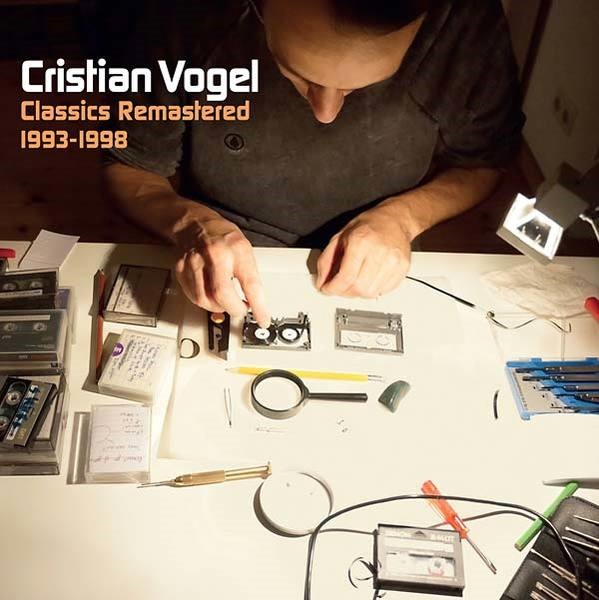
So, as the title suggests, this compilation picks the best cuts from Vogel’s 90s output, and presents them, remastered in 2015 by the artist himself (indeed, he’s been systematically remastering the majority of his early work, offering tweaked versions of his extensive back catalogue through BandCamp).

In terms of sequencing, the CD (the focus of this review) makes more sense than the vinyl. With the exception of the very last track, the material is sequenced chronologically, with Disc One spanning 1993 to 1995, with tracks culled from Beginning to Understand and Absolute Time, and Disc Two spanning 1996 to 1998, from All Music Has Come to And End and culminating in Busca Invisibles. It may be an obvious point, but it’s significant, in that it does mark a clear linear evolution of Vogel’s music.

Repetition lies at the heart of the compositions, with looping motifs running end-on-end with shifting layers of instrumentation on top, and with explorations of tonal shifts providing the focus and points of interest over progression or changes of key or tempo. ‘Machine’ combines techno robotix and Krautrock with drifting ambient currents, while ‘Beginning to Understand’ contrasts echo-heavy metallic, treble tones with thumping bass frequencies. Minimalist beats and stark bass grooves define many of the tracks, particularly on Disc One.

The tracks from Absolute Time showcase denser sound, the dominant beats making for a harder feel, more driving and propulsive. On tracks like ‘In’ and ‘Absolute’, it’s all about the frequencies; the bottom-end tones sit in the frequency range that really batters the eardrum, while the higher frequencies are cosseted in dense aural cushions while stomping 4/4 beats bump and grind hard.

The output from the years ‘96-‘98 are given less extensive coverage, with, for example, only two tracks apiece from Specific Momentific, Bodymapping, and Busca Invisibles featured (in contrast to the six cuts from Absolute Time and five tracks culled from All Music Has Come to an End . Nevertheless, it more than gives a flavour of Vogel’s output, and Disc Two begins with ‘Absence of Fear’ which marks a rather different approach from the earlier works. With a much looser, less claustrophobic sound, it’s built around contrast and juxtaposition, and with complex rhythm patterns criss-crossing one another to quite disorientating effect. In many respects the twelve tracks on this second disc are the more interesting, in that they show Vogel’s experimentalism pushing to the fore. While firmly positioned within the parameters of techno, these recordings document a desire to expand the territory of the genre, and it’s not difficult to hear in these nuanced pieces why Cristian Vogel is so respected, both within is field and far beyond.

Vogel


Cristian Vogel on Bandcamp

Cristian Vogel – Classics at Sub Rosa (with audio)