Posts Tagged ‘Crescendo’

Young God Records – 30th May 2025

Christopher Nosnibor

And so we arrive at the end of another era in the epic history of Swans. When they called it a day in 1996 with Soundtracks for the Blind, and a farewell tour documented on Swans are Dead, it really did seem as if that was it. Swans had run their course, and the colossal Soundtracks double CD summarised everything they had achieved over

It may seem strange that the bookend to this phase of their career should be titled Birthing. But such is the cycle of life, and indeed, the avant-garde: death gives way to new life, to build anew one must first destroy. And so in this context, Birthing, which Gira has announced will be the last release of this epic, maximalist phase, makes sense. With a running time of a hundred and fifteen minutes, it’s comparable in duration to its predecessor, The Beggar, and The Glowing Man (a hundred and twenty-one minutes and a hundred and eighteen minutes respectively) , but on this outing, the individual pieces are all immense in proportion, with the album containing just seven tracks, with only one clocking in at less than ten minutes.

‘The Healers’ makes for a suitably atmospheric, slow-burning opener. Around seven minutes in, the gentle eddying begins to swell, like a breeze which wisps and ruffles the leaves on the trees – a minute or so later, the drums have entered the mix, and the ambient drift begins to take a more solid form, and there’s a change in the air temperature, the barometer plummets and the breeze becomes a wind. In no time, there’s a swirling wail of sound surrounding Gira’s increasingly exultant enunciations, but as he growls and mumbles and raises his voice higher, he’s increasingly drowned by the maelstrom. And yet, it’s nowhere near a crescendo, and I’m reminded of their set on the 2013 tour, where, having told my friend that having seen them in the same venue three years previous that they took volume to another level, the first twenty minutes of the set was loud, but not remarkably so – and then suddenly, there was a leap of around thirty percent that felt like a double-footed kick in the chest. Will it happen here? Around the fifteen minute mark, it tapers down to a haunting whistle of wind – and it’s the calm before the storm, as a raging tempest suddenly erupts, a frenzied wall of noise that has become their signature, and the song surges to a powerful sustained climax.

While the delivery is considerably less brutal than it was in the early 80s, Gira’s lyrics are still riven with dark and disturbing imagery, and now coloured with a hint of abstraction and madness, and this is nowhere more evident than on ‘I Am a Tower’, which was aired as a lyric video a little while ago. ‘With thin boneless fingers and pink polished nails, I’m searching for the fat folds of your blunder. Speak up, Dick! …Bring your fish-headed fixer to whisper in my ear. Please worry me here, tongue that victim in there…’ he intones like a cracked messianic cult leader against a backdrop of swirling drones. Attempting to unpick sense or meaning from it feels futile, and potentially traumatic, so instead, it’s perhaps experienced holistically, as a jumble of images and impressions, a fractured collage, a derangement of the senses whereby you allow it to transport you to another plane, away from anything concrete or grounded, beyond all that you know. Seemingly from nowhere, a motorik rhythm kicks in and we get something approximating a driving Krauty post-rock riff, hook and all. It could be Swans’ most pop moment since the White Light / Love of Life albums in the early 90s.

The title track arrives in a ripple of proggy synth that has a hint of Mike Oldfield about it, but gradually builds into a dramatic swell of sound, the likes of which has come to characterise the last decade of Swans, with a single chord struck repeatedly for what feels like an eternity. And then, from nowhere, they launch into something approximating a jig – on a loop, where the bass and drums simply hammer away repeatedly, like a stuck record. It is, if course, pure hypnotic magnificence. Gira’s words slip into soporific sedation amidst descending piano rolls. ‘Does it end? Will it end?’ he asks at the start of an extend wind-down, and it does feel like this would make a perfect gentle close – but there are more jarring, jolting ruptures to come, whipping up a truly punishing climax by way of a close, and by the end of the first disc – a full hour in duration – we’re left drained and hollowed out, tossed this way and that on a sonic – and emotional – tempest only Swans could create. Disc one, then, feels like a compete album. But this is a Swans release, and a landmark one, at that there isa whole further album’s worth of material yet.

‘Red Yellow’ begins in a dreamy drift, but soon slides into a warping drone pitched against another of those relentless, repetitive grooves, this time with some jazz horns freaking out in every direction. And at this point, there does arise the question of what new this iteration of Swans is offering at this point, but the immense, immersive soundscapes provide the answer in themselves. Swans have certainly evolved, but they have always done so gradually. The first half of the eighties was devoted to crushing slow grind, and you’d have to be a glutton for punishment to listen to more than one album in a sitting. The point is that Swans have always pleased themselves and made music that tests the listener’s limits, and Birthing is no exception.

Reviewing a Swans album is always a challenge, especially their comeback releases. They’re not about songs, and, broadly speaking, not really about impact in the way their early works were: instead, they’re about transcendence, about moving beyond mere music.

‘Guardian Spirit’ starts out textured an atmospheric, but ends full Merzbow, before ‘The Merge’ takes noise to the next level, albeit briefly. It’s as if Gira is toying with us. Perhaps he is, but when the noise erupts, it really erupts. ‘Rope’ returns us full cycle to there My Father Will Guide Me, while making an obvious connection with all phases of their career, through which ropes and hangings have been a perpetual theme.

Birthing is not an easy album, but it is one which requires listeners (and reviewers) to do something different in terms of approach. You don’t listen so much a feel it, and ride its endless waves: sometimes slow, gentle, at others an absolute roar, Birthing brings together everything Swans have done, and achieved, over the course of this iteration. It’s often overwhelming, and almost impossible to reduce to words. The second disc does feel softer, more abstract, and leaves on wondering precisely what the next phase will look or sound like.
SwansBirthingalbum-cover-artwork-

16th February 2024

James Wells

US singer-songwriter Shannen Bamford trades in melodic rocky indie, and despite being a solo artist in name, delivers a full band sound. If the title brings connotations of anguish, agony, conflict, and distress, the song itself steps meekly in and looks at its shoes as it ponders what to confess.

With an acoustic guitar and Shannen’s easy, floating vocals to the fore, and with a picked guitar running through it, ‘Addicted’ is tuneful and accessible, as well as layered in its sound. While there’s no real musical resemblance, in terms of sound and production, I’m vaguely reminded of Natalie Imbruglia, but Bamford’s delivery is altogether more subdued and introspective, and perhaps less enunciated, more breathy. ‘I’m addicted to the pain’, she sings in this song of sadness and loss, on which the mood is more melancholy than anguish or agony.

Structurally, there’s no real separation between the verses and choruses, with the song instead favouring a cyclical repetition which rises and falls along with the vocal melody. It works, not least of all because of its sing-song nature, and her vocal delivery balances confidence with an intimate feel.

So far, so much ok but nothing particularly special, but half a minute from the end, it bursts into a big, big climax, where everything gets louder and the guitars overheat and suddenly, from nowhere, it’s a rush, and the preceding four and a half minutes of ‘nice’ proves to have been suspense while she was holding back.

I’m a sucker for a slow-burner, a climax, a crescendo, and find the fact that a large majority of listeners won’t give a song more than thirty seconds before skipping – because they’re missing out. The final thirty seconds of ‘Addicted’ are explosive and transform the entire song.

su84757-Addicted_Artwork

(Clicking image launches song)

Septaphonic Records – 7th October 2022

Christopher Nosnibor

While Dystopian Future Movies’ ‘difficult’ second album, Inviolate, took a full three years to land after debut Time, their third, War of the Ether crashed in after just over two, and it’s an immense sonic documents that the Nottingham trio have compiled in this time.

Back in the spring of 2020, I wrote of Inviolate that ‘Everything about Inviolate is bigger, bolder, more pronounced and yet more nuanced, shaper and more keenly felt and articulated. And every corner of the album is imbued with a sense of enormity, both sonic and emotional: Inviolate feels major-scale, from the driving riffs to the heartfelt human intensity.’ That amplification is again true of War of the Ether. Dystopian Future Moves’ previous releases amply demonstrate a band with both an interest in and a knack for the cinematographic, the dramatic, so it stands to reason that they should extend these focal elements here.

This time around they’ve drawn inspiration from little-reported but truly horrifying events which took place at the former Catholic-run Tuam Mother and Baby Home in songwriter Caroline Cawley’s native Ireland, where 796 skeletons found in the grounds after suspicions were raised by a local historian in 2012. As the press release explains, ‘to hide the shame of pregnancy outside of wedlock, women were sent to homes like this all over the country – forcibly separated from their mothers, many of the children died in infancy due to neglect, and some were trafficked for adoption to the US. The country is still dealing with the fallout from these discoveries.’

War of the Ether is not a joyful record. It is, however, a record with real depth, and imbued with real emotion, as well as an aching sense of tragedy. And, as has been established as Dystopian Future Movies’ signature style, it’s an album which balances riffs and restraint, and is built on atmosphere and menace. They promise an album that ‘explores a wide range of genres from prog and shoegaze to doom-metal, noise-rock and folk,’ and don’t disappoint.

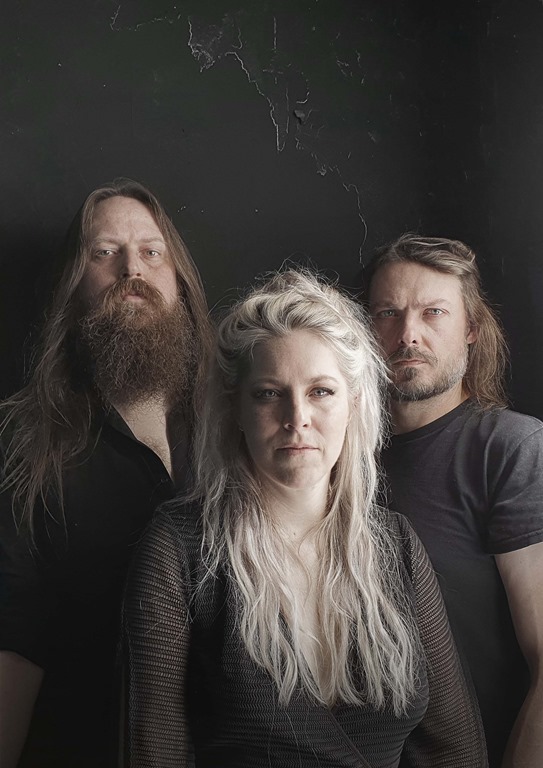
DFM 3 Portrait Photo 2000px WEBSIZE

War of the Ether opens – somewhat daringly – with the ten-minute spoken word crawler that is ‘She From Up the Drombán Hill’. For the most part, it’s sparse and spare, tingling guitars gently rippling behind the narrative – but there are bursts off noise, and it swells and grows and when it kicks in, it kicks in hard with piledriving riffage. The dynamics absolutely blow you away – exactly as intended. ‘Critical mass’ is appropriately titles, starting out with a haunting, echoed clean guitar and delicate drums rolling in the distance as a backdrop to Cawley’s aching, melodic vocal as it stretches and soars, and ‘The veneer’ is a magnificent slow-burner that builds to a shimmering sustained crescendo which unusually fades at the end. Against the weight of the subject matter and brooding instrumentation, it feels somewhat frivolous to focus on a fade, but it serves to highlight the many ways DFM are outside trends and exist in their own space. This is never more apparent than on the dreamy but serrated buzzing shoegaze of the title track.

For all its darkness, War of the Ether is a remarkably accessible album – not on account of its myriad hooks and killer choruses, but because it is simply so strong on melody and so utterly captivating. And because, as they demonstrate admirably on ‘No Matter’, the album’s shortest and most overtly structured song – they do have a real knack for snagging the listener with the combination of tunefulness and megalithic riffery. And then, the final track, the eight-and-a-half-minute ‘A Decent Class of Girl’ brings together all aspects of the album in a powerful accumulation of sedate, strolling psychedelia and climactic crescendos that optimise the impact of both.

Magical, majestic, and immensely widescreen, the scope of War of the Ether is simply breathtaking, and leaves you feeling stunned. Awesome in the literal sense.

AA

DFM 3 Album Cover Artwork 1500px

PNL Records – PNL040 – 20th April 2018

Extra Large Unit is an appropriate collective moniker: More Fun Please! is a live recording of an expanded iteration of Paal Nilssen-Love’s Large Unit ensemble, and features some twenty-seven musicians, in a line-up which features three grand pianos. Yes, three grand pianos. Excessive? Hey, if you’re going to go large, why not go uber-maxi, all-out massive?

The accompanying blurb explains that ‘The challenge of composing for so many musicians, while also maintaining the qualities and identity he had established with Large Unit, pushed Nilssen-Love to new creative levels. This was a monumental task…’ And More Fun, Please! is a monumental album. The question is, how much fun can you handle?

In his liner notes for the album Nilssen-Love writes, ‘When writing music, I search for extremes, pushing boundaries: physical, dynamic, instrumental limitations, if any, how fast and how slow can one play, how loud and how quiet. I search for unusual ways of thinking. I want to give the musicians trust and have them take initiative and to feel the responsibility of what it is to be an individual player in a group context’.

More Fun Please! is a thirty-minute aural rollercoaster, half an hour of highs and lows. At times, it sounds like a classic cartoon soundtrack, parping brass and sudden bursts of percussion; at others, it’s brimming with oriental exploration and eastern promise, and at others still, it’s utter bloody chaos, discord and cacophonous mayhem. In between, there are passages of trilling, tooting, droning and scraping, brought to abrupt halts by immense orchestral strikes – and I mean immense, earth-shaking, and borderline galactic in scale – and plinking, bibbling xylophone breaks.

The brass is beyond wild. Words simply aren’t enough.

The whole thing is an orchestral frenzy, a riotous ruckus of everything all at once, with sustained crescendos that seem to last forever.

It’s a lot of fun… but half an hour is probably about as much of this kind of fun as anyone can handle.

more_fun_please-42547043-

Future Void Records – 25th August 2017

James Wells

The pedant in me – and he’s a dominant, sarcastic brawling bastard – asks if two tracks with a combined running time of just over eight minutes really constitutes an EP. The same pedant also wonders if post-rock and post-hardcore can really sit together as a hybrid genre.

The debut release by Brighton’s Chalk Hands makes him shut the fuck up. These two cuts – ‘Burrows’ and ‘Arms’ – are both brutal and beautiful in equal measure. The guitars shift between delicate chiming notes and driving power chords, the vocals a nihilistic snarl of rage amidst the tempest.

According to the band’s bio, they’ve been compared to Pianos Become The Teeth, Caspian, and Envy. Because I’m old and because it’s impossible to know every inch of every microgenre or even every genre, I don’t know any of these bands, but instead draw from a sphere of reference that includes Profane and Andsoiwatchyoufromafar, and comparisons to both are favourable in the case of Chalk Hands. However, they also reference MONO and Russian Circles, and yes, they hold up nicely against them too.

On ‘Burrows’ in particular, Chalk Hands build some awesome crescendos from delicate, rippling washes of clean, chorused guitars, presenting an impressive dynamic and emotional range.

Chalk Hands EP Sleeve R2 OL

Self-released – 19th May 2017 – DL/CD (limited to 100 numbered/signed)

Christopher Nosnibor

Having witnessed the evolution of Her Name is Calla since the time of the first release of ‘Condor and River’ and their tour with iLiKETRAiNS (as they were styled back then), and having seen them play live at least a dozen times over the last decade, this release comes in many ways as a pleasing reminder of why they’re still a band worthy of attention and time.

Initially – and perhaps still – out of necessity, Her Name is Calla pursued a DIY ethos, recoding their ambitiously vast music at home and in tiny, cramped spaces and self-releasing in limited, hand-made, hand-numbered runs. And having worked with labels and achieved an international following, the fact they’re keeping things in-house means they’re a band that fans can still cherish and feel as if they’re ‘theirs’. And so it may be that they’ve settled into a certain cult position as they continue to plough their own unique furrow, but the offer of a limited edition of 100 signed CD copies of this live album reflects the band’s continued commitment to their ethics, their fans, and, above all, their music, which they continue to release with or without label backing.

Live at Bishop Street Church – recorded at Leicester’s Handmade Festival this year – captures the sound of a band with an ever-shifting lineup in their current incarnation, which sees them reunited with founder member and multi-instrumentalist Thom Corah, whose bras work proved to be a distinctive feature of their early work: his trombone action on tracks like ‘A Sleeper’ (by far the most buoyant song in their repertoire) and ‘Navigator’ certainly adds to the range of the overall sound, and changes the dynamics of some of the songs considerably.

Although they’ve changed the running order of the tracks, Live at Bishop Street Church is very much an honest account of the band’s live set.

While Her Name is Calla in 2017 are a lot more geared toward quiet, achingly mournful acoustic songs than epic, angst-dripping slow-burners that build to ear-bursting crescendos, there are still no shortage of songs which hit those emotional and sonic peaks to be found scattered throughout their post-Heritage recordings and which feature in their live sets.

The nine-minute ‘The Navigator’ is one of the clear standouts, not least of all because it encapsulates Her Name is Calla in their completeness: a hushed intro, a deliberately-paced build and a rip-roaring crescendo built on a tempest of brass, strings and guitar, with rolling drums rumbling like thunder toward the climax. Then again, the thirteen-minute ‘Dreamlands’ begins with a quiet, haunting segment where Tom Morris’ vocal soars, fragile and pained, over an acoustic guitar, before – three-minutes or so in – the build begins with sonorous brass burring low-end over crashing cymbals of increasing intensity and wordless vocals.

The write-up which accompany the release explain that “‘Meridian Arc’ and ‘Pour More Oil’ are presented here as ‘additional’ tracks as the multitrack failed during the recording of those songs. These were picked up solely by a handheld stereo audio recorder.” The audio quality is certainly less than the rest of the album, but the inclusion of the two tracks in integral to the release. While a shade muffled and heavily reverby, they do, nevertheless, capture the energy of the performance, and both tracks are quite integral to the set. The former is a work of thunderous dynamics and ragged emotional outpouring, while the latter, which closes the album, has become one of the band’s signature pieces, a haunting, spiritual offering which is incredibly moving in any context. Here, stretched out to almost ten minutes, it almost redefines the term ‘haunting epic’.

As a band whose catalogue is littered with incidental and peripheral releases, Live at Bishop Street Church adds to the sprawling clutter which renders them one of those acts which are a completist’s nightmare. But this is also a well-realised document of the latest phase of a band in constant transition. And while the older material is largely overlooked, it does highlight the quality of their later work, as well as evidence the strength of their current live form.


HNIC_Live BSC