Posts Tagged ‘Cold Spring’

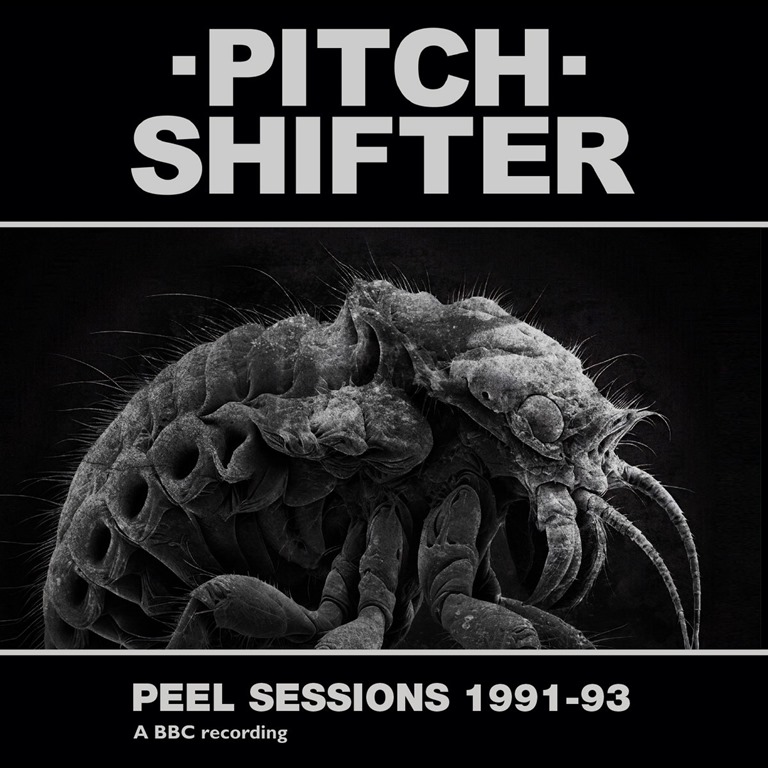
Cold Spring is extremely proud to announce the first ever release of the legendary BBC radio sessions that the seminal Nottingham-formed industrial metal act Pitchshifter recorded for the late, great John Peel in the early 1990s.

These ultra heavy tracks were recorded over two sessions at the iconic BBC Maida Vale Studios on 28th April 1991 and 30th March 1993 and were sourced directly from the BBC Archives (with thanks), with careful remastering for CD and vinyl.

The 1991 session was recorded during the same period that saw the release of the band’s debut album, ‘Industrial’ (Deaf Records/Peaceville), with the 1993 session recorded around the time of its follow-up, ‘Desensitized’ (Earache).

“If you look on your Pitchshifter album sleeves, you will see that we always credited John Peel,” states frontman JS Clayden. “He was instrumental in getting the band out there and often played our music on the radio when no one else dared. The ‘Peel Sessions’ we did were a great honour and every time I met John he was always such a great guy…a legend.”

Founded in 1989, Pitchshifter’s early music can be described as heavy industrial metal, with the band long cited as one of the originators of the self-termed ‘Death Industrial’ genre along with Godflesh. These sessions and their first two albums define that classic period, before the group shifted towards the beat-driven, crossover industrial style that they are best known for.

Ahead of the release, the Peel Session version of ‘Gritter’ can be heard here:

AA

a3964039450_10

“We may not speak the same language, but in the vortex of sound there is a raw, primal understanding that transcends words. Noise can be art – a visual representation could perhaps be Jackson Pollock’s ‘No. 5, 1948’ – a plexus of chaos redefining what music can and could be. Pushing boundaries with Masami wasn’t just a musical adventure, it was a masterclass in sonic anarchy.” Jack Dangers – MEAT BEAT MANIFESTO

Cold Spring is proud to present a unique collaboration between Industrial Breakbeat pioneers Meat Beat Manifesto (Jack Dangers) and the undisputed king of Japanese noise, Merzbow (Masami Akita). ‘EXTINCT’ sees the duo take listeners on a transcendental journey, focusing on the dismantling of beat and structure and recycling the result through layers of beautifully crafted noise and feedback loops, giving birth to new rhythms buried deep in the dirt.

The 20 minute opener ‘¡FLAKKA!’ takes constantly evolving breakbeats which are gradually broken down over time, driven through a filter of harsh noise, destroying the old to give birth to the new. Raw and unforgiving, the track is a behemoth that blends mutant forms of broken beats and hints of dub, creating rhythmic noise of the highest calibre in the process.

‘BURNER’ takes the record to its ultimate conclusion, the initial drum beat broken down so that it is barely recognisable. Pulsating distortion and high end audio fragments bleed into each other as the track lumbers forth and destroys everything in its path before slowly unravelling, degrading and falling apart.

A harrowing yet somewhat cathartic trip through walls of harsh industrial noise and audio degradation, ‘Extinct’ is a masterful pairing of artists who have delivered something truly unique yet totally relevant. Don’t sleep on this one!
(Text by Todd Robinson / Subunit)

Listen to the edit of ‘¡FLAKKA!’ here:

AA

f0f13226c8ffd8197b8401592d5d3cdd30872f0c

Cold Spring – 23rd October 2020

The reverence for Coil amongst their fanbase – which if anything has expanded in recent years, and particularly following the death of Peter Christopherson – is quite remarkable. Emerging in 1982 following the demise of Throbbing Gristle, Coil became the primary vehicle for Christopherson and partner John Balance after contributing to the early Psychic TV releases. And perhaps one of the reasons Coil are held in higher esteem than PTV is that their output, while still substantial, was less in volume but subject to a higher quality control, as well as pursuing esoteric experimentalism while largely managing to avoid cringe-inducing indulgence. That, and the fact they pushed so many musical boundaries without being massive tossers in a musical field crowded with individuals whose creative genius was tempered by tendencies toward major-league assholism: P-Orridge should require no real qualification now, and similarly, the shady characters of the industrial and neofolk scenes, not least of all Boyd Rice and Douglas Pearce have long been exposed. And the fact that both members suffered premature deaths only compounds the way their work resonates with fans, who can only contemplate what cuold have been

Everything around the rights to the Coil catalogue is spectacularly complex, and the origins of this compilation aren’t even entirely straightforward, having originally released by Russian label FEELEE, featuring tracks from all their major albums (barring The Ape of Naples which was released after Balance’s untimely death). They were hand-picked by Coil to represent their best work and originally released to mark their first performance in Moscow in 2001.

Subsequently out of print on CD for almost two decades, this edition courtesy of Cold Spring spans Coil’s entire living career, with A Guide For Beginners – The Voice Of Silver and A Guide For Finishers – A Hair Of Gold being made available together in one deluxe set.

As Nick Soulsby observed of Balance and Christopherson, writing for thevinylfactory.com, ‘As Coil they had embarked on a wild ride from industrial origins originating in the post-Throbbing Gristle outfit Psychic TV, through a spell as dancefloor-channelling experimentalists, onward to their destination as the respected priesthood of pagan rite electronica’. And with a career spanning three decades and eighteen studio albums, it can be daunting to know quite how best to make inroads, so a ‘Best of’ makes sense.

Disc one (A Guide for Beginners) spans their later career, while disc two (A Guide for Finishers) delves deeper towards their origins, and together, in a slightly mixed-up reverse chronology, we’re able to trade their development, and what’s most interesting and apparent is their range and their willingness to explore.

Singling out tracks from a collection that spans twenty tracks and a monster running time, but emerging from the swathe of brooding dark ambience and esotericism, ‘Ostia (The Death of Pasolini)’ stalks brooding neofolk territory, dark, stark, and portentous, but without any of the nationalistic bullshit that often typifies the genre, while ‘Where Are You’ is the soundtrack to psychosis, an eerily minimal backing creeping uncomfortably behind a monotone monologue that’s unsettling and uncomfortable.

Brooding piano and shrieking woodwind and horns forge haunting soundscapes while elsewhere, minimal two-note organ and trilling electronic extranea provide the backdrop to mesmerising spoken-word narratives. Cut-up samples and fragments drift in and out (no surprise for a band photographed with William Burroughs, who had an album released on Industrial Records in 1981) and the thing that really comes across most powerfully from this compilation is that while so any ‘experimental’ and ‘industrial’ acts were – and are – pretty dull, Coil were consistently engaging, focuses on tone and resonance, and ever-evolving.

It would be hard to improve on a selection picked by the artists in terms of what can be considered the best representation of their output, and bias aside, this is hard to fault by way of an introduction.

AA
COIL A Guide For Beginners - A Guide For Finishers - Lo res album cover for web

Cold Spring – CD 3rd August 2018 / LP 10th September 2018

Christopher Nosnibor

There are so many moments lost in the annals of history. This particular one has been languishing, unheard and unreleased for some 35 years. As collaborations go, this one is particularly special, and captures the spirit of the underground scene in the early 80s, with the original Coil lineup of John Balance and Peter Christopherson joined by John Gosling and Marc Almond. Although renowned as a pop singer, both solo and with Soft Cell, Almond has a raft of interesting collaborations to his credit: his work with JG Thirlwell as Flesh Volcano is a persona favourite, the pair amping up the sleaze and grime to deliver something quite dank and slimy. Better still, their live rendition of ‘Ghostrider’ for the BBC. And, lest we forget, undocumented save for some (painfully) ropey bootlegs, The Immaculate Consumptive, a short-lived live project (just three shows in three days in October / November ‘83) which featured Almond, Thirlwell, Nick Cave, and Lydia Lunch.

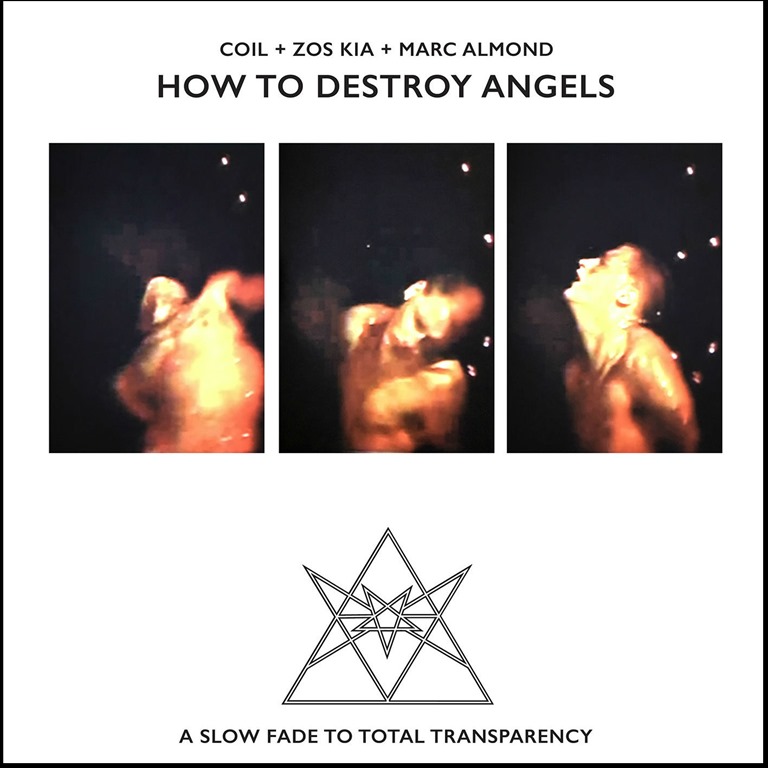
‘How to Destroy Angels’ was recorded shortly before The Immaculate Consumptive broke Brian Eno’s piano, on 24th August 1983, at the Air Gallery in London. And the recording has languished ever since, until now, emerging cleaned up and consumable. Although it’s still pretty raw, and if truth be told, sounds little better than some of the recordings of my own spoken word performances recorded on my phone. Of course, this has rather more cultural significance and wider interest.

As the liner notes observe, ‘the music bears only scant resemblance to the ‘How To Destroy Angels’ 12” that Coil would release as their debut vinyl the following year.’ And so the performance which would preface Coil’s studio debut was very much an experimental effort, a collaborative piece born of happenstance and a coalescence of creative fermentation that was bubbling around the time.

It’s Lunch’s influence that seems strongest on Almond’s contribution here: his narrative – a bitter tirade against an ex-lover – is full of bile and expletives as he spits the words quickly and abrasively against an eerie, unsettling dark ambient backdrop. Challenging is the word – but then, that’s entirely the point.

The Kos Kia remix of ‘How To Destroy Angels’, which whittles 23 minutes of audio to just over eight, feels a little redundant here. It’s not bad by any stretch: in fact, as weirdy ambient remixes go, it’s pretty good. It’s just a question of fit.

‘Baptism of Fire’ is an unreleased recording of Zos Kia and Coil at Recession Studios, London: dating from 12th October 1983, it’s contemporaneous with ‘How to Destroy Angels’. It’s the shortest piece here, and concludes the set with four and a half minutes of battering percussion, howling ululations and clanking, clattering noise that’s very Throbbing Gristle and very uncomfortable indeed.

While so many archival recordings and onus cuts on anniversary reissues – often of bands who were only of limited merit in the first place – feel like sloppy cash-ins, digging out second-rate demons , acoustic versions, remixes outtakes and live recordings of well-known studio tracks, this is a real rarity, which sheds new light on the origins of band whose effect has been significant and enduring. Moreover, it’s not only vastly illuminating in context of the nascent Coil sound, but a document which joints a number of dots in the wider context: and for that, this is an essential release.

AA

COIL ZOS KIA MARC ALMOND - Lo res album cover for web