Posts Tagged ‘busy’

28th July 2025

Christopher Nosnibor

Beauty, as they say, is in the eye of the beholder. Certainly, it requires a fairly specific subjective standpoint to hear the beauty in a bleeping rush of effervescent electronic froth, but there is something in it – and yes, it is intense – to the extend that it’s like a fizzing chemical reaction, like vinegar and bicarbonate of soda, exploding in your brain. And it’s quite a high.

Intense Beauty finds Gintas Kraptavičius (Gintas K) in his most common setting, with the album being fully improvised, ‘recorded live, using computer, midi keyboard & controller’. Recorded in June 2025 of this year, by the power of the Internet and micro-labels, it was released as a limited cassette on Tokyo-based label Static Disc just weeks later on 10th July, before also becoming available on Gintas’ own Bandcamp page.

As is common to many of Gintas K’s works recorded in this manner and with this – seemingly unique setup, there’s something playful, even joyful and uplifting about the sound. It is chaotic, but it’s also carefree, and it’s not remotely dark or heavy: there’s nothing harsh or abrasive to be heard here. ‘intense’ is skittery and skittish, off-key electric piano thumps and stomps erratically, glitching in and out throughout, while cellular sounds fly around all over like plankton in a storm before gradually slowing, tinkling and flitting at a more sedate pace until grinding to a halt.

‘harmony’ isn’t particularly harmonious, instead merging static and drone with groaning whirrs before yielding to discordant bent notes playing across one another. One thing that is a constant throughout Intense Beauty is a sense of movement. There isn’t a moment is stillness, as sounds and ideas flit from one place to another with no discernible flow, and th9is is nowhere more apparent than on the shifting sonic collage of ‘gal bet’. It’s hyperactive, and should be exhausting, but the sheer energy is contagious and uplifting.

Watching the accompanying video of Gintas recording for the album is illuminating, particularly the vigour with which he plays, simultaneously striking keys on the keyboard with hands, wrists, forearm, seemingly at random, but with remarkable speed and dexterity, while cranking knobs hard and fast: the camera and table shake under his frenetic kinetic activity. K isn’t one of those who creates sound simply by pushing buttons here and there: this is a full-body physical performance. This, too, is an example of intensity, and the artist pours it into the act of artistic creation.

There are a lot of experimental electronic artists around, but no-one else sounds quite like Gintas K.

AA

AA

a3925363230_10

Mind Altering Records – 13th November 2023

Christopher Nosnibor

Back at the start of 2021, I penned a pretty positive review of the solarminds album Her Spirit Cracked the Sky. The combination of ambience and extreme weight was a thrilling proposition. And it was – and still is – monumentally epic. It feels a long time ago already, and much has happened in the interim. If emerging from the pandemic was trailed for a long time by the release of myriad ‘lockdown’ projects, we’ve subsequently trickled into a ‘world’s turned to shit’ phase, and like the pandemic, it feels like there’s no end in sight. Trump may be out of office, but he still looms large and continues to pose a threat in the arena of world politics, and it’s a world at war, and a world where alternately wild fires and floods decimate swathes of land. Slowly but surely, the planet is becoming less inhabitable. And yet, still, people jet off on skiing holidays and bemoan the lack of snow despite being the cause of the lack of snow, and whenever it rains, people take to their cars to make five-minute journeys to avoid getting wet, thus ensuring it will rain an awful lot more in the time to come.

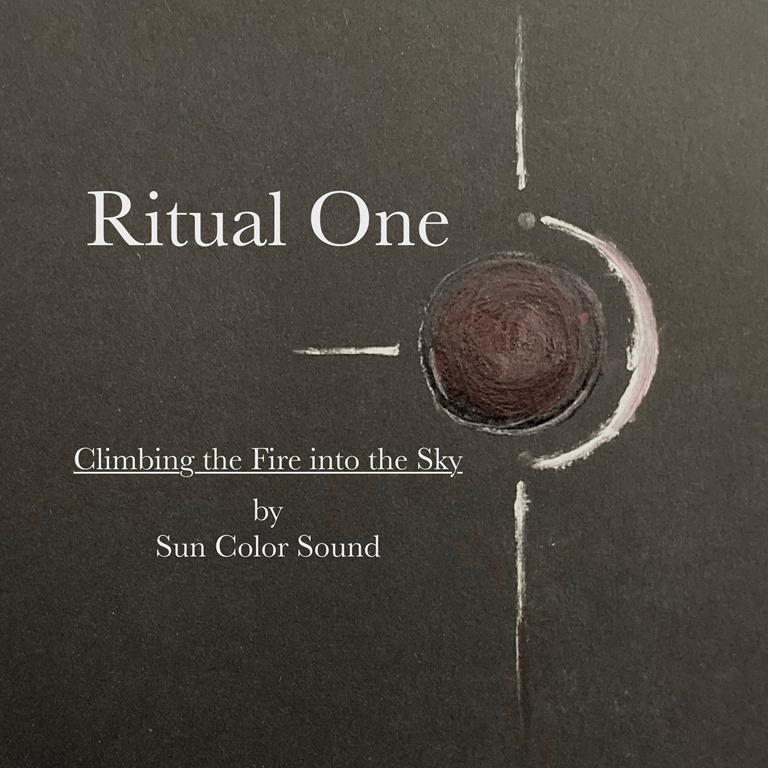
And since the release of Her Spirit Cracked the Sky, after more than a decade, Chris Miner has put the project to bed. But, like the proverbial phoenix rising from the ashes, he now returns with Sun Colour Sound, and the first in a projected trilogy of releases. On the evidence of this first one, it will be something special.

Ritual One (Climbing the Fire into the Sky) consists of a single piece, which runs just short of half an hour, and it shares many elements with solarminds – namely a fair bit of noise, some hefty guitars and punishing percussion, at least in the first two thirds, and it’s heavy, harsh, noisy, and it crashes straight in with some grating, heavy drone, twisting feedback and thudding drums.

This is one of those tracks which stars like the end of many sets, and it feels like it’s winding down from the offing. This is by no means a criticism, simply an observation that what in the context of many works is a climactic, tempestuous crescendo finale, is simply the start of a ferocious sonic storm. It does very much call to mind Sunn O))) and the epic, swirling instrumental passages of contemporary Swans, although the guitars are very much geared towards generating howling feedback rather than crushing, clashing chords that sound like buildings being demolished. Therte’s something of a psychedelic twist in the spacey delivery, too. As whining, whistling notes ring out, the percussion builds from the occasional roll to a relentless thunder. The combination is immensely powerful, and assails the senses with a real physicality. Buy around the thirteen-minute mark, it’s reached wall-of-sound levels, a dense, shimmering sonic force which shimmers and ripples while coming on like a bulldozer, at the same time as hand drums fly at a frantic pace and evoking something spiritual in the midst of a hypnotic frenzy. And still, it goes on, surging forwards.

The shift in the final third occurs subtly: the percussion continues to clatter away, but the guitar abrasion tapers away, to be replaced by altogether softer strings.

Ritual One (Climbing the Fire into the Sky) is more than just a really long piece of music: it’s an ambitious piece in every way, and its scope and scale are immense. There is so much depth and detail here, and it takes repeated listens to really appreciate just how much is happening, especially given that the first reaction is simply to bow to its sheer sonic force.

But the last ten minutes belong to a different world from the first portion. Hypnotic, soothing, graceful, the tension dissipates and Eastern vibes radiate through the gauze-like layers which drift and float over the busy but altogether more subdued percussion.

So while it is an ambitious work, it also delvers far above any expectations, and it’s both unique and special.

AA

Version 3

24th February 2023

Christopher Nosnibor

This Oxford based act describe themselves as ‘Techno Western New Wave Electroclash’ and ‘Synth lovers’. Unfortunately for me, this description conjures images of moustachioed hipsters circa 2009. The pair may well, be, choosing to keep their mugs off the record, and I’m all too aware of just how the field of instrumental electronic music is very much the domain of middle-class white guys tinkering with expensive toys. This lack of cultural diversity may be a leading factor in there being so much sameness stylistically.

Sameness isn’t really a criticism one could level at this album, for while it does assimilate many common tropes of contemporary synthesizer music – in that its inspirations are often retro in origin – stylistically, Errors offers a broad range.

‘Science of Errors’ is a punchy piece of electropop with some big, bold proggy sections that surge along in a rush, and it’s a strong start. ‘Conga Cop’ is very much a tune of 80s TV show vintage style. It’s extremely busy in terms of arrangement, stabby synths shooting over a hectic rhythm and samples flying around there and there, before going altogether more minimal on ‘Phil D’Ophear’, a much darker slice of techno where the dense bass dominates. Elsewhere, ‘Wibli Wobli’ packs a driving, energetic groove.

Errors is big on ideas: it’s positively bursting with them, and consequently, there is a lot happening, sometimes, if not all at the same time, then densely packed together, to the point that sometimes it feels as if there’s too much happening. And not all of the ideas necessarily work perfectly: the Clangers whistling over a microtonal waltz on ‘Satomi’ is novel and fun, but little more, but it’s Bruno Muerte’s willingness to experiment and the mix-and-shake approach to making music that’s a large part of the album’s appeal.

As they write in the accompanying notes, ‘One of the basic rules of the universe is that nothing is perfect. Perfection simply doesn’t exist without errors.’ It’s refreshing to hear: Errors, then, is not a quest for perfection, but a celebration of imperfection and the joy of being creative. And ultimately, it’s joy that Errors brings.

AA

a2776445249_10