Archive for the ‘Albums’ Category

Supernatural Cat – 8th November 2018

Christopher Nosnibor

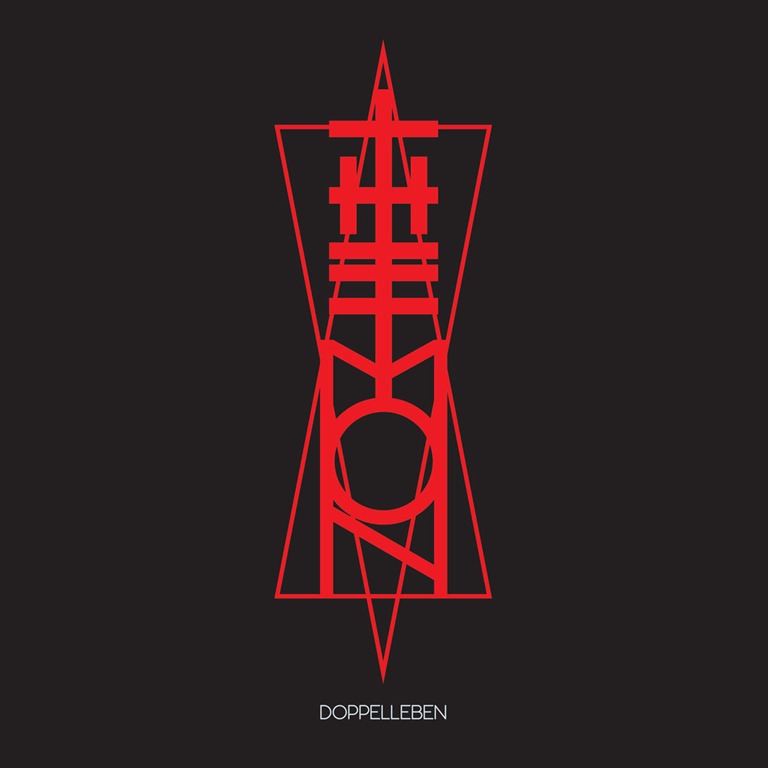
Eerie strings streak across an ominous low-end throb, transitioning expansive vaporous drones with serrated edges on the album’s first track, ‘Hefy Lamarr’ and it sets the ominous tone for the rest of the album, as piano notes hover in rarefied atmospheres with a slow-decaying sustain carried on a cold, dry echo. It’s minimal, sparse, dislocated, disconnected. There are no sonic hugs on Doppeleben. It’s an album that builds walls, force-fields. Nihilism, isolation, introspection… these are the moods of Doppeleben.

So what do we know about the artist? The Mon is the solo name of a new project by Urlo, best known as the lead vocalist, bass and synth player in heavy trio Ufomammut. Doppelleben is The Mon’s debut album, and, as the press release notes, ‘where Ufomammut create mind-expanding, heavy psychedelic, almost other-dimensional sounds, The Mon by comparison is far more intimate, looking inward, as Urlo explores and examines his inner most thoughts through music.’

And Doppeleben is very much an introspective set, which is far from heavy and as such, it is very much a departure from Urlo’s work with Ufomammut. But heavy is relative, and ‘Relics’ still manages to come on like Ministry on ketamine, with distorted, raw-throated vocals hollering out against a backdrop of plodding percussion and howling feedback. It’s representative, but it isn’t: the atmosphere of Doppeleben recreates the claustrophobic intensity of The Cure’s Pornography, while drawing on the stark discomfort that pervaded the alternative scene circa 1979-1983.

Fear chords ripple, delicate notes drip and drop over slow surges of dark density which rise and swell through interminable sustain. ‘Hate One I Hate’ sounds like Earth circa 1992 covering ‘One Hundred Years’ by The Cure. Devoid of percussion, the glacial synths and thick, crawling guitars coalesce for create a spine-stiffening tension.

With clattering metallic drums battering away in the background, ‘Blut’ grinds hard at a bleak post-punk seam, landing somewhere between Movement era New Order and Downward Spiral era NIN, with hints of Visage’s ‘Fade to Grey’ thrown in for good measure. It’s compellingly intense and makes optimal use of a handful of chords in a descending sequence.

In contrast, ‘Her’ offers a bend of shoegaze haze and Bauhaus-hued art rock as it washes blank curtains of synth and monotone vocals before a cascade of slide guitar swerves its way into the mix. And yet never could it be as far removed from country as the notes bend and glide and slide to fade.

Low, slow, and dark, there’s an oppressive density to Doppeleben which is hard to define and even harder to let go.

AA
The Mon – Doppeleben

Karl Records – 21st September 2018

James Wells

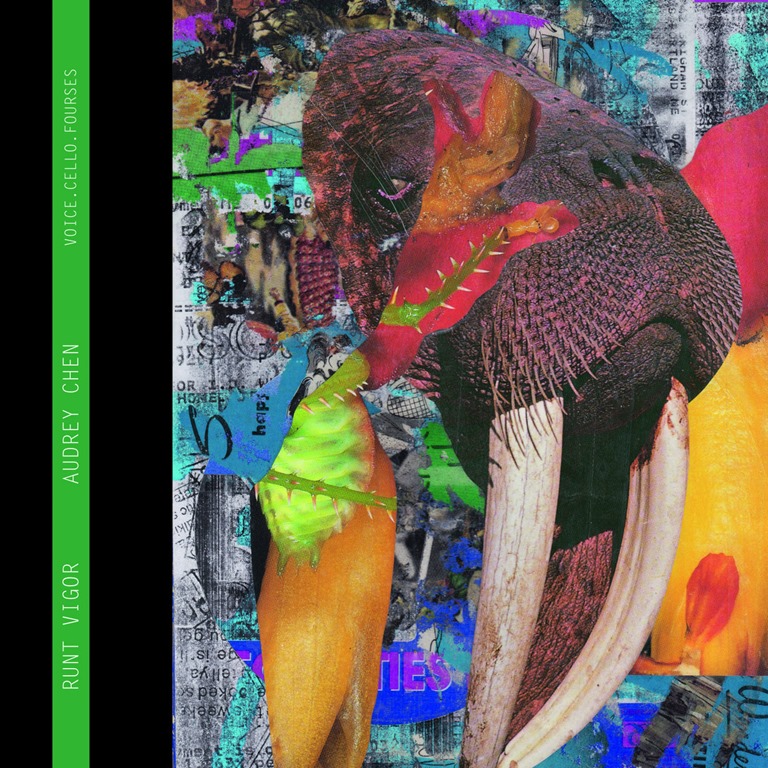
There’s nothing like an intriguing title, or one which ignites the imagination to generate interest in an album – or maybe it’s just me. And so the curious selection of the pairing of ‘runt’ with ‘vigor’ piqued my interest: the idea and image of a runt, smaller and weaker than nature intended, flailing feebly but energetically… Paired with the collage cover art, it all points toward something far-out – and I’m not mistaken or misled.

Now, I’m more accustomed and adjusted to music from the furthest, most extreme fringes, avant-gardism that redefines bizarre, inexplicable, outré. Chen is so outré that she’s bypassed me for all of 30 years, which includes a prodigious solo career punctuated by myriad collaborations that accounts for the last 15.

While much of her output is centred around cello, voice, and analogue electronics, vocal explorations have been at the heart of her most recent works including this four-track offering, which contains forty minutes of gulps, clicks, gargles and hums all emanating from the mouth and throat. Ululations and stuttering glottal stops create the very fabric of the compositions and occupy the foreground, along with asthmatic, gasping breaths, atonal, meandering whistles, and strangulation sounds.

While it’s more overtly ‘musical’ than Mike Patton’s Adult Themes for Voice which stands by way of a relatively obvious comparison, it’s not less disturbing or strange, and it’s impossible to distinguish the origins of all of the sounds here; the whispering hums, drones and wavering gusts of wind are, I would assume, as likely to originate from the artist’s body as from an instrument. It’s the way in which everything is rendered obscure, the voice twisted, pushed, pulled, distorted and disfigured beyond all recognition from the conventional utterances of speech, song, or even flatulence, which is so awestriking.

You may hear albums which share the same sonic territory, but I’d wager none will have been created in the same way.

AA

Audrey Chan

Front & Follow – 26th October 2016

Christopher Nosnibor

In the last property I rented, I suffered an infestation of moths. It may sound amusing, but it wasn’t. the larvae of said moths devoured chunks of carpet under the bed and in various other places in the bedroom and other spots on the first floor. So, moths, it transpires, consume wool-based material and require Rentokil to halt them. Miraculously, I did get my full deposit back, but was reminded that one sold never trust a creature made of dust. Yes, I fear moths. A body that powders on contact with a heavy blow presents a curious intangibility, a lack of substance, a sense of not really existing in the corporeal world.

This presumably isn’t the kind of scene the title of Sone Institute’s latest offering is attempting to convey, and the connotations of rust are more of slow decay and dilapidation, in keeping with the dark, damp crevices moths are more conventionally associated with inhabiting.

Sone Institute describes Where Moth and Rust Consume, his first new material in six years, as his ‘pop album’, but don’t expect to hear it on R1 any time soon, or ever. 6Music’s Gideon Coe has championed previous work, describing it as ‘delightfully strange,’ which seems a fair summation. Sone Institute inhabits the world of the unheimlich, the uncanny, and this is no more true than of the landscape conjured by these compositions.

Sparse, stuttering beats and even sparser synths provide the backdrop to robotic, monotone vocals on the first track, ‘Only I Exist’. ‘Your wretched anus / discoloured teeth / Tree-trunk legs / A dog on a leash…’ The obtuse, fragmented lyrics follow the trajectory that charts a line from Dada and Surrealism to Burroughs’ cut-up technique. The images layer up, juxtaposed and disconnected, and the album gradually unfurls, pushing a clinical 80s Eurodisco sound that’s centred around crisp, mechanoid beats. It’s the beats that are perhaps the most overtly ‘pop’ aspect of the album, bringing a consistency of structure and solidity to the compositions rarely found in Sone Institute’s work.

‘The Devil Works in ASDA’ judders and thumps along, building a conspicuously linear groove while exploring the dynamics of dance music, and if ‘What’s Bred in the Bone’ pulls back the intensity and volume a couple of notches, the spacious bump and bleep, built around a framework of drum machine evokes the spirit of retro-futurism. Analogue synths modulate rhythmic pulses, but stark angularity and minimal production values give the atmosphere a cold, detached edge.

‘Winter is Dead’ marks something of a departure, venturing into more ambient and also rather weirder territory with its woozy vocals and warping sonic backdrop. And there are times when it all goes Kraftwerk / Tangerine Dream, and if truth be told, that’s pretty cool. There’s creeping tension in the undulating drones and whispered vocal slivers of ‘Oblique Messages’, and the dark heart of Where Moth and Rust Consume beats on through to the final fragments of the crackle-scratched sketch of a closer that is ‘God Bless You’.

We need more of this: and with this release, we get more, lots more. Front & Follow don’t only deliver leftfield albums of quality, but are now, it seems, on a mission to go above and beyond in providing value for money with a bonus album: this release also marks the first volume of a new series on Front & Follow – Ex Post Facto – which, the label explains, ‘seeks to celebrate experimental electronic music in all its forms, showcasing new work and old, exploring the relationship between the current and the past, how they influence and shape each other and our experiences of them.’ And so, a collection of tracks from the Sone Institute archive, including remixes and previously unreleased music offers eighteen tracks lifted from the far reaches of Sone Institute’s career. Not only is it extremely interesting in its own right, but it resents a wide-ranging representation of the sample-riven, string-soaked and analogue-based wibble-tastic work of Sone Institute through the years. It’s not all comfortable, easy -listening, exploring equally areas of introspective elegy, discord, and smooth, rippling mellowness: the chanking ‘4 (Version 3)’ is a discordant guitar blitz over a creepy Theremin / organ shiver, while the stammering robotix vocal loop on ‘Dark Forest – Silver Sea’ hardy says ‘easy to get on with’: and the context is all.

Still reeling from Where Moth and Rust Consume, Past and Spared is the very definition of headfuck not because it’s especially intense, but simply because it is. And that’s cool. Just be prepared.

AA

Sone Institute – Where Moth and Rust Consume

Bearsuit Records – 20th October 2018

Christopher Nosnibor

The word ‘poets’ would seem to imply plural, but according to the accompanying text, The Moth Poets is the work of Edinburgh based musician, Billy Gilbert, who’s played in a few local indie bands and released a split LP with Japanese artist / musician Swamp Sounds, whose presence has graced this site on a previous Bearsuit release, as well as featuring in another Bearsuit-released act, Anata Wa Sukkari Tsukarete Shimai (AWSTS). Yes, once again, Bearsuit is the conduit for all of this uber-fringe creative activity from around the world, but mostly bringing Scotland and Japan together.

Doll is a magnificently idiosyncratic work which assimilates a broad range of styles and influences, and as a consequence, belongs nowhere specific or readily positionable. The eight compositions, in their titles and in their sound, convey a certain sci-fi undercurrent, infused with a twist of surrealism and plain abstraction.

‘A Hole in the Mothship’ starts the album with some spaced-out, opiate prog, a mellow, reverby instrumental which plods ponderously before trickling into the title track, where the drum machine kicks into overdrive and the soporific guitar mutates into a wildly meandering fizz of fuzz that sounds like J Mascis on a cocktail of acid and amphetamine. And this provides the backdrop for a vocal that sits somewhere between shoegaze and slacker, pitched low in the mix so as to render the lyrics indistinct. It doesn’t detract, and if anything, adds to the blurred, lo-fi layering that imbues the song with a hazy, dreamy quality.

As the title suggests, ‘Mothship Song’ is something of a companion to the opener, laying some echo-heavy guitar picking over a muffled heartbeat drum track and low, buzzing synth bass before going a different kind of strange, sort of like the into to ‘Frenz’ by The Fall, but with an oriental vibe and some synth stylings stolen from Stereolab.

‘Orange Peel Teeth’ goes grainy ambient with slanted analogue synth scrapes slipping through the rumbling atmospherics at skewed angles, and it’s this juxtaposition of tones and textures which provides Dolls with a much-needed sense of cohesion. Whether it’s prog, pop, or ambient – all performed with an experimental edge and an overt rejection of convention – Gilbert renders the pieces with an attention to less-obvious details that’s nothing if not distinctive.

All of the album’s disparate elements coalesce on the noodly, whacky weirdo wig-out of ‘Someone Put a Time Bomb in My Submarine’, the vintage drum machine sound – thudding bass, whip-crack treble top end snare – bounce it along nicely and keep things pinned to a groove that’s consistent and insistent. And because of this, however far-out The Moth Poets go, here’s always something to cling to. This is perhaps the key to keeping Doll on the right side of the line of (in)accessibility, and the reason it’s ultimately a success.

AA

The Moth Poets – Doll

LP/DL Rekem Records REKEM12/Fragment Factory FRAG45

Christopher Nosnibor

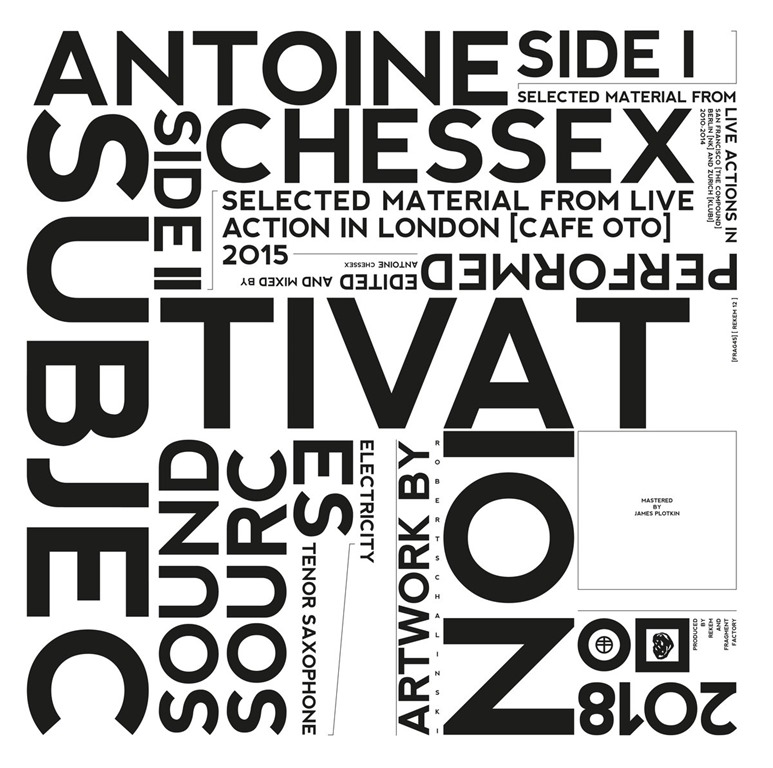
The music this album contains causes as much of a sense of overload as the cover art, with its perpendicular textual tessellations. Chessex has long pushed the tenor sax beyond the realms of conventional jazz or even overt compositional forms, and Subjectivation, a collection of live actions (a term also used by the notorious noisemakers Whitehouse). Side 1 takes pieces recorded in San Francisco, Berlin, and Zurich between 2010 and 2014, while Side 2 documents a performance at London’s Café Oto in 2015.

It’s all about the low frequencies at the front-end: the album begins with earth-moving, bowel churning bass tones that grind and snarl maliciously, and this, coupled with the conveyance of extreme volume places this in Sunn O))) territory, the atmosphere of creeping doom delivered at a pace and volume that punish slowly. And gradually – although not nearly so gradually – things intensify as additional layers of volume and frequency are added. The accompanying text describes it as a ‘field of distortion’, but it doesn’t come close. It seems unfeasible that such a raging sonic force could be sustained for any time, let alone increase, but increase it does, until there is nothing but a dense wall of obliterative noise. It’s impossible to discern there being any saxophone – or indeed any music instrument – in this vast, screaming whorl. I’m staring at the speakers in awe, wondering just how much sound they can actually carry, and moreover, how much sound could be created in pure physical terms. Seven minutes into the fourteen-minute sonic barrage – something akin to standing next to an RAF Vulcan preparing for take-off without earplugs or protective clothing, I’m wondering if my skull might not implode and my brain before the end. It’s a perverse pleasure the pain of this sonic assault provides.

The London side is less full-on, although it would surely be difficult to be more full-on. Nevertheless, it matches Side 1 in terms of intensity. It builds quickly from an irritated hornet buzz into an infinite echo, a thousand horns, honking in unison to create a rippling reverberation of sound. Some time around themed-point, the sustained crescendo fades, leaving eardrum-fluttering feedback notes, shrilly quivering on and on, before the air is rent with shards of scraping industrial noise, the grinding of metal on metal on a fast, rotational plane. It’s as if with each shift, Chessex introduces a pitch and tone more unbearable than the one before. The tiny sound that hangs where there should be silence mimics tinnitus, creating one final torture in the album’s closing seconds. There’s something cruel – and unquestionably uncompromising – about the way Chessex executes his sonic blitzkriegs, and for that, I admire him enormously.

AA

Chessex

Soundtracking the Void – 5th October 2018

Christopher Nosnibor

Collectively and individually, Gavin Miller and Thomas Ragsdale (worriedaboutsatan, Ghosting Season) have produced an impressive volume of work – although perhaps even more impressive than its quantity is the consistency of the quality. They’ve always been something of a yin/yang pairing, and the individual differences are integral to their collaborative works. So, while Ragsdale tends to bring the beats and beefy bass, Miller is the man who contributes wistful soundscapes and delicate atmospherics. The fact they’ve released solo efforts within a few short weeks of one another not only highlights their productivity, but affords the opportunity to compare and contrast the similarities and differences of their musical approaches.

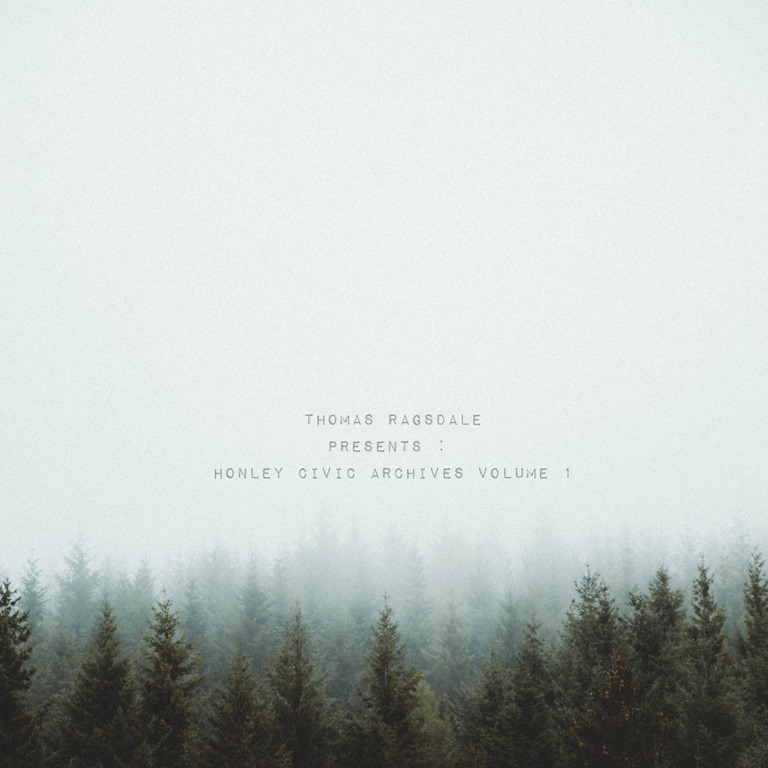
Honley Civic Archives Volume 1 marks not only the first in a prospective series, but something of a departure, being almost entirely beat-free (there’s a distant clattering on ‘Pick Up Sticks’ but it’s almost buried by the sonar bass frequencies), and adopting from the outset a soft, piano-led sound and an elegiac tone.

In contrast to Gavin Miller’s near-simultaneous solo release, Shimmer, Honley Civic Archives Volume 1 is a much more overtly ambient work: the electroacoustic elements are filtered by synthesis, so while Miller’s ambience contains elements of shoegaze right at the fore, Ragsdale takes abstraction as his form, and runs with it. Many of his signature elements are in evidence: layered electronics, strings, and field recordings are all carefully interlaced to forge a sonic cloth as delicate and intricate as lace. However, the vocal samples lifted from film and radio which can be found in abundance on other recordings and in his live set, are as conspicuous by their absence as the beats.

In abstraction lies evocation: with so little overt or explicit signposting, the listener’s mind wanders free through the intangible forms. Without any temporal location in sonic terms, it’s left to the lister to fill in the gaps of space and time. But the titles of the compositions are referential, with several making direct reference to nursery rhymes – ‘Pick Up Sticks’ and ‘Four and Twenty’, for example. They remind us that so many of these rhymes have a darker undercurrent. Elsewhere, ‘Will You Still Love Me Tomorrow’ lifts its title directly from The Shirelles’ 1960s hit. Sonically, there’s no relation, but again, the sentiment of the title connotes a certain sadness, even anxiety: vintage pop lyrics, too, often cast shades of darkness when you scratch the surface and wipe away the bubblegum delivery. And it’s creeping darkness that pervades the slow, deliberate sonic expanses of the more dolorous passages of this album, of which there are many.

And so Honley Civic Archives Volume 1 provides the conduit for the listener to engage with their own interiority, exploring at leisure and from a distance, the images and scenes conjured by the mind’s eye in response to the sonic provocations. There’s something disquieting and disorientating about Honley Civic Archives Volume 1 – an album you feel first, and hear some time later.

AA

Thomas Ragsdale - Honley

Sound in Silence – 30th September 2018

Christopher Nosnibor

Collectively and individually, Gavin Miller and Thomas Ragsdale (worriedaboutsatan, Ghosting Season) have produced an impressive volume of work – although perhaps even more impressive than its quantity is the consistency of the quality. They’ve always been something of a yin/yang pairing, and the individual differences are integral to their collaborative works. So, while Ragsdale brings the beats and beefy bass, Miller is the man who contributes wistful soundscapes and delicate atmospherics. The fact they’ve released solo efforts within a few short weeks of one another not only highlights their productivity, but affords the opportunity to compare and contrast the similarities and differences of their musical approaches.

Shimmer comprises six tracks, simply titled parts one through six. The tones are soft, the textures deep. It begins with vaporous drones, soft-focused, broad in spectrum, providing a backdrop to delicately picked, reverby guitar and a hesitant bass, bringing hints of the instrumentation of Julee Cruise’s ‘Falling’.

Piano notes reverberate and organs trill and wheeze. There’s a lot of air and a lot of space: this is music which breathes, drifting, an organic ebb and flow providing the irregular patterns of ever-shifting form. The pieces don’t so much segue as melt into one another, while the individual instrumental sounds blur together, a gauzy halo surrounding each note which ultimately creates a sense of vaporousness.

With Shimmer, Miller trades in intangibles. That isn’t to say the pieces are without form or structure, but that the forms are ever-shifting and impossible to pin down, the structures possessed of an opacity which renders them indistinct. So while the successive passages are interesting in their own right, Miller doesn’t resort to repetition or motifs to hold them together, instead allowing them to flow freely. It’s the kind of ambience that fades in and out of the foreground of consciousness: as such, it’s not completely background, but it is ideal for after a mentally strenuous day at the office or equivalent.

AA

Gavin Miller - Shimmer

Kranky – 28th September 2018

Christopher Nosnibor

Total immersion. This is what I get from Tim Hecker, both recorded and live. Responding critically to such a sensation is a major challenge.

My first attempt to review Konoyo redefined ‘failure’, as I sat, vacant and staring for the duration without typing a word. Yes, other things happened around me: emails continued to ping into my inbox, text messages, Facebook notifications, and so on. So much peripheral shit. But while pushing all of this noise to the peripheries, I struggled – nay, found it impossible – to get a firm grasp on the drifting soundscapes of Hecker’s latest album. My second stab proved no different. I can no longer blame the distractions: I’m reminded of ‘seeing’ Hecker’s performance at the Belgrave Music Hall in Leeds a few years ag. Purple smoke filled the room. It was so dense I couldn’t see my friend standing next to me: I felt as if I was in an isolation tank or a sleeping bag. With my surroundings completely removed, I found myself alone with the music, and in an almost trance-like state, swaying on my feet, in my own world. When things like this happen, I immediately assume I must have drunk more than I should or that I’m tired or something. But music at its most potent is like a drug, and Hecker has the capacity to transform the mental state and one’s relationship with one’s surroundings. And this is certainly true of Konoyo.

Inspired by conversations with a recently-deceased friend about ‘negative space’ and the banal density of contemporary music, Konoyo was largely recorded in a temple on the outskirts of Tokyo with a view to creating something that has room to breathe, rather more cerebral than physical, drawing back from sonic force to invite a different kind of engagement.

The first composition, ‘This Life’ wails eerily, resonant low notes hanging ponderously beneath escalating layers of discord that bow and shriek, before oriental motifs chime a certain note of freshness and innocence… but the notes are bent, the underlying washes of sound begin to twist, scrapes of extraneous noise swell to shrieks of metallic feedback.

As is Hecker’s signature, Konoyo, is very much about shifting textures and juxtaposed tonalities, but more than anything, the incidentals, the way layers fade in and out, and extraneous knocks and clatters suddenly appear from nowhere, and then disappear just as quickly. There are murky pulsations and hazy echoes that resonate through spatial densities that range from the subaquatic to the zero-gravity. Hecker conjures space outside of space, spaces which transcend both time and space to exist in another realm entirely, suspending time in the process. It’s ambience with edge.

An abrupt halt in the soothe drones just 20 seconds into ‘Keyed Out’ provides the album’s first real indication of just how difficult Hecker can – and will – make this. Jolting discord and jarring dissonance rupture the smooth, vaporous backdrop as thigs become overtly challenging around three minutes into this ten-minute journey through dissonance and sonic difficulty, across which a lacey cloak of accessibility slowly settles. The fifteen-minute finale, ‘Across to Anoyo’ is a slow-evolving epic which mutates from quiet mellowness into a warped, woozy discord, which twists Japanese motifs into funnelling electronic abstractions.

Piano tones which should offer tranquillity and comfort are rendered with an edge of attack and amidst a metallic edge of reverb, and nothing is quite as it seems or should be on Konoyo. It bends the brain and pushes the listener to explore unexpected spatial experiences, challenging connections to concrete orientation. The physical world disappears, and time evaporates. Konoyo delivers a path to transcendence.

AA

Hecker

Consouling Sounds – 5th October 2018

Christopher Nosnibor

It’s been five years since A Storm of Light graced us with Nation To Flames, released via Southern Lord. Anthroscene has a very different mood, and isn’t exactly a Southern Lord type of album. It’s still very much a metal album at heart, and still has the sharp, snarling throb of latter-day Ministry at its molten core – but on this outing, they’ve opened things up a way – without losing any of the fire.

Josh Graham’s take on the album is that “Anthroscene ignores genre and freely combines a lot of our early influences. Christian Death, The Cure, Discharge, Lard, Fugazi, Big Black, Ministry, Pailhead, Melvins, Pink Floyd, Killing Joke, NIN, Tool, etc. Where Nations to Flames was a very a focused sonic assault, this record has more time to breathe, yet still keeps the intensity intact. We allowed the songs to venture into new territory and push our personal boundaries. It’s heavy and intense, but always focuses on interwoven melodies, song structure and dynamic.”

It’s a slow build by way of a start: the six-minute-trudger that is ‘Prime Time’ is constructed around a stocky riff, choppy, chunky. The guitar overdriven and compressed, chops out a sound reminiscent of post-millennial Killing Joke. The vocals are more metal, and then it breaks into a descending powerchord sequence that’s more grunge. The overall feel, then, is very much late 90s and into the first decade of the noughties, and lyrically, we’re very much in the socio-political terrain of Killing Joke. Indeed, the shift in focus is as much about the album’s heart as its soul, as ASOL turn to face the world in all its madness and corruption and pick through the pieces of this fucked-up, impossible mess. It’s practically impossible not to be angry; it’s practically impossible not to feel angry, defeated.

‘Blackout’ grinds in with some big chuggage, and ‘Life Will be Violent’ is remarkably expansive as it howls through a barrage of percussion that blasts like heavy artillery for eight and a half minutes. There are no short songs here: Anthroscene is the post-millennial cousin of Killing Joke’s Pandemonium. Only, whereas Pandemonium was pitched as prophetic and prescient, Anthroscene is clawing its way through the wreckage that is the future now present. Yes, the damage is done, and we’re standing, looking into the rubble as the dust drifts across a barren wasteland. But we’re too busy on social media and with faces buried in smartphones and tablets to even contemplate what we’ve done, and our children, heading inexorably toward an existence bereft of meaning as they too bury their faces in smartphones and tablets and Netflix on the 50” flatscreen, have no idea.

But this is no by-numbers template-based regurgitation: Anthroscene is sincere, and original. The squalling guitars of ‘Short Term Feedback’ sizzle and squirm over a barrage of drums and throat-ripping vocals as A Storm of Light revisit industrial metal territory, tugging at Ministry and early Pitch Shifter by way of touchstones. Elsewhere, the lugubrious ‘Slow Motion Apocalypse’ fulfils the promise of the title, but perhaps with more emotional resonance than you might expect.

Anthroscene is harsh, but evokes steely industrial greyness in its dense, claustrophobic atmosphere. A challenging album for challenging times.

AA

289671

CD/DL Fourth Dimension Records/Foolproof Projects FDCD107/PRJ049

7th September 2018

Christopher Nosnibor

The blurbage: Void Axis is Brighton duo Map 71’s fourth album. The previous one, Gloriosa, released on Fourth Dimension as both a limited edition cassette and, later, a CD featuring bonus material, saw them garnering more praise and attention than before. During the interim they have continued to play live regularly and have a few more shows planned around the UK in September and October, including an appearance at the Fourth Dimension Records’ label night at Cafe OTO on 19/10/2018, where they share the bill with Alternative TV, Richard Youngs and EXTNDDNTWRK (Andrew Fearn of Sleaford Mods’ solo endeavour). A 2×7” compilation will appear to coincide with this likewise featuring a track by them. Lisa Jayne (words and voice) and Andy Pyne (drums and electronics) are based in Brighton and became Map 71 in 2013.

The critique: This is glorious. It’s not accessible, easy, light. In fact, it’s anything but either. Atonal vocals and clattering motoric percussion dominate. We’ve moved a long way from The Fall and Kraftwerk, but at the same time, MAP 71 call to mind the sparse simplicity of Young Marble Giants, but synthier and dronier.

Blank, monotone narratives about nothing in particular drift out over repetitive synth oscillations and cyclical synthesised rhythms. For ever.

‘Nuclear Landscapes’ presents a thunderous, murky, barrelling noise by way of a backdrop. The rhythms are messed-up, sound bouncing against sound to build a dark mess of noise like tennis balls in a tumble dryer. Elsewhere, ‘The Future Edge’ goes murky and dips into Suicide territory with its dark, dank, throb which provides the sonic backdrop to Lisa’s expressionless spoken-word narrative.

‘Armour and Ecdysis’ goes spacious and eerie, with fear chords and heavy echo and infinite delay creating an unsettling atmosphere, while ’21:12’ goes dark and robotic in in its plundering of early 80s post-punk electronic works for inspiration. And it works Void Axis is tense and dark, and clinical and difficult in a stark analogue way.

Void Axis isn’t an album to engage with on an emotional level: there’s no engagement or resonance here.

Sonically, I’m reminded in some ways of Dr Mix and the Remix’s Wall Of Sound – the album released by Eric Debris post-Metal Urbain through Rough Trade in 1979 and which provide a blueprint for both The Jesus and Mary Chain and Big Black. Being one of my all-time favourite albums, this is a good thing: Void Axis is spectacularly primitive and claustrophobic and insular. And in its revisiting the technologies and production values of almost 40 years ago, Void Axis is also imbued with a certain sense of authenticity, despite its being spectacularly out of step with, well, pretty much any zeitgeist. Let’s face it, no-one else sounded like Dr Mix back then, and nor has anyone before or since, and the same is true of the drum-machine thump-led treble overload of Big Black.

But ultimately, what sells Void Axis is that is doesn’t sound like any other album. MAP 71 have found their niche.

AA

MAP 71 – Void Axis