Archive for January, 2020

James Wells

Largely eclipsed by the vast melting pot that is Leeds, York tends to exist some way off the musical radar. Years of acoustic blues and middling indie acts probably didn’t do much to promote the city, either, but lately, some interesting and angry bands have emerged, with Old Selves being the latest to throw down some fiery post-hardcore with debut single ‘Strength In Four’.

It’s 3’33” of roaring fury, which throws lashings of loathing inwards and out. It’s tightly structured, and pins down a nice alternating loud / quiet verse / chorus before erupting into a driving mid-section propelled by a springy bass. It’s solid, and says these guys are an exciting prospect for 2020.

AA

Potomak – 31st January 2020

Christopher Nosnibor

hackedepicciotto is Alexander Hacke (Einsturzende Neubauten) and Danielle de Picciotto (Crime & The City Solution), and The Current is their fourth album It’s pitched as being ‘their most powerful album yet,’ and the press release explains that ‘after composing desert drones for their previous album Perseverantia and dark foreboding melodies for Menetekel, their new album moves forwards, gaining in speed and energy’.

The energy is abundant, but it’s dark and flows in subterranean currents. Recorded in Blackpool, of all places, there is little sense of illumination in a work that’s dominated by shadow, although that’s by no means a criticism.

‘All people / are created equal’ de Picciotto announces in a stilted monotone which echoes out across a bleak and solemn soundscape of atmospheric, picked guitar and dramatic strings which glide and swoop over a swirl of electronic crackles, indistinguishable voices and dolorous bells. Over the course of the piece, she utters various permutations of the phrase, revealing new meanings with each arrangement.

There is very much an exploratory feel to The Current: this is not an overtly linear work, or an album comprised of songs in the conventional sense. These are eleven distinct ‘pieces’ which are more spoken word / narrative works with music than anything, although this misrepresents the fact the words and sounds are very much equal in their billing. And yet there is a sense of progression, as the rhythms become stronger, more forceful, and more dominant as the album progresses.

‘Onwards’ plunges downwards with a grating bass pitched against a relentlessly rolling rhythm; ethereal, choral vocal harmonies and cold, cold synths forge an unusual juxtaposition, and the result is powerful, stirring deep-seated emotions that swell in the chest as the energy rises.

In contrast, ‘Metal Hell’ goes post-industrial with metallic clattering an scraping disrupting a choppy, processed guitar riff that cuts a murky path over an arrhythmic mess of percussion, and the title track thunders a slow martial beat to build a grandly epic piece that conjures images of sweeping vistas dominated by rugged mountains and dense forests.

Things take a turn for the unsettling on ‘Petty Silver’, which finds de Picciotto writhe and wheeze in a sort of little girl lost voice against a backdrop of chiming xylophone and a heavy synth grind that’s pure Suicide. The penultimate track, ‘The Black Pool’ opens with a cluster of samples from news soundbites or similar about ow ‘the UK is fucked’ (fact, not an opinion) over some swirling ambient drone and a Michael Gira-esque monotone vocal trip

When the pair share vocal duties, Hacke’s cracked, grizzled growl is the perfect contrast to de Picciotto’s clean, airy yet tense and high-string delivery. And it’s the contrasts that make The Current: it isn’t any one thing, but a number of things simultaneously and while the rhythm section resonates deep and low, there’s lot going on at the front of the mix, and it’s this dynamic that gives the album a constant movement. To dissect it beyond this would be do damage the effect: The Current is an album that possesses a subtle force and brings submersion by stealth.

AA

hackedepicciotto – The Current

Fabrique Records FAB073 – 17th January 2020

Christopher Nosnibor

As the press text summarises, ‘Cusp is a collection of compositions taken from the soundtrack for the film STRESS by Florian Baron. The feature-length documentary gives voice to five young veterans, their experiences and trauma’. It was never going to be light or upbeat, and immediately, the sounds emanating from the speakers are unsettling, disturbing: blasts and reverberating crashes echo all around over slow, elongated drones, and ‘It’s Happening’ washes into the slow ebb and flow surges of synth that form ‘Them or Me’.

It may be good to talk, but those of us who haven’t been there simply cannot relate, cannot compute or comprehend the meaning, the pain, the anguish. It’s a world beyond and it would be a mistake and an insult to pretend otherwise. Anything, from sympathy to empathy feels like an underestimation and an undersale, a devaluement. Perhaps it’s an act of solipsism: the suffering in the mind of another is unknowable. This renders the territory Cusp and the film it soundtracks difficult on a number of levels.

Trauma is by no means entertainment, and while I haven’t seen the film, Irmirt’s handling is impressive in its subtlety, and it’s understandable why she was awarded the German Documentary Film Music Award in 2019. The jury remarked how in her soundtrack, she ‘dissolves the boundaries between sound design and musical composition in a virtuoso and at the same time self-evident way, thus creating a sound cosmos that, through uncompromising reduction, generates brutal knowledge.’

The best soundtracks are always understated, and compliment, rather than dominate the visuals they accompany, and Cusp, which takes fragments of the soundtrack as a whole – with eight tracks, half of which are only around the two-minute mark, this is a distillation of a broader experience, and it works well.

It is dark, unsettling, but nothing is overdone. And that’s why it works.

AA

Jana Irmirt - Cusp

Karlrecords KR073 – 24th January 2020

Christopher Nosnibor

Aidan Baker and Gareth Davis are no strangers to Aural Aggro: both feature in the roll-call of post-rock collective A-Sun Amissa, led by Richard Knox, and Baker’s myriad collaborations and contributions have received coverage here, and with good reason. Their contributions to the field of post-rock / ambient / brooding neoclassical orchestral avant-garde are substantial, to say the least.

It was two years ago that Canadian guitar player Aidan Baker and Belgian clarinettist Gareth Davis came together to release Invisible Cities, which, as the press release notes, ‘the duo explored the calmer side of things – from chamber jazz to ambient / drone and back, giving much space and air to breathe to their respective instrument’.

And so to the sequel: more of the same, yes, but different. Because there is always evolution, and never stasis.

Ominous. Unsettling. Slow-moving. Atmospheric. Resonant. The adjectives bubble up through the mist of ‘Hidden’, the album’s first composition as strings scrape and moan through a gauze-like haze and layers build and drift. Everything is vague, the elements fading into one another, with brief incidentals bringing tension and disquiet to an otherwise tranquil but strangely indefinable atmosphere.

‘Eyes’ rumbles into darker territory, rumbling, billowing darkness providing an undercurrent for wisps of otherworldly drones – forged on strings, but detached from the context of specific instrumentation

When listening to ambient works, I do, at times, find myself pondering the source or the various sounds. ‘That’s a violin’; or ‘that’s a cello’; or ‘that’ll be the clarinet’. It’s a distraction I could do without, especially when effects – and sometimes just reverb and the way notes and sounds rub against one another to create seemingly unnatural sounds – mean that instruments don’t sound like the instruments they are, and often don’t even sound like conventional instruments. It’s better just to let it all wash over you, and to let the sound swell and envelop your being.

This is very much true of the dense, malevolent sonic swirl of ‘The Dead’, which tapers down seamlessly into ‘Continuity’, where drones hover and piano notes crash as if sliding down a staircase and metallic drones slide and it’s a minimal approach to instrumentation that creates the greatest tension, which ultimately dissipates in the altogether warmer climes of ‘Names’.

Baker and Davis bring out the best in one another, combining their creative capabilities to forge ambience with depth and the power to affect mood rather than merely hover, and Invisible Cities II is strong, moving, and evocative while at the same time conjuring a perfectly distracting aural fog.

KR073_front

Midira Records – MD080 – 13th December 2019

Christopher Nosnibor

It’s new year’s day, 2020. Like many, I’ve spent the last few weeks reflecting on the passing year: I usually do around this time, remembering where I was a year ago, two, three, five, ten years previous. Wondering precisely what I’ve got to show for it. that slow, sad, weight of nostalgia as the images captured in memories fade and curl around at the corners. Wondering: was I actually happier then, less prone to panic, or is this simply rose-tinting, psychological refuge in the comfort of the known, the life lived, rather than the fearful prospect of the unknown future? Such conflict, such dichotomy and dilemma.

And so, another year is indeed over, and here we are, staring into the void. Teetering on the brink of the abyss of a new decade in a post-fact, post-truth world where the capitalist world teeters on the brink of self-induced collapse and global climate catastrophe. And there is no success like failure.

We’ve failed as individuals, and as a species. The year is over… so what is there in prospect?

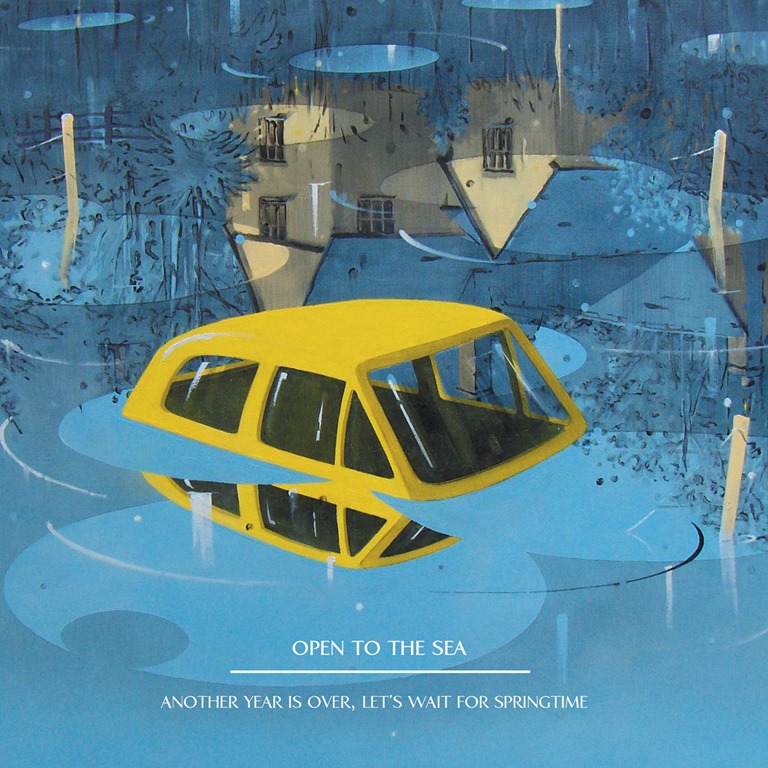
Open to the Sea’s new album, released late December provides the soothing backdrop to my existential strife, and it’s barely there for the most part. And yet, it’s there just enough: understated, yet still clearly stated.

The press release provides some useful insight into the album’s origins and its creators: ‘Open To The Sea is the collaboration project of Matteo Uggeri and Enrico Coniglio and Another Year Is Over is their second album. While Coniglio focusses on guitar, synths and other instruments, Uggeri adds samples and field recordings to create a soundcosmos full of tiny melodies and themes with appereance by some guest musicians on drums, trumpet and cello. That would make a perfect experimental ambient album with jazzy moments, but Uggeri & Coniglio push this release further by adding some vocals to most of the tracks by inviting guest singers like Dominic Appleton (This Mortal Coil) or Lau Nau from Finland.’

Minimal post-rock forged from sparse piano notes which drift into a rarefied air, spun with subtle, near-subliminal swirls of ambience, and stammering, glitching beats that hammer like a palpating heartbeat rattling in a tense ribcage, and picked guitar notes waft into the ether.

With different vocalists contributing to the various tracks, the tone and feel changes: ‘Heavy Like a Falling Leaf’ is soft, airy, yet poised, while ‘Uninvited Ghost’ and ‘Crystal Dog Barks’ feature a spoken word lyrical delivery, which in some respects changes both the dynamic and balance, and the function of the musical accompaniment, rendering the piece less a song and more of a narrative with instrumental backing.

‘Duduk Confession’ is hushed, brooding, with haunting strings and ominous hums lingering in the shadows, and on ‘Tapes and Cows Pt 1’, lonely brass wails softly over low notes to produce the most forlorn jazz imaginable. Scraping strings and frosty synth flickers accompany the deepest woe, which gradually evolves into warped space-age electro that melts into some warbling jazz trumpet.

The penultimate composition, ‘facing the waves’ is by far the most conventionally ‘songy’ of the ten, with a straight-ahead drum rhythm and solid piano providing the primary instrumentation on a whispy indie/shoegaze work. The fading refrain of ‘time now to start again’ is sung by a layered-up vocal set and, unexpectedly, Interpol come to mind.

The final song, ‘Another Year is Over, Let’s wait for Springtime’, with its whispering dialogue and soft dulcimer shimmers and soft, snowy strings that glide smoothly into the darkest corners, reminds me of my urge to hibernate, but also the fact that everything passes in time and everything is cyclical. Yesterday, today, tomorrow – they’re all points on a circle, and as linear as life lived is, as sure as birth and death, one year will follow the last, and so it will go on, whether we’re here or not.

AA
MD080_front