Posts Tagged ‘Zeitkratzer’

zeitkratzer productions / Karlrecords – 22nd September 2023

Christopher Nosnibor

SCARLATTI represents something of a departure for zeitkratzer, the neoclassical collective headed by Reinhold Friedl, master of the prepared piano and a renowned avant-garde composer in his own right. While their performance and recordings usually focus on modern composers and avant-gardists spanning Stockhausen and John Cage via Whitehouse and Lou Reed, with a reinterpretation of Metal Machine Music, here they turn their attention to the altogether more historical figure of Domenico Scarlatti (1685-1757). He is best known – although this is relative – for composing some five hundred and fifty-five keyboard sonatas, and his being a progenitor of classical music. But a large portion of his work went unpublished in huis lifetime, and much has only been available sporadically since.

As the notes which accompany the album explain, ‘Little is known about Domenico Scarlatti… His music is, so to speak, left to its own devices: free, cheeky, playful, sonorous, surprising… Harmonically strolling again and again into unforeseen regions, the ear leads, not the theory; and also the fingers get their right: playful and haptic it goes. Scarlatti explained, “since nature has given me ten fingers and my instrument provides employment for all, I see no reason why I should not use all ten of them.”

But Scarlatti does not contain music by Scarlatti. Instead, the six tracks presented here are all composed by Friedl in response to Scarlatti’s work.

As such, this is much a celebration of Scarlatti’s ideas and approach to composition and so the explanation of the process and thinking behind it bears quoting: ‘Freedom, friction and listening pleasure instead of convention: “He knew quite well that he had disregarded all the rules of composition in his piano pieces, but asked whether his deviation from the rules offended the ear? He believes there is almost no other rule than that of not offending the only sense whose object is music – the ear.”

‘Reinhold Friedl applied this principle and composed the music for a choreography by dance company Rubato. Dance music drawn from Scarlatti, who was so inspired by dance music. The material of the piano sonata F-minor K.466 is twisted anew in all its richness, shifted back and forth, declined, frozen, noisified, sound structures extracted, floating. Those who know the sonata, will more than smell it’s [sic] shadows.’

The six pieces are indeed varied, in terms of mood and form. ‘lias’ is booming, droning, woozy, slow discordant jazz, low, slow, and with lengthy pauses. It’s not something anyone can dance to, and rather than light and playful, it feels dark and sombre. This is less true of the altogether sparser, but stealthily atmospheric ‘muget’.

‘pissenlit’ blasts in with churning industrial noise, a snarling blast that lurches and thunders, crashes and pounds withy relentless brutality. It’s clearly as far removed from the music of the seventeenth century as is conceivable, but beside the lilting piano and quivering, droning strings and subsequent stop-start levity of ‘reine des prés’ the sequencing of the pieces serves to highlight Scarlatti’s versatility, if not necessarily his predilection for playfulness. The playfulness manifests differently and unexpectedly here: ‘pissenlit’ is in fact the French word for ‘dandelion’, a plant often associated with a certain element of fun, of lightness, so the fact that this piece is three and a half minutes of gut-punching abrasive noise worthy of Prurient or Consumer Electronics is illustrative of the disparity between expectation and actuality.

Discord and discomfort abounds as drones and strings tangle amongst one another, heaving and wheezing and occasionally offering glorious, sun-hued vistas through the breaks in the widely varied forms, which feel elastic, and as if Friedl and co are stretching the fabric of the material to see just how much it will give. And it turns out, there is a fair bit of room. ‘reine des prés’ explores space, the gaps and pauses between the notes, and feels like a sort of musical cat-and-mouse which would equally work as soundtrack piece, but it has a cartoonish quality which means it’s more Tom and Jerry than anything else. But it is by no means flippant, throwaway. Entertainment is serious business, after all.

‘violette des marais’ brings pomp and drama… while the final track, ‘astis’, is skittish, playful but also frustrating in its hesitant, halting structure.

Scarlatti is interesting, entertaining, and bold, going out on a limb to present such an unconventional interpretation of a historical artist’s career. But this is largely the purpose of zeitkratzer: together, they re-present music, excavating the archives but presenting them through a prism of contemporary and avant-gardism, with jazz leanings but without being jazz in the way most would interpret it. In short, zeitkratzer continue to push and redefine musical boundaries, and long may they do so.

AA

a1585066167_10

zeitkratzer productions – zkr0027 – 23RD October 2020

Christopher Nosnibor

As the founder of one of Europe’s leading avant-garde orchestral ensembles in the form of zeitkratzer, whose releases include recordings of Metal Machine Music, works by Stockhausen, and two collections of Whitehouse ‘covers’, Reinhold Friedl is very much at the forefront of contemporary classical. Formed in 1997 with Friedl on piano (sometimes a ‘prepared’ piano, a la John Cage), they’ve established themselves a formidable force, incorporating elements of free experimentalism and drone.

For the recording of KRAFFT, the nine-piece ensemble came together with another respected musical collective, Ensemble 2e2m, a chamber group from Paris dating back to 1972, known for their unique sound and the first recordings of Giacinto Scelsi’s music.

As the press release recounts, KRAFFT for orchestra was composed in 2016 as a commission from the French State and premiered in Paris and Marseille. It was also the first meeting of the two ensembles – and yet the come together perfectly to create four immense, drone-orientated passages.

Being Friedl, there is a great deal of detail and precision behind the methodology: this is certainly not random stop-start hums and thrums or elongated notes played with varying – and usually increasing – intensity, and for this reason I shall quite at length: ‘KRAFFT is a minimalist maximal composition: all instruments play in rhythmic unison throughout. Only the sounds and their combinations change relentlessly throughout the piece. KRAFFT is spelt wrong on purpose to create an ironic-onomatopoetic rendition of the German term “Kraft”, meaning “power” or “force”. The listener is exposed to a sonic undertow. The notion of huge power and force is connected here to clandestine and unknown rules controlling the progression of sound; something is happening, but we do not exactly know what, when or how. KRAFFT is composed with the help of the computer program TTM (Textural Transformation Machine), developed by Reinhold Friedl to sculpture multiple random processes.’

The TTM formed part of Friedl’s Ph.D. at Goldsmiths University London, and was developed by the composer to sculpture texture transformations with the help of sophisticated random processes. As such, Friedl’s compositional methodology develops way in which John Cage incorporated random determiners within his work, and in using a ‘machine’ to make those random selections, he distances the ‘composer’ from the composition and increases the likelihood of true randomisation.

Returning to KRAFFT, there is a clear trajectory to the composition as a whole, namely an intensity and volume which increases incrementally as it progresses over the course of half an hour. The first part is soft, light, even playful, moving into somewhat darker, more discordant territory onto the second.

By part 4, immense booming low-end notes surge and rumble with such density as to have an almost physical force. Atop of this, the smaller strings scrape, squawk and twitter like birdsong and feedback. It’s an eleven-minute tidal wave of sound that swells and surges to a crescendo of truly enormous proportions. While it’s safe to say it’s unlikely to be aired on Classic FM, KRAFFT is as accomplished and powerful orchestral work as you’ll hear all year.

AA

zkr0027_front

keitkratzer productions (zkr0020) (CD) / Karlrecords (KR027) (Vinyl) – 26th February 2016

Christopher Nosnibor

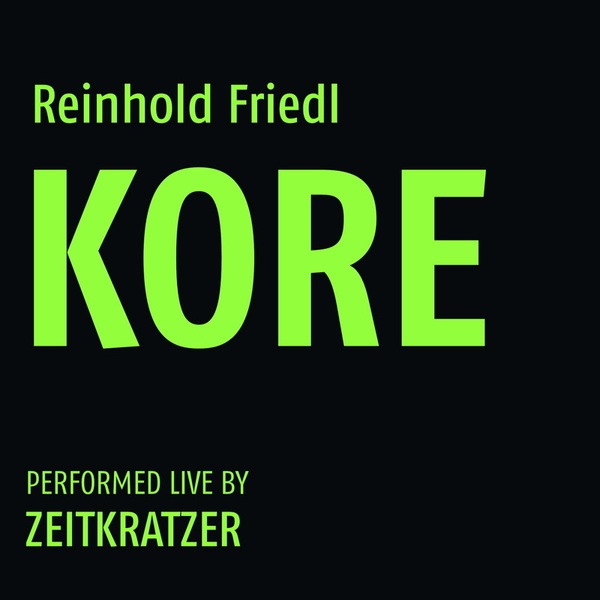
Reinhold Friedl’s keeping it in-house with this one, with the Zeitkratzer collective which he helms performing a reworking of one of his own pieces. Kore is a development of his earlier Xanakis [a]live! (2007), which was an homage to French-Greek composer Iannis Xanakis. Originality may be dead, but artistic evolution is not, and here we see Friedel engage fully with the organic processes of influence and appropriation, and the idea that a work is never complete but continually subject to re-evaluation, reinterpretation, reconfiguration.

Pained screeching of tortured strings, form long, agonized screams and wails. On the lower register, cavernous rumblings and ominous echoes. It quakes and trembles and teeters and bucks, crashing and lashing, a sustained and calamitous wall of sound akin to how one may reasonably imagine a galactic storm. And it goes on for what feels like an eternity, light years of shuddering textural depth stretching out and fully enveloping the senses.

While the CD track-listing shows ‘Kore’ as being presented in just two parts, its mastering in fact replicates the vinyl edition’s four sides, with each piece between 11 and 16 minutes in length. As a single entity, it crashes and grates, squalls and shrieks, grunts and groans. And it never lets up, a sustained crescendo of sonic and psychic disturbance, a tempest of clashing noise, a raging storm.

The segmented arrangement works well: for while ‘Kore’ is clearly a single body of work, there are distinguishable differences between the four tracks. The second is comparatively quieter and less intense than the first, but the tones still forge sharp shards which slice into the cerebellum. Trilling and tweeting shrilly in the upper reaches of the spectrum, dark scrapes create perilous undercurrents which build in density.

Vast crashes of sound, immense gongs of violence slice the atmosphere in the third, more percussively-orientated part. It shudders and heaves, before finally screaming onwards through the tumultuous final 11 minutes. A blasting wall of noise which assails the listener with all sounds all at once, it’s an immense sound and an immense sensation that sounds like no orchestral work you’re likely to have heard before, and, quite conceivably, nothing else you may have experienced, period.

Zeitkratzer - Kore

zeitkratzer Online

Keitkratzer Productions – 26th February 2016

Christopher Nosnibor

Reinhold Friedl’s Zeitkratzer collective are well established as trailblazers, tackling not only some of the most challenging composers and musical works, but also dismantling the distinction between genres and fields. They may use conventional orchestral instruments, but the sounds they produce are anything but conventional or readily recognisable as orchestral. It’s their unique approach to the creation of sound that has enabled them to not only interpret and perform, but do justice to, works ranging from Metal Machine Music to material by Whitehouse. Here, the nine instrumentalists are joined (for the third time) by Japanese experimental / noise performer Keiji Haino on vocals, and we find them revisiting one of the most difficult, divisive and groundbreaking composers of the 20th century in the work of Karlheinz Stockhausen.

The track-listing is the same as the Aus den Sieben Tagen album, recorded live by Keitkratzer without Haino in 2011. The compositions are the same and the performance similar in essence, but the overall sound achieved on Aus Den Sieben Tagen feels less brutal. But with restraint comes a greater sense of nuance, and a more menacing overtone.

After a silent play-in, ‘Unbegrenzt’ builds a long, low wheezing drone that sustains in perpetuity. Earthmoving bass tones growl in the sub-strata beneath it, while Haino emits droning, guttural incantations, groans and coughs as if attempting to expel his innards through his mouth before the sound once again fades gradually toward silence.

Emerging from the void, ‘Verbindung’ builds on the dark atmospherics which characterise the album, which simmers with, low, slow-building tension, scratches and scrapes, hums and hisses. Dank echoes and alien, animal sounds, snarling, growling, salivating dangerously.

The discordant brass and crashing, non-rhythmic percussion of ‘Intensität’ is a blast of anti-jazz, over which Haino coughs and splutters and heaves, howls and jabbers and screams like a possessed man in the throes of an exorcism.

Final track, the seventeen-minute ‘Zetz Die Segel Zur Sonne’ hangs on an eternal drone, the subterranean croak of the vocal conjuring images of ancient demons performing purgatorial rituals reminiscent of ‘Monoliths’ era Sunn O))). Truly, it’s a monster.

Zeitkratzer - Haino - Stockhausen

Zeitkratzer Online