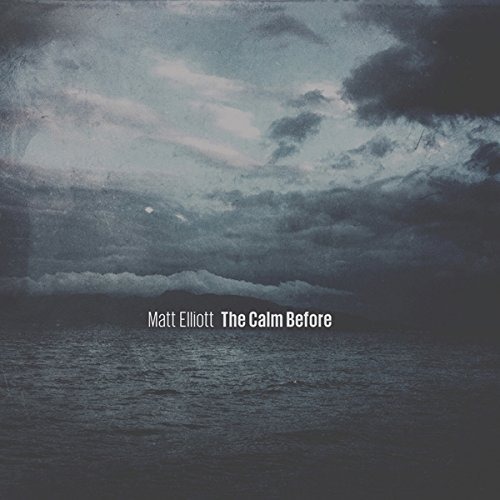
Matt Elliott’s solo work released under his own name is a world apart from his output under the Third Eye Foundation moniker. However, as the press release reminds us, he’s ben flying solo for a while now: The Calm Before, released four years ago, was his seventh solo effort. Farewell To All We Know is not the storm his previous album, The Calm Before alluded to, but nor is it an entirely mellow affair either. There are currents that run deep and perturbed in Farewell To All We Know, an album that leaks a certain sense of despondency which is often hard to define. It’s all in the mood.
The title track, which arrives after a brief instrumental introductory piece, is representative of the album as a whole: sparse acoustic guitar is the primary accompaniment to Elliott’s Leonard Cohen-esque growling drone. He sings low and mumbles his lyrics, but there’s something appealing about this gruff unintelligibility. Oftentimes, the vocals are emitted in monosyllabic breaths, breaking the words down to simple sounds, at which point they become less about linguistic meaning than the conveyance of a feeling, a mood, an emotion.
Flamenco favours and understated piano colour the instrumental slant of the album, giving it an almost continental hue. The soft, vaguely romantic – but bleak – stylings of the compositions are charming, sedate but with an undertow from currents that run dark and deep.
‘Can’t Find Undo’ is dark, stark, and brings a rumbling ambience as a prelude to the almost nursery-rhyme sing-song melodies of ‘Aboulia’ and the scale-driven ‘Crisis Apparition’ is easy on the ear but still drags on the soul.
Farewell To All We Know is a lugubrious and at times slow to the point of dragging effort, but one feels that’s the intention: this is not a pop album. Or a rock album. Farewell To All We Know is bleak and harrowing, but also charming and enjoyable in a dark, dark, dark folksy way.
‘There can be no doubt with release of his third album, A Night Full Of Collapses, that Les Marquises is a remarkable project,’ proclaims the press release. Ordinarily it would be readily dismissible as hype, but a few tracks into A Night Full Of Collapses it becomes clear that this is not the case. Moreover, it’s a statement of fact.
I’m by no means the only critic to laud albums for their diversity and eclecticism, citing these qualities as evidence of evidence of artistic vision and capability. More often than not, this eclecticism manifests as an explosion of disparate sonic fragments, pulled together as if by some magnetic force, their relationships unknown and unknowable to the listener, with their only overt connection being the associative links forged in the mind of the creator. We applaud the creativity and the artist’s capacity to convey the electrical storm of the mind and something approximating the experience of life in the postmodern age in a single document. Sometimes, we may marvel at the artist’s ability to pull together such myriad sources and reference points while retaining some semblance of cohesion. Oftentimes, the likelihood is this praise will be sincere. It’s hard not to find some admiration and respect for an artist who can demonstrate a capacity for such mental and sonic gymnastics.
A Night Full Of Collapsesis an album which is a rich tapestry of ideas. However, it isn’t an explosion of ideas: it’s something infinitely more subtle, more refined, more nuanced, more articulate. I’ve spent an entire week of evenings attempting to capture the album’s appeal and the experience of listening to it, but invariably find myself becoming distracted – not because the music fails to engage me, but because it sends me off on divergent psychological journeys, each track prompting a new trajectory for my introspective mental meanderings. I’m listening, but I’m not, because I’m being subliminally guided towards interior spaces, and A Night Full Of Collapses is the soundtrack to my fugue-like experience. I’m so reply immersed in the experience, I forget to type. Repeatedly. I resurface momentarily, and suddenly realise that once again, four or five songs have passed and I’ve not typed a word and can’t remember a thing. No, it not the Oranjeboom, Rioja, or Russian Standard which is responsible for my apparent amnesia.
Whatever this album seems to be at any given point, it is not. It begins as a work of haunting chamber music, in equal parts solemn and playful, as strings, picked and struck, form a regimented backdrop to the breathy, vocal utterances delivered with a Gallic je ne sais quoi… ‘Valées Closes’ possesses a quiet, restrained intensity, even when the drums rush in against a burst of expressive piano notes which cascade in an effusion of excitement.
Jean-Sébastien Nouveau leads an extensive ensemble (which now includes Matt Elliott of The Third Eye Foundation and Agathe Max of Ofield and Farewell Poetry), through a carefully-orchestrated set of compositions. It’s the hushed restrained approach to composition which renders A Night Full Of Collapsessuch a remarkable album. It encroaches into the mindspace by stealth. The dreamy, drifting ‘Feu Pâle’ is exemplary: a slow, hypnotic drifting tune, over which Nouveau croons a heavy-lidded, slow croon that’s sort of soporific, sort of comforting but sort of uncanny.
‘The Beguiled’ is built around an insistent tom-led rolling rhythm and suspense-laden piano and builds an expansive tension which ultimately dissipates rather than climaxes. ‘Following Strangers’ is a woozy, soporific semi-ambient song, driven – no, not so much driven as pinned together – by a slow, echo-soaked, dub-inspired beat. The darkly brooding piano-led Des Nuits’ is dark, uncomfortable, the low, creeping bass and piano providing a sparse sonic backdrop to Nouveau’s queasy, semi-whispered vocals, a strathing whisper building unsettlingly beneath the surface.
Coming to, to discover ‘The Passing’ has almost passed, I wonder again where the time has gone where the album has gone, and how Les Marquises have achieved this sonic sleight of hand, this mystical folding of time and mind. After so many slips in time, so many strange moments of detachment accompanied by A Night Full Of Collapses, I have decided that I am happy for this question to remain unanswered in perpetuity. It’s rare for an album to have such an inexplicable effect, and to attempt to unravel it would be to break the spell.
Taking only half of a well-known phrase by way of a title, The Calm Before carries an implicit connotation of incompleteness, something unfinished, abridged. While there’s nothing remotely sketchy or half-formed about the six tracks on this album, their sparse, spare and elegant folk qualities do subscribe to a certain degree of minimalism.
As Third Eye Foundation, Elliott singlehandedly redefined the parameters of drum ‘n’ bass, while his solo work is broadly categorised as dark folk. The Calm Before isn’t really so dark, and doesn’t have the same sombrenesss of, say, Drinking Songs.
The simple acoustic instrumental piece, ‘A Beginning’, which appropriately introduces the album, has a lilting, lullaby quality, which drifts into the 14-minute title track. Elliott croons gently, quietly, calmly, the melody ascends and descends. Its simplicity is its strength, and the mood is at once uplifting and wistful.
‘I Only Wanted to Give You Everything’ finds Elliott in a darker place, a delicately picked guitar line reminiscent of early Leonard Cohen providing the backdrop to his Thom Yorke-like mumblings, before shuffling beats creep in and gradually swell while widescreen strings swoop in and build to a crescendo of abject rejection as he repeats ‘but you don’t love me…’ over and over.
There’s a downtempo Latin flavour to ‘Wings & Crown’, which demonstrates almost rockist tendencies, before the final track, ‘The Allegory of the Cave’ offers some light at the end of the tunnel as soft ambient notes drift over distant beats and piano and acoustic guitar skip lightly towards hope.
 Aural Aggravation