Posts Tagged ‘postmodernism’

COP International – 31st December 2024

Christopher Nosnibor

The adage that you should never judge a book by its cover is a nonsense, and certainly doesn’t apply to records. I was instantly drawn to Stoneburner’s ‘New Year Same Fuckin You’ for its referencing – by which I mean almost direct lifting – of the artwork for the Foetus All Nude Review ‘Bedrock’ 12”, one of JG Thirlwell’s first forays into the ‘big band’ swing sound back in 1987.

It transpires they’ve got form: previous releases ape the fourth Foetus album, Nail, as well as Big Black’s Atomizer, and no doubt other releases reference things I’m unfamiliar with, as it’s impossible to know everything within another’s sphere of reference, and Stoneburner have released a hell of a lot in a comparatively short time. But I always maintain there’s more honour in being up-front in acknowledging one’s influences than trying to hide them, and have all the admiration for Stoneburner for their unashamed referencing. By now, we all know – or should know – that there’s nothing news, so better to front up and embrace the fact instead of feebly proclaiming artistic innovation.

The solo project of Steven Archer, best known for his work with the electronic rock band Ego Likeness, as well has is abstract electronica project ::Hopeful Machines::, he’s one of those creatives who simply gushes new material.

For ‘New Year Same Fuckin You’, Archer has enlisted Rodney Anonymous, Matt Fanale, and Mark Alan Miller, and it’s something of a departure from the majority of the Stoneburner catalogue, which, while very much given to industrial leanings, also place considerable emphasis on atmosphere and drama (in the way JG Thirlwell and Raymond Watts do, setting Foetus and PIG apart from the majority of the field). There’s no such subtlety here: ‘New Year Same Fuckin You’ is a balls-out blaster.

The track is pitched as ‘a rallying cry for a time when so many feel defeated and powerless. A time when giving up seems easier. But when I think of those who marched across the bridge in Selma, knowing full well what was waiting for them; when I think of the women who sacrificed everything for their autonomy; when I think of every brave soul who stood tall against oppression, I know this: we owe it to them to rise again.’

It’s a strong sentiment delivered at a time when mood and energy feels like it’s at an all-time low. It’s hard to recall a festive season that’s felt less festive, and celebrating extravagantly with gifts and feasts has felt quite wrong while the world is at war and hyperconsumption continues to drive climate change. What are we actually celebrating here? The idea that we’re ‘doing it for the kids’ rings rather hollow when you know that every overpriced piece plastic of tat stuffed in a stocking is another nail in the coffin of the future they’ll inherit.

And this brings us to the gimmick of New Year’s resolutions. How many last past the first fortnight of any given new year? Mostly people seem to resolve to get fitter, and take out gym memberships with good but misguided intent. Gym conglomerates rub their hands as they make half the year’s profits in a week or so, knowing that the regulars won’t be complaining of overcrowding again come February. Most goals set are as pointless as they are unattainable., but how many set themselves the target of being less of a cunt in the coming year, eh? Eh? Yeah – New Year Same Fuckin You.

This is a full-throttle raging technonidustrial banger, and curiously, as much as it’s in the vein of KMFDM and the entirety of the Wax Trax! catalogue with its pounding, hard-edged disco beat and snarling synths and mangled vocals, I can’t help but be reminded of ‘It’s Grim Up North’ by the JAMMs.

As an anti-trend anthem, with it’s ‘Fuck you! Fuck you! Fuck you!’ refrain, ‘New Year Same Fuckin You’ is the perfect counterpoint to all of the motivational guff that circulates all year round but becomes particularly prevalent at this time of year as every agency going advertises to appeal to your shame – shame for your indulgence, your weight gain, your slacking, your failure to move forward in your life goals – in an attempt to take your money and convince you that spending with them will make your life better. Yes, fuck you! Get a grip. You want your life better? Start by taking control of your own direction, instead of paying for apps and influencers and life coaches to tell you what you already know. Need reminding that this is the true way forward? Listen to this on repeat for an hour daily.

AA

a1200904832_10

Human Worth – 18th October 2024

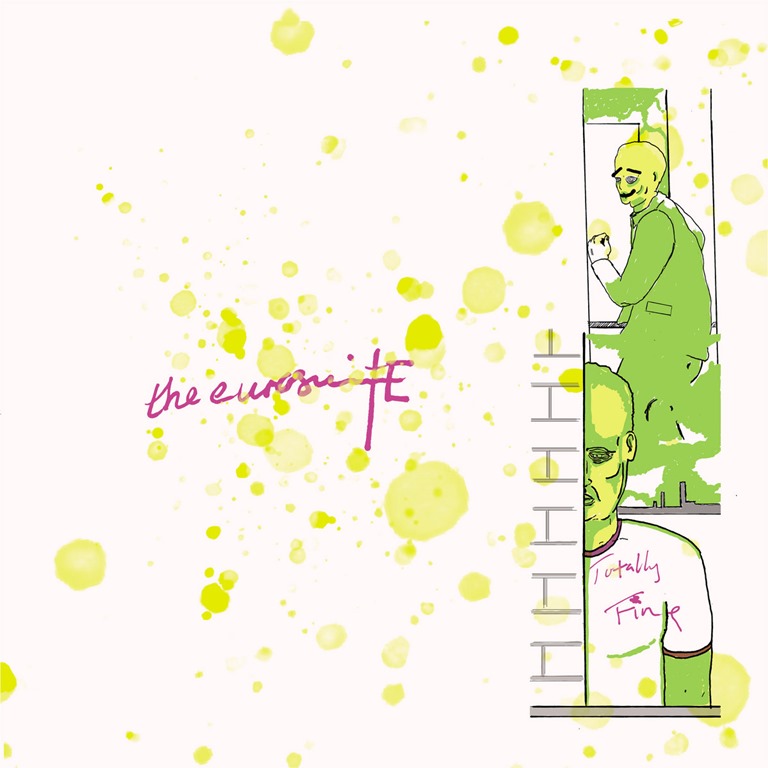
Sorry, not sorry, as they say. In the spring of 2023, off-the-wall supergeroup collaboration featuring members of USA Nails, Nitkowski and Screen Wives, The Eurosuite, released their third album, through Human Worth. They were so sorry, they’ve done another. Only this time, they promise, it’s different.

As the accompanying notes explain, ‘Produced by Wayne Adams (Petbrick / Big Lad) at Bear Bites Horse Studios, the band have taken a different approach from their maximalist output on their second LP Sorry – do less. Where the songs on Sorry were built from a variety of jams, band member ideas, traded demos and looped phone recordings, the 10 songs within Totally Fine were all built and mercilessly edited from a full band improvisations, with individualism, indulgence and egos set aside to better serve the songs… That spirit of minimalism is threaded through each track, which veer from sinewy post punk (‘Crustacean Blue’), throbbing death disco (‘Antimatter’) and something between driving krautrock, surf rock freakouts and an evil version of the B52s (‘12 Diphthongs’, ‘Houseplants’)’.

Sorry was a cracking album: that’s essentially a fact. It still is. But it was seeing them live that they really clicked for me: something about that manic energy in the room, the way each member of the band bounced off one another, if felt as if there was something happening in real-time that went beyond the recorded work.

Here, all of the same elements are present: fizzling synths, jerky guitars, sudden thundering bass runs, changes of tempo, blasts of noise, beats that flit from disco to industrial pounding, and vocals which swing from half-spoken to shouty – and that’s only in the first couple of songs, with a combined running time of less than five minutes. But there’s a newfound focus and intensity, and well as, perhaps a greater separation of instruments which lays the components elements more evident.

There seems to be an emerging subgenre of weird, quirky, jerky noisy shit that’s a bit mathy but with some fried electronics and simply prone to exploding in any direction without a moment’s notice, and it’s noteworthy that both The Eurosuite and Thank, prime exponents of this wide-eyed demented frenzied kind of racket have both found homes at Human Worth. The label’s always had its ear to the ground and its tendrils out for noisy stuff with something different about it, and this feels like an emergent form.

Somewhere in the recesses of my overcrowded memory, there’s a vague recollection of an interview with a band sometime in maybe the late eighties – it may have been a grebo act like Gaye Biker on Acid on how the future of music might be weird, like ‘people playing bits of toast or whatever’ (the quote is from memory, since I’m buggered if I can find it on the Internet and don’t have a month spare to look through books and press cuttings for the sake of fact-checking a detour in a review for an album due out next week). Anyone who’s seen Territorial Gobbing will likely agree we’ve reached that point. But with the likes of Thank and The Eurosuite, they may not be quite that far out, but they’re pretty damn far out in terms of the way their compositions leap and lurch all over, and are simply so far removed from more conventional song structures with verses, choruses, mid-sections, even bridges and pre-choruses or whatever that song forms are being pushed to new limits. And this is exciting and brain-bending in equal portions.

Perhaps this is the culmination of everything that’s preceded it. Perhaps it’s a reaction to the crazy, overstimulated world we live in. Perhaps it’s the soundtrack to emerging from the other side of postmodernism. After all, postmodernism was deemed a ‘schizophrenic’ culture by Deleuze and Guattari in their seminal work, Anti-Oedipus¸ suggesting that schizophrenia is the only sane response to a deranged world. And perhaps this is the proof.

Totally Fine as a title intimates a breeziness, but the kind of airy offhand response which often masks a darker truth. Not that Totally Fine is a showcase of frenetic flailing and pedalling in all directions, and as such has a groundlessness to it. It’s the sound of searching, of grappling with reality, and the very concept of reality.

Some of the songs are barely a minute long: ‘Crustacean Blue’ brings a stuttering blast of a riff that lasts for a mere fifty-five seconds, electronic squeals adding that all-essential eye-popping dimension, and only ‘Reflection Monster’ runs past three minutes. ‘Bellyache’ is one of the most ‘conventional’ songs on the album, and comes on a bit like Suicide and early Cabaret Voltaire with a hint of Throbbing Gristle.

Somehow, by stripping things back, they’ve cranked up the claustrophobia and amped the intensity. There are some dark, low, grinding grooves and some manic hollering vocals on display here, and they do define the album – but that defines it more is the audacious racket, the wild anti-structures, the sheer imagination.

Clawing my way through ‘Bagman’ ‘Earworm’ I can feel my blood pressure increasing as the manic noise amps up… and up. But I’m totally fine. Really, I am. Totally Fine.

AA

a0485217786_10

22nd December 2023

Christopher Nosnibor

We live in strange times – times which have gone beyond the established expectations of what defines postmodernism into a period which is something else. Something else we’re yet to come to terms with, let alone define. Postmodernism heralded the arrival of what one might call ‘the nostalgia schtick’ by meshing together past, present, and future to conjure something of a liminal territory in which all times exist simultaneously. But if postmodernism, as defined by the likes of Francois Lyotard and Frederik Jameson is primarily defined by an accelerated pace of communication and an overwhelming blizzard of media, one thing which no critics or theorists could have readily anticipated when defining the term was the rush to cling to the recent past, or that the next big boom in industry would be nostalgia and revivalism.

The advent of the Internet heralded a revolution in terms of all things archival. Back in 1996 or thereabouts, when I first got online – with AOL on a floppy disc and a 14k dial-up modem plugged into a second-hand IBM 486 ­ it seemed like a new dawn. It was basic, but text from obscure zines from the 60s, 70s, and 80s and pretty much anything you could ever wish for from the depths of the most subterranean archives was suddenly available, as was anything else. By the early 00s, Warren Ellis’ Crooked Little Vein was the world as it was: if it existed, it was on the Internet. But then the Internet got hijacked by big business, MySpace ceased to be the anarchic free virtual world that it had been, and everything turned to shit. Because capitalism ruins everything.

Amidst all of this, postmodernism is – or was – characterised by a celebration of depthlessness, of rejoicing in its own disposability, what Stewart Home referred to as ‘radical inauthenticity’. Postmodernism was laced with irony, knowingness, self-awareness. We seem to have lost the sense of irony and humourous knowingness somewhere along the way, and as we grapple with AI, deep fakes, and music industry plants, we have come to return to the question of authenticity as something which should perhaps be valued. Admittedly, these debates are perhaps minority issues, because for the most part society is split between those who believe everything they’re told and those who believe nothing, and there is only limited space for nuanced critical debate. It is, of course, hard to have a nuanced, critical debate in segments of 140 characters or so, and this compression, coupled with an ever-decreasing collective attention span has, undoubtedly been damaging in many ways.

The tug-o-war regarding the value of authenticity has been particularly apparent in music, as fellow musicians and critics alike have descended on punk and ‘indie’ bands to challenge their authenticity as exponents of punk and indie. With the rise of the ‘industry plant’ threatening the integrity of the DIY and indie music scene, it does make sense, but the point I suppose I’m ultimately making is that nothing really makes sense anymore, and that everything is a contradiction.

So, at the same time as AI has surged forwards to recalibrate the means of production, we’ve also witnessed a sustained boom in all things nostalgia. As much as it would pain many to admit it, it’s that same pining for the past that has driven the demand for vinyl, cassettes, grunge, tribute bands, as brought us Brexit. Admittedly, a yearning to return to the days of the Empire and when England resembled a Hovis advert is more socially damaging than basking in the glory days of Britpop, but it’s a pretty close call. A significant portion of the success of Stranger Things, for example, is its retro context, which has seen many hailing it as bearing parallels with The Goonies. I can’t help but wonder if this passion for the not-so-distant past is a means of escaping the absolutely hellish present and the utterly-fucked-up future we’re hurtling headlong into.

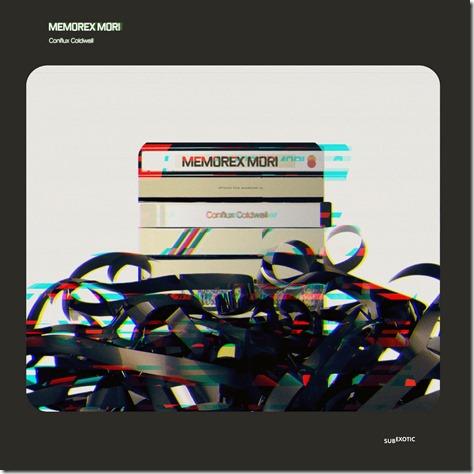
Conflux Coldwell’s latest project is one which plunges deep and direct into nostalgia, and as such resonates with the zeitgeist which has been simmering for a few years now. We’ve all seen it: the ersatz recreation of scratchy recordings, crackles and pops of old vinyl and the warps and snow of videotapes. And now everyone’s back to buying vinyl and audiotapes… how long before the VHS renaissance? And at the same time, it raises the question of ‘the archive’, of the (im)permanence of documents. We have always believed that documenting and recording events was the route to immortality, and that the advent of modern media would solidify our legacy in the same way as The Anglo-Saxon Chronicle or The Bayeux Tapestry. It was not so long ago that the Internet was supposed to be an eternal archive of everything ever. Only now, it’s apparent that modern technology is as ephemeral and disposable as our very culture, and that online archives vanish the moment their owners stop paying for the domain.

Memorex Mori is an unusually authentic work, born out of an excavation of -personal archives, as Coldwell explains: ‘Last year I found a dusty box of old unlabelled VHS tapes at my parent’s house, including some early work of my own I’d long forgotten about. Unfortunately the tapes were all in very poor condition and I only managed to recover some of the material. Despite the bad quality I decided to sample the videos anyway and make something new out of the various noisy remnants – the final result of that extended process is Memorex Mori.

Coldwell himself isn’t outside the frame of nostalgia with this ambitious project, either, as he continues: ‘VHS was the medium of my childhood in the 80s and 90s, and was still routinely used for budget productions by the time I started making films and music of my own. Looking through the old tapes made me realise the ultimate fragility of all our recordings and the memories they hold. These analogue tapes only have an estimated lifespan of 25 years, and this artificial life is only granted to the videos we actually decide to keep. The vast majority ended up in landfill when the world went digital – what was lost in the waste? In contrast, we might think that current digitisation and cloud storage allows our memories to live forever, but they are still fallible. The major difference is that with digital archives this mortality is hidden – with analogue media we can potentially witness that death happening in slow motion before our eyes.’

It’s an interesting and valid distinction between analogue and digital: growing up in the 80s and 90s myself, I remember being told not to vacuum clean near any video tapes, and so on, while toward the turn of the millennium the emerging digital future was presented as eternal. But now, it’s clear, that there is no such thing as permanence, or the eternal, and that any archive is as fragile as life itself.

And so, Memorex Mori is a multi-faceted, multi-dimensional, multi-media project, where past, present, and future collide, and postmodernism melts into the as-yet-to-be-defined present. It’s a film and it’s a soundtrack, and both can be appreciated independently of one another, as intended.

Coldwell expands on his notes, explaining ‘This project continues a lineage started by William Basinski and The Caretaker, exploring themes of memory loss, entropy and spectrality, through the sampling of destroyed recordings. But Memorex Mori extends this idea into the visual realm, presenting a feature-length music video alongside the music. As well as sampling early Conflux works from tape (Traveller, Glitch, Machinedance and Trainboy) various other unknown recordings were appropriated from the video box – all sorts of forgotten cultural detritus including my Mum’s 30 year old Open University programmes. A few modest pieces of equipment were used to add extra sonic layers – including the Korg NTS-1 and a home-made Marantz tape delay – then all bounced back to VHS.’

The video is a disorientating barrage of film clips, from train journeys to clouds, via small aircraft lifting off and droplets of water rippling out. Everything flickers and fades , glitches and warps. At times, we’re simply submerged in a snow of magnetic degradation and ruination, and it’s not always easy to discern what we’re actually being shown. But, often devoid of context, these detached, fragmentary scenes take on a sense of significance. The effect is an uncanny emotional response, a pull in the lower intestine as something unexplained and inexplicable evokes something within. There’s a comparison to be drawn with Memorex Mori and the experimental works created by William Burroughs and Brion Gysin in the late 50s and early 60s – in the soundtrack, the tape experiments, perhaps, but more so the whole audiovisual project, which calls to mind films such as Towers Open Fire, produced in the mid-60s with Anthony Balch, and a step closer to what Gysin’s quest to realise ‘a derangement of the senses’.

The soundtrack is the perfect soundtrack to this endlessly unsettling sequence, an eternally shifting sonic drift that’s at times noisy, even harsh, while at other altogether more ambient. Like the visuals, it draws you in, but it also stands independently as a purely sonic experience, and it’s also a smooth, expansive scene for reflection, and perhaps it’s to be expected that the soundtrack has greater impact when experienced in isolation, without the distraction of the visuals.

As a whole, or in part, Memorex Mori is quite an unsettling experience: visually compelling, and aurally challenging. It demonstrates the fragility of any documentation, any archive, and of life itself. Nothing lasts forever. And it speaks of how, as memory fades, so the documents diminish in value: moments captured in moving or still images which seem so essential at the time lose meaning over time: where was that picture taken? What was I doing there? Why did I think that would be worth filming / photographing? Who even is that?

I feel a weight descend as I reflect on all of these things while immersing myself in Memorex Mori. I can’t even begin to imagine the experience of assembling it. Then again, I can’t really assimilate the experience of other viewers or listeners, either. What’s intensely personal to an artist is likely to hit a spot with the audience, but for each, the reception will differ, based on their own experiences, their own immediate headspace.

But, regardless of individual interpretation, the vast ambition of Memorex Mori is matched by its accomplishment. THIS is a document. A powerful work, which will stay with you long after the silence descends.

AA
a2043088135_10

fals.ch – 9th June 2023

Christopher Nosnibor

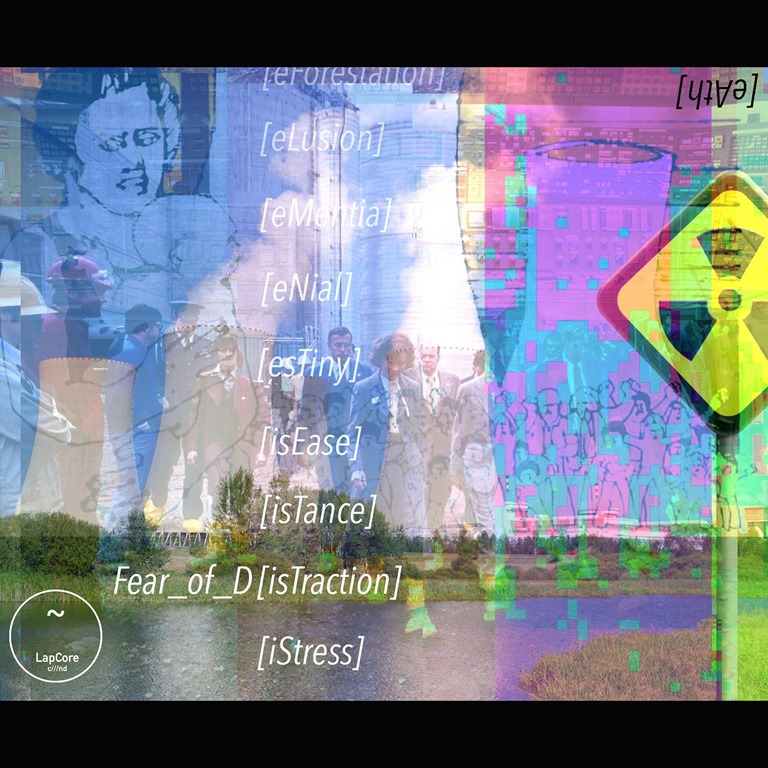
On clocking this in my inbox, I fleetingly felt a flicker of amusement as I recalled a long-lost article I had written over a decade ago about fictitious musical genres, which included LARPcore, where bands inspired by Viking Metal re-enacted historical battles in full costume. (I also mentioned Symphonic Doom before the term appeared as a thing). Then I realised that, as I’m prone to doing when I’m not concentrating, I’d misread, but then on reading the notes which accompany the new album by Kent Clelland, aka LapCore (which makes a lot more sense in context of what he does musically), my amusement was replaced by a certain crackle of excitement.

For this reason, it’s worth quoting: ‘With Fear_of_D[istraction] LapCore continues his exploration of digital audio synthesis and distortion techniques, researching the complex tonal digital structures he affectionately refers to as cTonality. In contrast to the more upbeat and aTonal album LapCore 132 (his 2017 full-length self-published release), Kent Clelland has freed himself to explore the darker, and more cerebral faces of computer music composition. With multi-channel oscillators he brings sonic entrainment into the musical range of frequencies as opposed to the typical sub-audible entrainment frequencies, composing melodic and harmonic parts with the artefacts to create cTonalities.’

But here’s where it gets interesting, and will likely prove divisive:‘Weaving polymetric binaural oscillators with a lopsided bass drum engine, he lulls your senses into a state of receptivity upon which he then sews synthesised tapestries inspired by his hyper-perceptual, cancer-treatment-infuenced dogma adventures in the pre-pandemic delirium. LapCore produces these tracks as an attempt to preserve his brain damaged audio hallucinations, sharing them in a venue larger than the space between his ears.

‘The performance of LapCore’s Fear_of_Di[straction] (2017-2022) is a 48 minute sonic quilt of recordings of AI Musical Agents during training sessions intricately hand-sewn into the fabricated projection of the audio dimension.’

Yes, Fear_of_D[istraction] incorporates elements of AI. ‘Nooo!’ people will likely shriek and no doubt some will be unhappy even with my writing about this album on this basis for propagating the death of the artist. But the death of the artist – if we take ‘the author’ in a broader context – has long been a preoccupation of literary theory and postmodernism, as far back as Roland Barthes’ 1967 essay of the same title. Yet now, as we find ourselves pondering what some are variously referring to as post-postmodernism or metamodernism, there is mass panic over the chimera we have created with speculation that not only artists but most occupations will be obsolete in a matter of years and we will soon be driven to extinction by our errant creation. I’m reminded of numerous sci-fi novels, not least of all Michael Chrichton’s Prey. Published twenty years ago, it feels more relevant now than ever, as is the way with much true science fiction, which takes current science and projects hypothetically forward, but also demonstrates that this fear is nothing new. And yes, of course, we – as a species – have pursued this end. Our demise through AI seems unlikely, but if it does happen, we probably deserve it.

While AI photos and even falsely-attributed Guardian articles are giving great cause for consternation – understandably – overall, it’s still the potential of AI which is scarier than the current capabilities, and this is nowhere more evident in music, where it’s fair to say that most purely AI generated compositions are toss. But also, in more experimental fields, composers have been using algorithms and customised programmes to generate sound since the advent of computers and synths – and I have covered countless of these in the last fifteen years.

LapCore incorporates AI as simply another tool in his kit, and has used this hybrid of man and machine to forge a work that melds Krautrock and minimal techno, microtonal experiments and harsh electronics to eye-opening effect.

The first of the album’s seven compositions, ‘Stuck Like a Magnet in Switzerland’ is built around grating oscillators and some extreme stereo panning, which is well-executed, and immediately grips both sides of your cranium and squeezes. The flow of blooping synthesised rhythms is rent with a buzzing distortion the like of which some of us will remember as the way a mobile phone signal would interfere with the TV – and at three times the volume of the busy bubbling track, it comes as an uncomfortable moment of shock. All kinds of feedback and interference disrupt the musical melange thereafter, dial-up tones and all kinds of electrical chaos collide and crackle unpleasantly. But being unpleasant doesn’t make it bad: this is one of those works that is relentlessly challenging in its pursuit of ‘difficult’ tones, textures, and frequencies, often simultaneously.

‘Microdose’ feels more like an overdose, as an angry hornet the size of a lion takes residence in the space at the front of your skull, right in the sinuses, and vibrates your brain without mercy against a backdrop of disjointed techno. This is some brutal synth torture, and elsewhere, there are drones and whistles reminiscent of early Whitehouse and Throbbing Gristle, atop dome very DAF-like electronica. ‘Americium’ is busy, a constant drip and froth of watery notes bouncing against one another – and it sounds experimental. And this is the key to appreciating Fear_of_D[istraction]: it’s not a work that tries to pretend to be a human creator hiding behind AI for a laugh, and nor is it the sound of AI running wild. Instead, it’s an album which sees its creator consider the challenge ‘how can we use this?’

If it sounds somehow ‘impersonal’, the same is true of much electronica; by the same token, Fear_of_D[istraction] very much sounds like a guy pressing buttons and twiddling knobs and looking to see just how much disruptive, disturbing synthy noise he can throw over a sequenced beat. The artist isn’t dead yet.