Posts Tagged ‘Nakama Records’

Nakama Records – 29th November 2024

Christopher Nosnibor

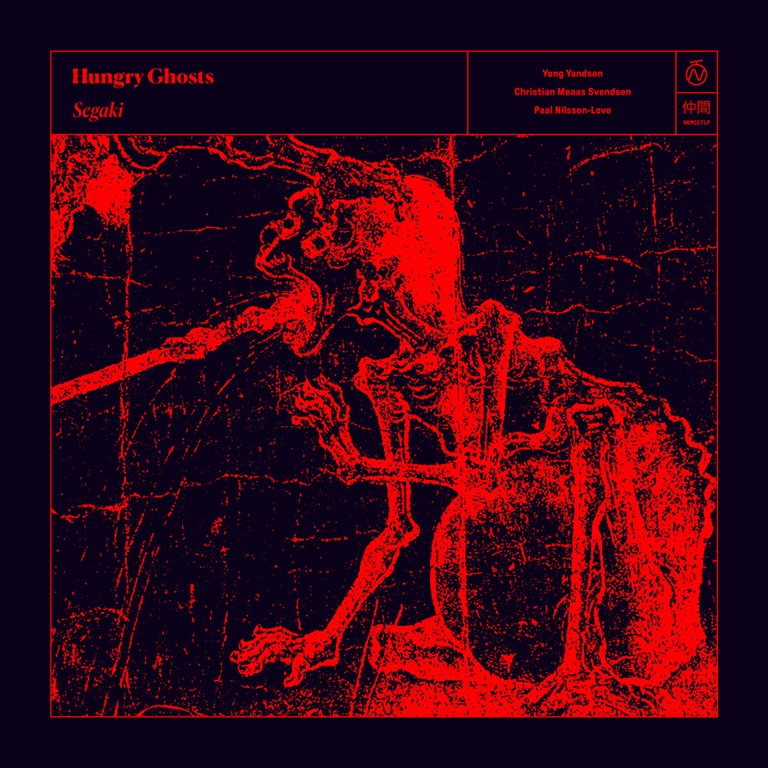
Is there such a thig as music-listening burnout? Probably not, but reviewing a new album on a more or less daily basis is knackering. There’s listening to music, and then there’s listening to music: one is passive, while the other is very much an active pursuit. But engaging – and fully engaging – with different forms of music can be strong and vigorous exercise for the mind, and when presented with music which is overtly challenging, there is a sensory workout involved, too. And Segaki, the second album by the Norwegian-Malaysian trio Hungry Ghosts, consisting of Malaysian tenor saxophonist Yong Yandsen ‘accompanied by the Norwegian powerhouse duo of Christian Meaas Svendsen on double bass and Paal Nilssen-Love on drums’ is most certainly challenging.

As their biography attests, ‘their debut record has been described as an album with an ‘unstoppable energy’ and like actual hungry ghosts (my italics) — the unfortunate souls who are reborn as pitiful creatures into their own miserable realm, punished for their mortal vices — the trio has an insatiable appetite for more… This appetite was temporarily quenched during their European tour in 2022. As part of this tour they played in a small Austrian town by the name of St. Johann in Tirol. That concert was recorded, and that recording became the raw ingredients for this release. Now, after having gone through a rather extensive two year long digestive system of listening, mixing, listening, mastering and listening again, the trio has brought us their second dish of hard hitting improv.’

The digestive system must be in quite a state if the album’s first track is anything to go by: ‘In search of filth like vomit and faeces to eat’ is sixteen sprawling minutes of frantic percussion and discordant sax frenzy. The title conjures an array of disturbing scenarios, from the dog, driven by stress, boredom, or anxiety to eat bodily waste, to something altogether more depraved and disturbed. The music itself provides no answers, only a crazed sprawl of rabid jazz which wanders and lurches in all directions, but amidst the mania, the phrase ‘shit-eating grin’ pops into my head uninvited. Of course it did. Some swear by various narcotics to open the mind, but for my money, music is the most powerful gateway to making unexpected associations and triggering recollections and reminiscences from almost out of nowhere. It’s not a grin I’m wearing by the end of this wild excursion, though, but a grimace, white knuckles gripping the sides of my chair as I exhale slowly. My head’s swimming, and I’m dizzy from the rollercoaster ride, and it’s the phrase ‘eat shit and die’ which bubbles up into my mind from my churning innards.

The viscerally continues on the altogether shorter ‘Small bits of pus and blood’ which completes side one. It’s sparser, atmospheric, uncomfortable. The percussion is altogether more restrained, yet dominates the minimal arrangement, and rhythms fleetingly emerge from the erratic clomps and clods before petering out to a lone trilling whistle.

Flip to side two and ‘Mountain valley bowels full of grime’ starts quietly but soon builds to a sustained crescendo, and keeps on crashing and braying away with a cranium-splitting intensity for almost twenty-two minutes. The drums explode in a perpetual roll, the double bass runs… run and run beneath sax mania that sounds like a jet engine.

‘A great decomposing odour’ delivers the final blow: at a minute and fifty-three seconds long, it feels like a jazzed-out sucker punch which takes unfair advantage of the dizzy, bewildered state one finds oneself in having seemingly, unknowingly, fallen down the mountainside into the valley and into the grime head-first.

The titles feel as if they belong to a gritty, grimy, sludgy metal album, but what Hungry Ghosts evidence on Segaki is that darkness, weight, intensity, and befouled viscerality are not exclusive to the metal domain, and that it’s possible to articulate sensations with a rare physicality without the need for distortion or snarling vocals – or, indeed, any vocals at all. With Segaki, Hungry Ghosts achieve a level of intensity and a power which is intensified by just how unexpected it is.

AA
a4155131662_10

Nakama Records – NKM014 – 23rd March 2018

Christopher Nosnibor

The title sounds like a Radio 4 quiz, or perhaps some selections for ‘Call my Bluff’. The accompanying blurb outlines how the album consists of three nonsensical musical conversations between Malaysian nylon guitar player Goh Lee Kwang and Norwegian bass player Christian Meaas Svendson, and describes it as ‘the story of the first encounter between two different mindsets, nationalities and generations trying – and totally failing at – making any sensible dialogue with their respective musical languages.

Success and failure are relative, of course, and one may contend that there’s no success like failure. It’s in the disconnect between artistic vision and the material realisation that unexpected creative outcomes emerge. The three pieces – I would probably hesitate to describe them as ‘compositions’ given that they are, in effect, haphazard jumbles of notes played over and across one another – are indeed sonic babble. But it’s still just freeform jazz to my ears. And for once, this isn’t a complaint or criticism.

The description reminds me of those days when every conversation feels like a misfire, and you miscommunicate with everyone you encounter. Try as you might, you never connect as intended. A jovial quip lands as an insult, a reply to a simple question leaves your interlocutor nonplussed and you realise you’ve misunderstood or misspoken, or otherwise just gabbled a stream of random bollocks for no apparent reason. You question whether the fault lies with you, or the world at large. You burn with shame. You want to hide away, an avoid people for a while. I say ‘you’; I mean me, of course, and as usual.

It takes a certain – nay, special – ability to separate and absorb any shame or embarrassment to place a document of those misfires and disconnects out into the public arena with the free admission of failure. But then again, failure in intent does not necessarily equate to artistic failure. And the disjointed, discordant jumble of notes on the three pieces – respectively entitled ‘Gibberish’, ‘Balderdash’, and ‘Drivel’ are entertaining and stand as art in the sense that they document a collaborative creative process.

At the heart of Gibberish, Balderdash and Drivel is an exploration of language, and the apparent obstacle of linguistic disparity. I’d long assumed -and believed – that the language of sound transcended linguistic boundaries. But on delving into the development of this skewed collaboration, I realise that while this may be broadly true, it is not a universal truth, and am reminded that context counts for a lot.

But the language itself matters. Dialogue doesn’t have to have explicit meaning or linear cohesion to convey something. It’s as much about interpretation as intention: the receiver / listener will inevitably bring their own perspective and one man’s throwaway nonsense is another’s serious art. The accompanying pencil for the owner to draw their own art into the blank white cover is a nice touch, which adds to the interactivity. The listener is inevitably – and incontrovertibly -implicated in the process, and this inclusion only serves to accentuate this point.

And for all its self-effacing flippancy, Gibberish, Balderdash and Drivel stands as a work of art. The very word selection is telling. In dismissing its very own existence as lesser, it does so using elevated language, indicative of an advanced and expanded vocabulary, while also adhering to the rule of threes. This is not by any means an illiterate work. Quite the contrary, in fact: Gibberish, Balderdash and Drivel is a celebratory work.

AA

AA

Goh Lee Kwang & Christian Meaas Svensen – Gibberish, Balderdash and Drivel

MC/CD/DL – Nakama Records –NKM012 – 22nd September 2017

Christopher Nosnibor

I’m not entirely sure what a no-input mixer is, and I’m not sure I have the energy or motivation to find out. But it’s one of the ‘instruments’ Utku Tavil ‘plays’ on this album, in addition to snare drum and sampler.

What I do know is that Juxtaposition is a studio work of four Oslo based improvisers (and not the indie mongs who went by the same name who came round to my flat in Glasgow in 2000 to be photographed by my achingly hip flatmate) recorded in the spring of 2016. Various timbres of opposite extreme, as a result of each musicians’ different approach and background, coexist without hierarchical restrictions. Having that in mind during playing, the mixing process played a crucial role to deliver a concrete body of equalitarian sonic output. Without compromise, moments of joy and pain, screams, feedback and bird sounds are layered on top of each other.

This is not music that’s easy to listen to, let alone love. Scraping, distorted clanks and clatters echo atop growling, prowling, near subsonic bass intrusions and an elongated howl of sustain. And that’s just the first thirty seconds. An overloading mass of shuddering, screeding extranea rapidly builds to skull-crushing intensity, as shrieks of treble erupt like solar flares from amidst the tempestuous racket.

‘Pakistansk Mango’ is a fiendish mash of vocals – Natali Abrahamsen Garner does not sound of this world, and it’s hard to compute that the sounds emanating from her being are untreated, unprocessed – shudder and judder to a babble of stuttering repetition, against a backdrop of bubbling synths, ear-shredding bursts of pink and white noise, and nail-scraping feedback reminiscent of Total Sex era Whitehouse. Pleasant it is not. In fact, as distorted metallic bangs and hammers batter through a sonic riot of indeterminate origin, I’m feeling pretty fucking tense.

A yammering percussion that sounds like a cross between a locomotive and a nailgun provides the spine behind a whirling aural assault for ‘Revolver’.

Natali Abrahamsen Garner and Agnes Hvizdalek’s voices exist outside the realm of the human, and serve to add a disturbing, unheimlich aspect to the already hellish, grating sonic torture. Screams, shrieks howls and growls are all integral to the traumatic experience. ‘1000 Poeng’ features a host of primal screams over growling synth bass and brutal, waspish feedback. On ‘Enkle I’, a deranged bleating entwines with a surging skitter of overloading electronics and a swirling vortex of nastiness, and a mess of brown noise buzz blasts in around five minutes into the final track, ‘Trost’.

Juxtaposition is a cruel and punishing work, which exploits the full sonic spectrum and every texture, from grainy abrasion to the razor-sharp to inflict maximum pain.

AAA

- dsn - JUXTAPOSITION - VIDEO titles