Posts Tagged ‘minimal’

Shhpuma – SS028LP

Christopher Nosnibor

Perihelion may be MIR 8’s debut, but the collective consists of respected veterans of the musical underground, with a lineup consisting of Andrea Belfi (drums, percussion), Tim Wright (computer, electronics), Werner Dafeldecker (function generators, bass) and Hilary Jeffery (trombone).

For those unfamiliar with the term, and / or too lazy to look it up, perihelion is ‘the point in the orbit of a planet, asteroid, or comet at which it is closest to the sun’. If the notion of translating the experience of such a journey into sound seems more than a challenge, then MIR 8’s approach is very much non-literal, with the album’s four expansive movements formed from spectral abstraction, leading the listener on a journey which is cerebral rather than physical.

Sparse notes chime, ringing out in the near emptiness. A mournful trombone note stretches out and elongates to near unrecognizability. This is a work of minimalism in terms of volume and spatial exploration, but in terms of things going on, a lot happens, just at distant intervals. Eerie, otherworldly notes ripple and ring into one another against indeterminate hums and drones. These are not linear compositions, the structures vague and informal and without regularity or definite shape. Everything exists within the incidentals, and everything is incidental.

The pace is sedate, but on ‘Scarborough Sky’ the various sounds rub together at an increased pace and affect a creeping tension with subtle dissonances and frequencies which touch – delicately but definitely – on the more sensitive ranges of the human ear, to discomfiting effect.

An interminably elongated note hangs through the first moments of ‘De Orbit’; subtle yet busy percussion begins to patter in the background, distant cymbal crash and as the depth of the sound builds, the effect is like listening to something very loud from a long way away. Heavy, single notes sound out like a ship’s horn from miles out to sea. At some point, the rhythm stops. Detonations rupture still air before bleeding into ‘Event Horizon’. The final track contains the most overtly conventional elements of rock and jazz, with a bas / snare beat underpinning some roaming, spaced-out freeform brass honks. But these elements by no means make for a conventional composition, as the elements exist with the sense of doing so independently of one another, before gradually being swallowed in reverb and muffling.

As a whole, Perihelion is a subtle, nuanced work. It’s distinguished by the attention to detail to the way in which the individual sounds relate to one another, and how their shifting places of divergence and convergence, create different sensations.


MIR 8 – Perihelion

Trace Recordings – 8th July 2016

Christopher Nosnibor

It’s virtually impossible to hear or read the word ‘Rothko’ without thinking of the abstract expressionist artist Mark Rothko – at least if you have any kind of cultural awareness. And if you didn’t immediately consider Mark Rothko on arriving here, then either kindly leave, or settle in for an education of sorts. I’d hate to be accused of elitism here, but equally, I anguish on a daily basis over the mass cultural ignorance of our supposedly educated society. Having not been taught something in school or the fact something predates one’s existence is no excuse since the advent of the Internet. ‘I don’t know any Beatles songs – they’re before my time,’ is something I hear depressingly often. They’re before my time, too, and growing up in the 80s and 90s there was no Google. Perversely, the same people who are clueless of their artistic cultural heritage know all about Star Wars and Scooby Doo and Marvel heroes created well before their time. These people are buying into nostalgia kitsch of years which predate their existence. But the chances are that while they’ll happily buy into marketed nostalgia, they won’ grasp real nostalgia or real history.

This, of course, is where the latest offering from guitar / bass duo consisting of Mark Beazley and Michael Donnelley comes in. Discover the Lost is an album out of time, and in many ways bereft of context. And yet, it’s important to orientate oneself in time and space before engaging with this album.

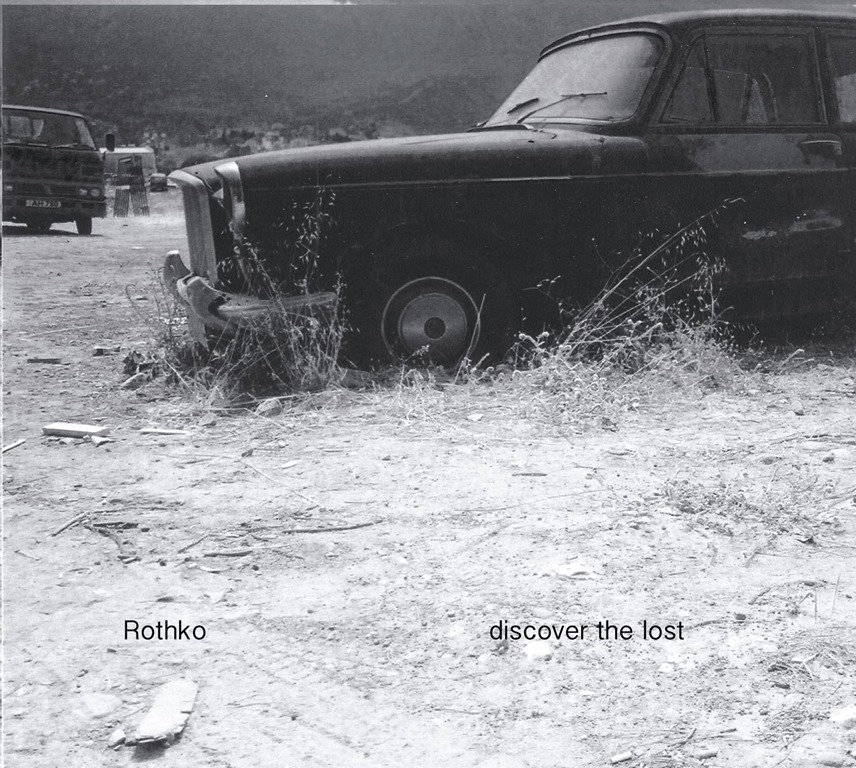
The black and white cover art is the very definition of nostalgia. It intimates the passage of time, the gradual decline of things made. The grass growing tall around the abandoned, rusted car is a representation of abandonment. Time moves on. The man-made world slowly degrades and is taken back by nature, But, during the process, the natural world is sullied by these once valued but now ugly, unwanted items, stains haunting the landscape with echoes of the past. But it’s important to distinguish between the kind of ersatz nostalgia of the mass-market, whereby the Rubik’s Cube and bigger Monster Munch are the focus of a widespread collective reminiscent sigh, and the kind of personal nostalgia which is altogether more difficult to communicate let alone package. Discover the Lost sees Rothko look beyond the consensus market-led strand of nostalgia and tap the vein of the latter in a work that’s evocative and intensely personal to the listener.

There is a grainy warmth to the instrumentation on the album’s ten tracks. The album’s intent may be upbeat, but the reflective atmospherics style of Rothkos’s music is thick with reflection, regret and missing. The analogue tonality of the guitar evokes through sound the sense of something old, worn to a deep patina by people long gone and forgotten. The music is slow, deliberate, haunting, the notes drifting into the air, carried on the echoes of empty rooms, as still as a tomb.

‘Thoughts for Tomorrow’ calls to mind the epic instrumental introduction to Her Name Is Calla’s ‘Condor and River’, but it would be erroneous to describe it as post-rock. It is, however, an evocative and subtly moving piece that resonates, and while the title suggests a forward-facing perspective, it’s nevertheless laced with melancholic retrospection. Strings sigh forlornly over ’Photographs of Then’. Of course, a photograph can only ever show the past, however recent, and often, the image only gains its full meaning or sense of place over time. Context reconfigures with hindsight. Nothing is fully fixed

The dark ambient drone of ‘Time that You Took’ marks a shift in tone. Upbeat it is not. A sinister bass prowls around ‘Truths and Signs’, before the closing couplet of ‘Way to Home’ and ‘You’ offer the light of hope.

The sequencing of Discover the Lost is integral to the listening experience: the tracks stand alone individually, but it’s only listening to them each in sequence that the full effect of the album really emerge. This is the beauty of Discover the Lost: it’s not about immediacy but a slow unfolding and realisation, the emerging discovery.


Rothko