Posts Tagged ‘Mamka Records’

Mamka Records – 15th November 2015

Christopher Nosnibor

It feels like a while since we heard from Maja Osojnik – and, I suppose it has: her debut solo album, Let Them Grow, comprising work composed and recorded between 2013 and 2015, was released in early 2016: we’re now near the end of 2024, and a lot has happened in the last eight years.

Life… and we’ll spare another retread of the pandemic ‘lost years’. Along the way, Maja has founded her own record label, created and exhibited visual artworks, and produced some collaborative audio works, notably DRUCK with Anthony Pateras.

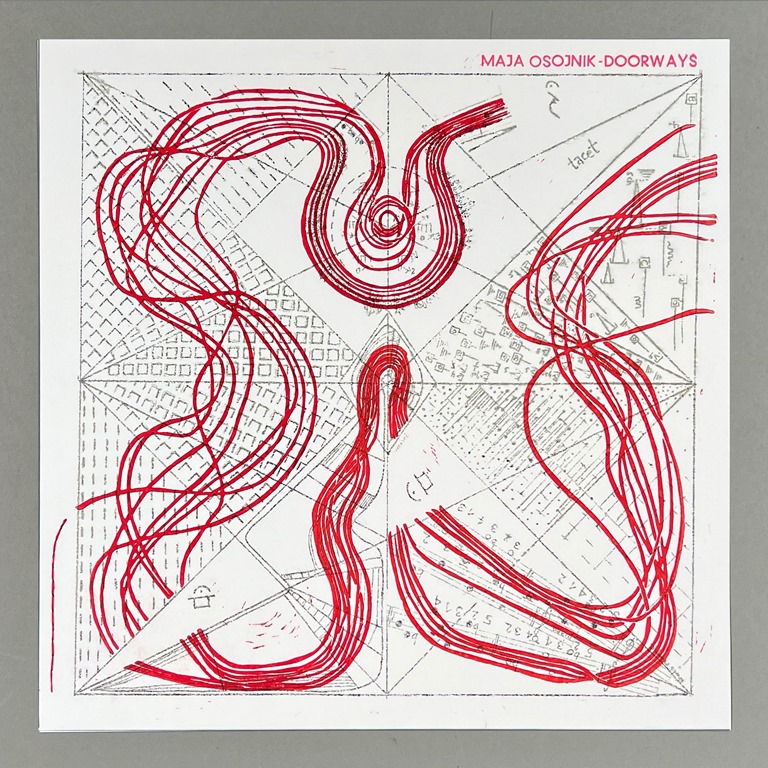
But the time between Let Them Grow and Doorways is significant in terms of the album’s inspiration and purpose. We learn that ‘Doorways was born from a longing to escape the city and everyday life – and the problematically fast pace thereof, a pace of production that accelerates the erosion of attention. In seeking to arrive in a quiet place, to linger there with an observational unprejudiced eros, to become completely aware of being alive. In line with Pauline Oliveros’ practice of deep listening, Maja Osojnik’s album explores the involuntary nature of hearing and the conscious nature of listening. It raises the question: How attentively do we perceive, recognise and internalise the ever-changing (aural) environment?’

It’s a question few likely ponder, although one that I have found myself contemplating in recent years. It began with the first lockdown. I used to travel to work – a twenty-five minute walk, followed by a further half-hour bus journey – with my earphones firmly wedged in my ears, desperate to ensure the noise of everything and everyone was blocked out by music, and I craved my own space. But then, suddenly, I felt the need on my daily hour’s walk, to hear nature – and it’s true, my paranoia peaked to a level that meant I felt the need to have my eyes and ears open and be aware of anyone in the vicinity, when people were much scarcer in the street. But this reconnecting with the sounds of birds, the wind in the trees became more than simply a lockdown hobby. And while, it seems, ‘The Great Pause’ – something only some got to experience or enjoy – gave way to ‘The Great Return’ and ‘The Great Acceleration’ Maja Osojnik has been motivated to seek peace and space, and instead of yielding to any pressures – real or perceived – to produce endlessly, she has chosen to explore time, and space, and allow herself to draw long, slow breaths, and to absorb the details of her surroundings. And it is this different focus which has informed Doorways.

While essentially consisting of two compositions – ‘Doorways #9’ and ‘Blende #1’ – each with a running time of over twenty minutes, and corresponding with a side of an LP, for digital release purposes, each piece has been segmented into five movements or fragmentary length. This may seem to run contra to the idea of reclaiming headspace from the current climate of the truncated attention span endemic in Westers society, but it does reflect the collaging approach to sound Osojnik has taken in assembling a broad range of field recordings, along with the input of woodwind and strings. As the accompanying notes point out, ‘It’s about active listening – what the artist Maja Osojnik calls cinema for the ears – an interactive game with one’s own self. The compositions invite the listener to hear them deeply; they function like a rotary dial, bringing extremely sensitive changes into focus. By constantly readjusting the focal point, they create new relationships between the electronically generated sounds, instruments and field recordings.’

And yes, it’s a timely and necessary reminder not only about the way we close ourselves off to the world, but how music is often something which simply floats around in the background while you’re doing other stuff, and how listening habits have changed: the majority now listen to an endless shuffle stream on Spotify. Simply typing that sentence plunges me into a state of despair.

In its collaging approach to composition, Doorways has, in a sense, inbuilt the shuffle into its structure – but at the same time, it is best experienced as an album, as intended. Doorways is not a bunch of songs, penned as singles, lobbed together to make an ‘album’: Doorways is very much an album album. It’s also a very good one.

‘Doorways #9’ bring with haunting disquiet and glitches and trips, backward surges and traced of feedback. It’s meant to be skin-crawlingly uncomfortable, and it is, as insectoid scrapes and scuttles.

The first five minutes of ‘Doorways #9’, in its cave-dripping tension, builds anxiety, and it’s only when birdsong develops that there evolves a sense of levity. But the tone grows increasingly dark, and there are increasing obtrusive spikes in jarring organ, and a sense of menace hangs heavy in the atmosphere. ‘Doorways #9’ is in some respects a dark ambient work, in that it’s unsettling, uncomfortable and free of percussion, and as such drifts from one moody, uncomfortable segment to the next. Suddenly, unexpectedly, in the last three minutes, things plunge deeper into darkness, as there’s a churning noise and a sense of falling… down… things take on a nightmarish quality, and the experience is dizzying, gut-churning and it would work well as a piece off a horror soundtrack. Perhaps one day it will be incorporated in one.

‘Blende #1’ grinds, scrapes, and skitters through an array of tones and textures. And it goes on… and one, twisting, turning, droning, scraping, and churning. There’s some avant-jazz in the distance. It’s pleasant, but mournful.

This is not an easy, or immediate, album. We all need time, and to take and make time. Along way, Osojnik leaves us haunted an incurring . It’s a spacious, and low—key but cheering experience.

Maja Osojnik has created an album that’s dark, and difficult, but which creates space for slow contemplation and reflection and it’s no vague criticism to report that Doorways is ‘nice’. It’s much more besides: intriguing, it draws you in, and pulls you in different direction. It’s an album, alright.

AA
MAM08 front

Mamka Records – 3rd December 2020

Christopher Nosnibor

Just when things threaten to be getting a bit safe and predictable, with many musical artists having found ways of working around Covid restrictions to record remotely, release digitally and promote by means of performing on line or otherwise streaming shows, the ever-restless Maja Osojnik manages to do something truly different and innovative.

The third release on her recently-established Mamka Records is far, far more than just another digital single, and it’s not just about the music, either: it’s about both art and artefact, and forms the very fabric – literally – of an exhibition as well.

With Matija Schellander, Osojnik is Rdeča Raketa, and for this project, they’ve teamed up with author Natascha Gangl and evolved a genre unto themselves, in the form of the ‘sound comic’ (or beautifully evocative ‘Klangcomic’ in German). The concept – whereby, as with comics, ‘where words and images merge into one another, here it is the spoken word and sound which blend together.’ As such, this is a graphic novel in audio form, a juxtaposition of word and sound that conjures an alternative space in between, a cut-up collage of sorts.

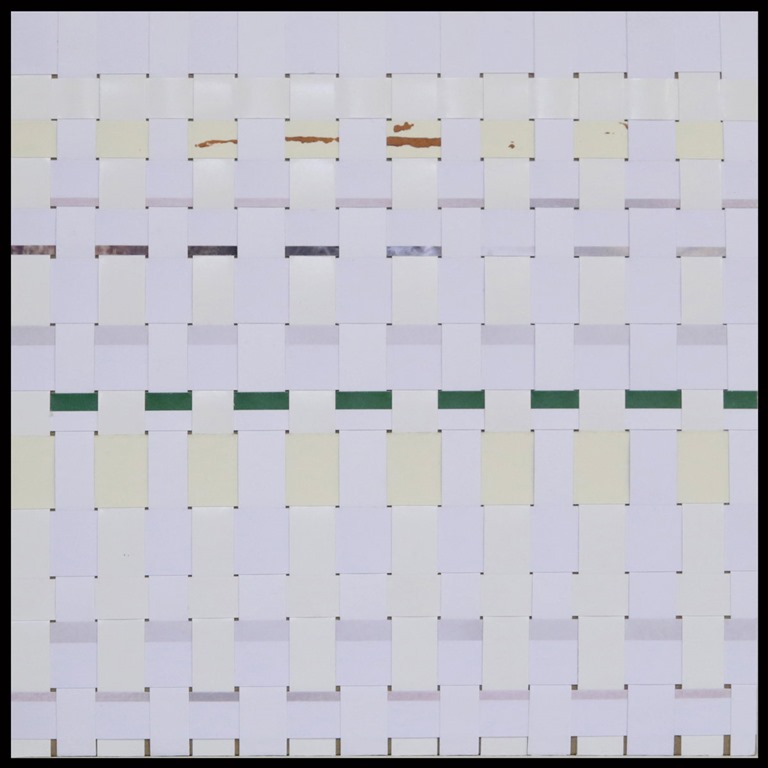
But first, the artefact: as the liner notes explain, ‘Each individual record is its own uniquely woven and hand-printed specimen. Woven from the randomly selected strips of paper, cutting remnants from the other works’. Consciously or otherwise, this links the project into the lineage of cut-up forms that feeds through from Tristan Tzara to Kenji Siratori, although perhaps most obviously via William Burroughs. The assimilation and recycling of pre-exiting material taps into the subconscious on a level that’s difficult to explain, conjuring a strange sense of deja-vu, whereby the ghosts of those remnants and scraps of other works forge a subliminal nexus of intertextual references, reminding us of the things we know, but don’t know that we know (to paraphrase Burroughs).

‘Superandome’ very much exists within this territory of the simultaneously familiar and unfamiliar, a murky electronic collage – not really a tune or a song but a shifting soundscape – but an immersive experience. Woozy, tremorous synthy wibbles oscillate and ripple and churn, while a mutter of voices gradually rises in volume and pitch until it reaches a helium-filled cacophony or babble. As with any collage, interpretation is as much about rezeptionsästhetik – essentially what the individual brings to the work as its specific meaning as bestowed upon a work by its creator. And as such, I find myself increasingly on edge, the swelling conglomeration of chatter evoking the anxiety of overcrowding and agoraphobia.

‘Super Random Me’- which is exactly the same 4:28 duration as ‘Superandome’ – is a yet more extreme collage as fragments of voices are overlaid and cut in / out over ominous rumbles, eerie drones, and random tweets. Again, it’s disorientating, bewildering – and yet equally, an encapsulation of the experience of life as lives, a clamour of voices and random sounds all at once.

Both tracks are reworked and edited from a previous work, and so such, are recycled cut-ups that in turn form a self-referential intertext which also challenge the concept of a work of art ever being ‘finished’ or a fixed definite article.

As for the art, in lieu of a conventional single launch, the record was set to be presented as a picture (built out of 110 of the 160 singles) and a video on 17th of December as an Exhibition in the Gallery Kluckyland in Vienna, and the exhibition is scheduled to run until the 3rd of January 2021 – and while at present it can only be viewed from outside, ‘Superandome / Super Random Me’ stands as a remarkable accomplishment that shows once again that it’s the artists of the avant-garde who innovate the hardest. In the year of the lockdown, we need art even more than ever.

AA

a2731630175_10

Mamka Records – MAM01 – 1st November 2018

Christopher Nosnibor

‘Language becomes sound, and sound becomes language. Out of the fragmentary, the density is weaved. From the depths of the fragile, the whole is born. Time structures are questioned and assembled through loops. Field recording from Mexico meet Osojnik’s singing. Spoken language turn into melodies, whole noise turns into bittersweet rancheras.’ The words from the text – more of a short essay – which accompanies this release resonate: as a long-time student and practitioner of cut-up methodologies, I’m a firm believer in the unusual power of the fragmentary, the capacity for those broken, ruptured pieces of discontinuity to unlock experiences and emotions direct approaches to narrative and the channelling of experience cannot. similarly, I’ve long maintained that the language of sound has the capacity to transcend the language of words, to touch deep and difficult parts of the soul and the psyche irrespective of the tongue or tongues in the listener’s ken.

And so it is that the first release on Mamka records, the label established by Maja Osojnik – whose work I’ve not only covered previously but greatly admire – is something really quite special. My download arrives – personally addressed, handwritten, stamped, embellished – all the way from Vienna, in an envelope 7” square and therefore resembling a 7” single, accompanied by a six-sided press release packed with words far more engaging than the usual hyperbole. There’s also a numbered cut-vinyl print, 7” square included in the package, and it all adds up to a multisensory experience – sonic, tactile, visual – which above all conveys a real sense of commitment, a passion, to making something tangible, something that’s not ephemeral or disposable, but something that matters. The medium is the message, and Maja has found a way – labour-intensive as it is – which goes beyond the medium of the audio release to create… art. The same approach applies to the ‘commercial’ release, a 7” available in a super-small run of 150 copes, only 120 of which are available for public consumption. But better target a small, passionate niche than a large indifferent mainstream if art is your pursuit.

Finding a way to render digital media tactile, visual, and above all, personal, in giving the digital listener a large portion of the vinyl experience, Maja is quite possibly breaking new ground, or at least standing at the forefront of something new. For me, it’s less about nostalgia and more about recovering some of what’s been lost with the demise of physical media.

Said release finds Maja performing with Rdeča Raketa (together with Matija Schellander, she’s integral to the duo who go by the name of Rdeča Raketa) and author Natascha Gangl to deliver a brace of tracks – very much a replication of the classic 7” A and B sides.

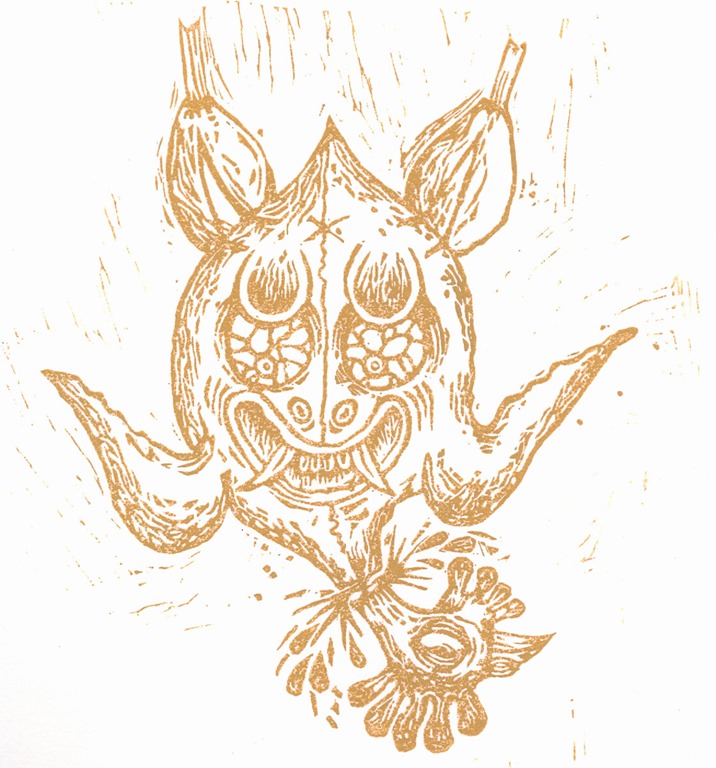
‘Chicken’ opens with a frenzy of analogue synth noise. It simmers to a grating buzz and pulsating electro beat before Maja barrels in with a deep-throated monotone with a barrage of lyrics about a chicken in her heart which bleeds and bleeds, and while clucking electronic bleeps twitter and bleep here, there, and everywhere. It’s weird, it’s noisy, it bumps and thrums, but still has an off-kilter pop sensibility partially submerged in the layers of noise and oddness.

‘Die Toten’ (that’s ‘the dead’ in translation) is rather less accessible, but no less intriguing, engaging, or odd, and in fact, introduces a new level of strangeness to proceedings. It’s low, slow, lugubrious.

Simultaneously weird and wonderful, ‘Chicken’ is everything you want – and need – by way of an introduction to partially-accessible, highly idiosyncratic, and extremely engaging weird shit.

AA

Natasha Gangl & Rdeča Raketa – Chicken