Lamour Records – 16th December 2024
Christopher Nosnibor
When you read that someone is exploring metal, the likely response is to think it’s a metal album in terms of genre. But not Tomas Järmyr: his explorations into ‘the deep frequencies of metal’ are quite literal. ‘Using only cymbals’, the notes accompanying the release explain, ‘Järmyr creates a slowly rotating musical sphere that holds beauty, deep emotion, and fierce heaviness… Entrails is an album that shows the core of his artistic expression and serves as the perfect introduction to Tomas Järmyr as a solo artist.’
As titles go, Entrails is unquestionably visceral in its connotations – another thing which would, for many, suggest a ‘metal’ album rather than a ‘metal’ album. But here we have an album containing a single track, which runs for thirty-eight minutes, consisting of nothing but cymbal work.
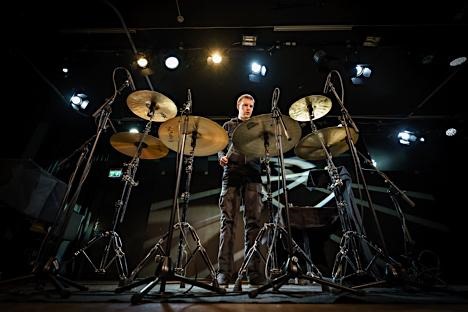
Photo: Thor Egil Leirtrø
In the context of a full drum kit, cymbals provide expression, and also an amount of ‘fill’ to the overall sound, not only of the kit, but the band, creating a wash of resonance in between the notes of the instruments and the beats of bass drum, snare, toms, etc. How do cymbals stand up when separated from everything else?
In the hands of Tomas Järmyr, we come to appreciate the range and versatility of the cymbal. Size certainly matters, and Järmyr’s setup which spans small, light crashes to huge, resonant, bell-like peels, against a backdrop which builds from a delicate clatter to a clashing, splashing tempest, is educational.
There are passages where the clatters and chimes diminish, and make way for dank, atmospheric reverberations which evoke the gloom of subterranean caverns, dark ambience which bears no discernible resemblance to anything remotely percussive, at least to the average ear – or mine.
Sometimes, with experimental music, the mystery is an integral part of the appeal: I prefer not to know which instruments have been used to create which sounds, and similarly, knowing how certain synths or laptop-based programmes have been used to conjure alien sounds feels like something of a spoiler, because I find myself scrutinising the sound and seeking to pick apart its construction. On Entrails, the opposite is true, because most of the sounds simply do not correspond to the source. So on the one hand, Entrails does lay bare the guts of the instrumentation: on the other, as I sit in the swirling drone which fills the room around the eighteen-minute mark, I find myself perplexed and in absolute awe at the creativity of the musicianship. How does anyone come to discover that cymbals have the capacity to be this versatile, to create sounds like these? Who has both ready access to this many cymbals and the time to explore their sounds and the way they interact with one another in such detail?
Sometimes the crescendos are delicate, slow-building: others, they explode unexpectedly. At others still, the sensation is more like an outflow of molten lava from a volcano.
Järmyr’s metal album may be devoid of guitars and guttural vocals – or, indeed, any vocals – bit it is still, for the most part, a heavy album, issuing forth an immensely dense, dark atmosphere, not to mention some quite challenging frequencies, spiking at the top end while rumbling heavily around the lower sonic regions. Ominous, oppressive, Entrails is not a fist-forward punch to the guts, but instead prods and pokes. The effect is no less potent.
AA

 Aural Aggravation