Posts Tagged ‘geography’

10th January 2025

Christopher Nosnibor

Metlaogue’s Bandcamp pitches the project as ‘Industrial/IDM/breakcore with cinematic tendencies’, while the notes for Apposition Breach note how it ‘explores the threshold of geography and inner world – where landscape becomes the medium for emotion’. This, for me, seems to carry almost Ballardian connotations, the idea of inner geographies, the way in which the geometry of a landscape can slide between the literal and the metaphorical, how one can become an analogue of the other. The inner and outer worlds exist almost separate of one another, and the only point at which they intersect is in the mind as one processes the physical world as experienced through the shading of the emotional state. A sunny day may be a joy to behold, but may not bring joy in the face of a trauma. How we respond to our surroundings is influenced by not only circumstance, but the way we react to it. Yet rarely do we pause to consider these variables. Why did you have a shit day at work? Was the work itself shit, or did you arrive carrying the burden of something else which made something comparatively minor a catastrophe? You may walk the same route daily for a year, but it will never be the quite the same experience. The variables are infinite, and on Apposition Breach, Metalogue interrogates those variables and the reflex of memory and their complex relationship on a nuanced suite of compositions, some six years in the making.

The atmospheric ‘Threshold’ draws the listener into that fluid space, where soft ambience wraps itself around hard mechanical drones, and the percussion shifts in pace and intensity, at first muted, subtle, but firing forth in explosive bursts to become the dominant feature, and in doing so marking a dynamic shift in mood. It’s somewhat akin to climbing a gentle hill and suddenly finding a sharp crag just as the wind picks up and clouds darken the sky. The temperate changes with the change in tone.

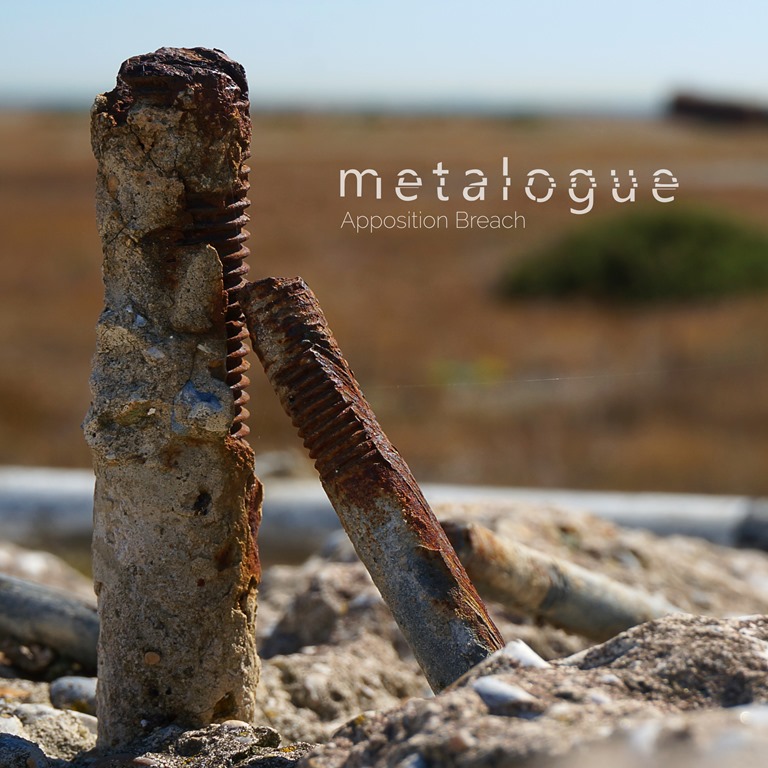
While the images which accompany the release are illustrative, the soundscapes themselves evoke rusted machinery, dilapidated mills and farming equipment gradually yielding to the elements. As much as it’s industrial, Apposition Breach offers haunting echoes of industry, once-thriving communities and factories abandoned – not the collapse of civilisation, but the decline which comes with ‘progress’. Wraith-like synths wisp and envelop pulverising beats on ‘Triangulation’, a composition which builds and transitions through a series of different forms. The pieces tend to be on the longer side, in excess of six minutes and pushing to almost twelve on ‘Outer Margin’. This gives them time and space in which to evolve at a pace which feels natural and necessary.

‘Ilira’ is ominous, scraping drones create an eerie fog of tension which is punctured by hard, violent beats. Between the snarling mechanical grind of ‘Reflection’ and the dark, pulsating title track, Metalogue conjures an array of sonic sceneries which present a journey of sorts. Not a linear journey whereby one travels from A to B, B to C, but one which seers the retinas and scours the mind with a succession of scenes, flashbacks, rapid cuts, with the effect being not dissimilar to the way memory skips here and there in time and space when triggered by seemingly unconnected and unrelated prompts – a word, a sound, a smell, nothing at all – or a dream, in which one suddenly finds themselves in a different location or setting seemingly apropos of nothing. Just as William Burroughs remarked of his discontinuous narratives that he was not concerned with explaining how characters get from one place to the next, so it is that we, as participants in the immersive experience that is Apposition Breach, find ourselves effectively teleported.

There’s the hard attack of ‘Redoubt’ and the echoing mystery of the swampy but hypnotic ‘Day Marker’, and in between, all shades of hefty percussion and cold, razor-edged synths shiver and scrape kneed and throb to render an altogether uncomfortable experience. Apposition Breach is expansive, ambitious, and meticulously realised.

AA
cover

Mortality Tables – 7th June 2024

Christopher Nosnibor

Mortality Tables have continued to release titles from their ‘Life Files’ series at a remarkable rate, with instalments 18 and 19 landing in May, and hot on their proverbial heels, this, number 20, in the first week of June.

The premise remains consistent, namely ‘Recordings of places, people, objects, moments in time, environments and quotidian events [which] are shared with a range of artists working across different disciplines. Those artists are free to respond to the recordings in any way they like. And so, as ever, the field recordings, courtesy of Mortality Tables main man Mat Smith provide the foundation and inspiration.

Killiegrew Monument is a peculiar thing. Located in Falmouth, and intended as a memorial to the last surviving member of the Cornish family, the monument is a sharp obelisk constructed in 1738. It looks altogether more contemporary, and ultimately anomalous with its surroundings. And one might say that this release is similarly anomalous. I can imagine that beholding this curious construction would inspire an array or reactions. But why the fuck would you play a stone monument with a sharp stone? Is that really one of the responses you’d likely have to coming face to face with such a construction? Well, perhaps, if you’re possessed of an avant-garde mindset, whereby instead of reflecting on the origins of The Wind in the Willows, you find yourself contemplating ways of making unusual noises.

Once again, when it comes to the ‘Life Files’ series on Mortality Tables, we don’t know what the source materials actually sound like.

‘Killigrew Monument Played With A Sharp Stone (Part One)’ is an odd sound work: there’s chatter and ambient drift and scratches and shuffles and scrapes, but what on earth is going on? Seagulls wheeling and cawing – and on those squawks the sound echoes and reverberates, and the collage of sound collides with a strange rendition of ‘One, two, three four five, once I caught a fish alive’.

There’s lots of processed echo and cawing gulls at the start of ‘Killigrew Monument Played With A Sharp Stone (Part Two)’, as well, and it does, in some respects, sound like someone crooning abstractly into a child’s echo mic just to see how it sounds. The longer of the two pieces, at almost thirteen minutes in duration, it creates a deeply strange and disorientating atmosphere, which is likely evocative of this curious monument, which stands out of time and out of keeping with its surroundings as a testament to human folly, and, ultimately to vanity.

Too abstract to be ‘songs’, too much happening to be ‘ambient’, the result is a haunting and somewhat disorientating soundwork of a rare quality.

AA

a4230686863_10

Herhalen – H#023 – 21st May 2021

Christopher Nosnibor

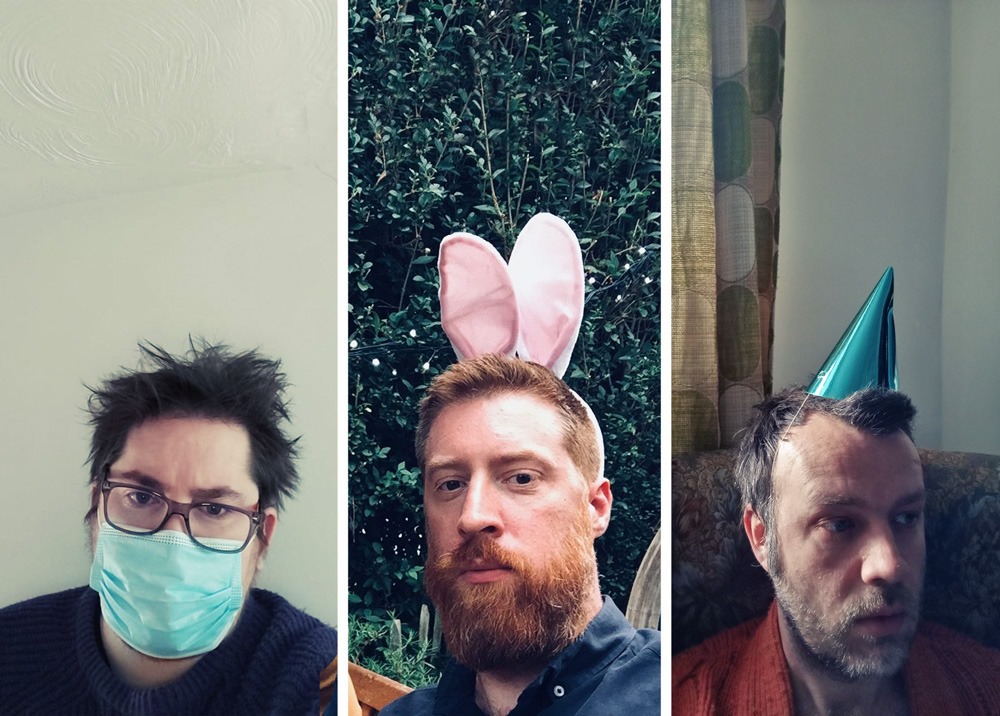
The press release for this second album by The Incidental Crack – a collaboration between Justin Watson, Rob Spencer and Simon Proffitt – which follows last year’s Before The Magic describes the trio ‘exchanging field recordings, samples and random noise between Manchester, Wigan and North Wales, culminating in studio sessions focused on detailed processing and sound manipulation. They have yet to meet. Maybe one day when this is all over, in a pub in North Wales, free from this madness’.

As such, it’s a classic lockdown project, a virtual collaboration that proves that when it comes to the making of music, distance doesn’t have to be an object. In fact, it’s probably easier to collaborate without the logistics of brining people together in the same place at the same time. Writing on the project, Justin (one half of The Gated Canal Community and formerly of Front & Follow, a label which will be familiar to regular readers of AA), notes that Municipal Music ‘includes tracks recorded during the same period, using our now foolproof approach of sharing stuff, fiddling with it, sharing some more etc.’, adding, ‘It kept me sane at least during the last year!’

That is something that’s certainly relatable: keeping occupied has, for me, been the only way to keep myself together. I’m not saying it’s healthy, it’s just how it is. And increasingly, I’ve found abstract music easier to manage. Structured music, anything overtly ‘song’ orientated and rhythm driven is, all too often, just so much noise and instead of providing a welcome point of focus, feels just like being smacked from all sides at once. So while there may still be a lot going on in this, it’s not psychologically disruptive, and is suitably absorbing and immersive.

There are three extended-length tracks in all, which exploit the full dynamic range, with a strong focus on texture. The first, ‘The Second Cup of Tea of the Day’ is strong – certainly more English Breakfast or Nambarrie than Earl Grey or anything herbal – and probably inspired by the sound of a boiling kettle that’s been manipulated and fucked around with. However, it sounds at first more like a freight train, an extended continuous roar occupying the first three minutes before it gradually abates in volume and intensity, and gentler, softly-woven ambient drones fade in. there are still rumblings and incidental clatterings, forging a soundscape that never fully reconciles the tensions between the elements of soft and harsh, the light and dark. Bubbling Krautrock with bulbous beats collides with metallic shards of grating noise.

‘Just Passing Through’ is appropriately positioned in the middle, and is altogether gentler, softer, warmer, and pursues a more conventional ambient line. But there are peaks and troughs and ebbs and flows as the sound swells and at times shifts toward more unsettling territory, with some woozy oscillations that tug uncomfortably at the pit of the stomach before receding and allowing calmer vibes to return once more.

The third and final cut, the fourteen-minute ‘Ice Cream at the Pavilion’ starts with what sounds like the crashing of waves against a rocky beach in a storm, which strangely reminds me of a number of occasions we’ve had ice cream at the coast on family outings, because it’s always ice-cream weather for children. Voices chatter and babble and whoop excitedly, while a dolorous church organ begins to while away majestically in the background. Eventually, it’s superseded by a barrelling drone and a throbbing, slow-pulsing sound that swells and surges.

There’s a certain wistfulness and nostalgia to be found in the spaces in and around Municipal Music, although perhaps some of that’s my own reception aesthetic, a response as much to the circumstances of its creation and the allusions of the title, both of which remind me I’ve not left my own municipality in months, haven’t met any of my collaborators or friends in so very long, and yearn for both proximity to (some) people and also the countryside and country pubs. All of these thoughts wash around in my mind as the sounds surround me, and it occurs to me, finally, that Municipal Music is good music to think to.

AA

023 The Incidental Crack - cover

AA

The Incidental Crack - artist photo

24th February 2020

Christopher Nosnibor

Kemper Norton’s kept a steady trickle of releases coming for some time now, and while the last couple – Hungan (2017) and Brunton Calciner (2019) – had bypassed me until now, the consistency of previous works, from Cam (2013), Loor (2014), and Toll (2016) was more than enough to ensure my immediate interest on the arrival of Oxland Cylinder. His music always has an intrinsic sense of place, however elliptical, and if on the face of it Oxland Cylinder appears to break this trend, the accompanying text is informative:

‘In the late nineteenth century and early twentieth century the majority of the world’s arsenic was created in Cornwall and Devon. The “Oxland Cylinder” was one of the methods used and was a revolving iron tube used to process and vapourise arsenic pyrites. None of these devices remain intact.’

Immediately, we’re transported to England’s south coast over a century ago, and not only to a bygone era but a practise essentially lost to history. And in this context, Oxland Cylinder takes on layers of meaning and caries a certain historical weight.

If the first piece, ‘halan 5’, which introduces the album with discontiguous electronic scrapes and buzzes, and a swell of bleeps and bloops, an analogue bubblebath that slowly eddies and swells, feels like so many other post-Tangerine Dream ambient electronic drifts, it’s also an evocation of a process akin to alchemy, only instead of turning lead into gold, it turns minerals into alloys, including lead.

Oxland Cylinder forges temporal spaces through the medium of sound, slow-spun ambience that conjures a certain mental blankness into which the listener is free to project their own sense of alternating coastal countryside and industrial production. Some will likely visualise Poldark, although the ruins that remain today tell little of the intense labour, heavy mining and vast engines involved in the extraction of ores and pyrites and their conversion to various alloys as lined the south coast at this time.

‘Dark as a Dungeon’ finds the first occurrence of vocals: it’s a sparse shanty with ringing electronics building a glistening, metallic backdrop to the lilting vocal melody. Singing about mining against funeral echo-laden rings feels like a sad thing.

Oxland Cylinder is as rich in evocative depth and subtlety as the south coast is in social and industrial history, and an absorbing album irrespective of context or intent.

AA

Kemper Norton – Oxland Cylinder