Kranky – 7th July 2023
Christopher Nosnibor
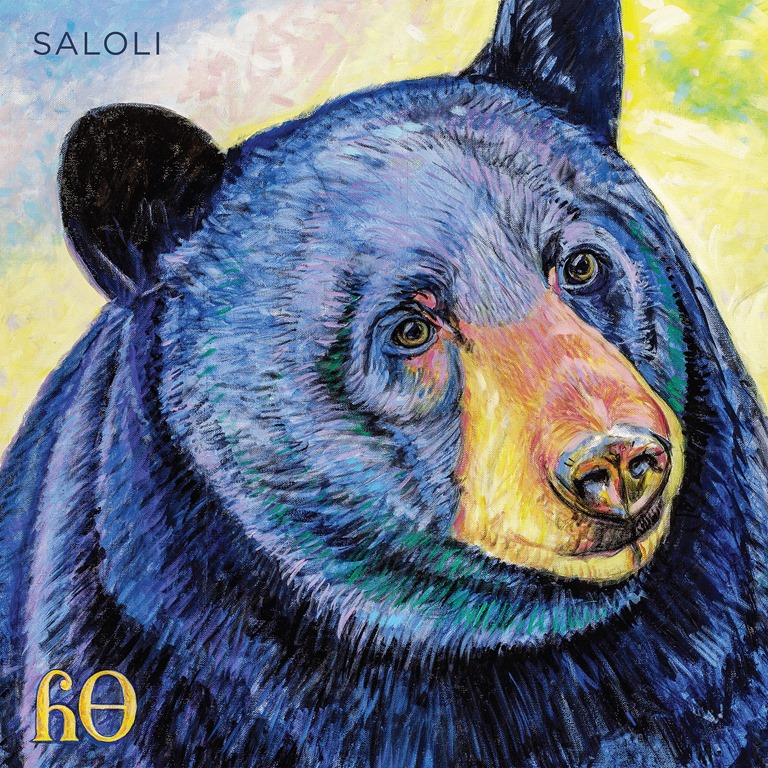
If the prospect of an album from a solo pianist whose recording moniker is the Cherokee word for ‘squirrel’, and which is intended to evoke ‘a day in the life of a bear in a canyon in the Smoky Mountains,’ with each track channeling a different emotion or experience in its daily explorations, sounds as if it may be soft, neoclassical tinkling, Canyon will come as rather a surprise.
As the accompanying notes explain, ‘Canyon was composed and performed live on a Sequential Circuits MultiTrak synthesizer…routed through a delay pedal. This refraction adds a lyrical spatial quality, as though “echoing off canyon walls.” It’s music both gentle and adventurous, curiously rooting through soils and streams, in a sustained state of discovery’.
It’s a proper vintage piece of kit, an analogue synthesizer only produced for a couple of years in the mid-1980s. Described by Vintage Synth Explorer as ‘a six voice analog synth with sophisticated filters, envelopes, modulation capabilities and built-in sequencing’, it’s clearly got versatility in its favour – which means Saloli has a broad range of sounds and effects at her disposal to articulate the range of moods and emotions of her subject. But above all, it has that classic analogue warmth of tone, the rich, organic texture that resonates in a way that’s almost biological. It’s something that’s both affecting and in some way comforting, the fuzzy edges conjuring a sonic blanket, and even when venturing into more abrasive territories, analogue synths very much have the capacity to reach the parts their digital successors somehow can’t.
The album starts strong: ‘Waterfall’ spirals and cascades in a swirl of synth that doesn’t necessarily evoke – at least to me – anything bear-like, but the more ambient end of Krautrock ‘Lillypad’ drifts soft-edged semi-ambience strolling and ‘Snake’ is unexpectedly graceful. But then, if you’ve ever watched a snake move, it is a graceful, supple movement, and snakes have an undeservedly bad reputation among humans. Very few of them are dangerous, and they’re certainly not the only creature to shed its skin. Again, the notes provide an insight which perhaps has a bearing on the tone here, explaining that ‘In Cherokee teachings, humans and animals are considered to have no essential difference – originally, all the creatures of the earth lived together in harmony’, and as such, ‘Canyon captures shades of this Edenic notion across eight elegant pieces, alternately meandering, pensive, playful, and pure. Sutton’s playing, as always, is dexterous and dimensional, mirroring the dazzled senses of its muse. If then, the compositions don’t quite confirm to our expectations, based on our perceptions of the various inspirations, it could well be on account of Saloli approaching them from a very different perspective. Why are we scared of snakes? Some of it is likely biblical in origin, some to popular portrayals in movies and media. But one is not afraid of one’s equal, and living together in harmony means there is no reason for distrust.
Such belief systems may be difficult to comprehend, but how much better, more pleasant, more bearable, would life the world over be if everyone held these views? There would be no social hierarchy, there would be no capitalism, there would be no war. Consider that for a moment.
The beauty of Canyon is that it’s a work which encourages and inspires contemplation.
It’s the playful side of Saloli’s songwriting that comes to the fore on the slowly bouncing ‘Yona’. It’s mellow, light, uplifting, and contrasts significantly with the introspective ‘Silhouette’ which follows, a reflective, melancholy pie, which makes you ache ever so slightly inside: you can’t quite pinpoint the reason, but that’s the power of music. Moreover, it’s the power of Saloli’s music, as the forms shift from string-like elongated notes to shorter, more piano-like sounds, with all of the variables in between.
‘Full Moon’ is positively bloopy and gloopy, trilling tones like synthesized pan pipes echoing out over a bubbling, bass, and it works nicely: there is contrast, there is movement. And in an abstract way, it captures the energy that seems to emanate from a full moon. And there is an energy which affects creatures and humans alike: some if it’s mystical and mythical, but I’ve often felt hyper without even realising it’s a full moon.
There’s something buoyant but also stealthy and predatory and then again, at the same time, increasingly discordant and with shades of darkness, about ‘Nighthawk’, a seven-and-a-quarter-minute monster with transportative qualities, before the true closer, the eight-minute ‘Sunrise’ heralds the arrival of the new. A new dawn, a new hope. Breathe deep. This could be our reality too.
AA
 Aural Aggravation