Posts Tagged ‘Anne-James Chaton’

Unsounds – 4th July 2025

Christopher Nosnibor

Oops. It seems I let things slide a bit. Just over two years ago, I provided coverage for the first ‘Handmade’ volume, and now, here we are, faced with the third instalment of a four-single series. And for those who mat be wondering, ‘A physical album of the collection will be released with volume 4’.

As the accompanying text outlines, ‘The Handmade series is an homage to craftsmanship through an exploration of the lexicons specific to traditional metiers. It unfolds over the course of 4 thematic volumes. With guest Yannis Kyriakides on electronics they create works where abstract notions mix with tangible ones by linking the arts of the hand with sound and poetry.’

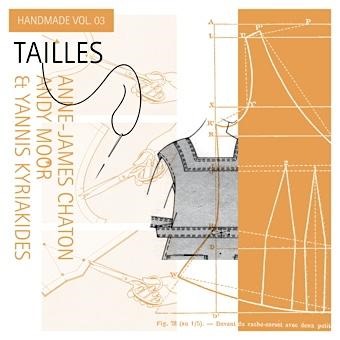
Before we delve into the single’s two tracks, it’s worth relaying the contextual blurb, as it might as it might be to paraphrase, I always worry about missing something pivotal ad looking lame, so I prefer instead to lay it out as given: ‘Equipped with the “Method of Cutting and Assembling for Women’s Dresses, Children’s Clothes, Trousseau and Layette” by Mrs. G. Schérer, a work duly authorized and distributed in state normal schools and municipal schools at the end of the nineteenth century, Anne-James Chaton imagined a contemporary dance choreography in which « grand battement » and « pas chassé » were performed by following the instructions for the construction of a bodice with basques, a frock coat, a little boy’s jacket. Then he cuts, pleats and sews together a few letters of the alphabet – a, e, i, l, n, o, p, s, t, u – and writes a sentence that he borrows from the French poet Jean-Marie Gleize. In Tailles, the art of couture thus reveals its affinity with dance and literature.” Are you all on board?

Here, ‘The trio push the boundaries of traditional rock music incorporating spoken word, electronics with experimental angular guitar riffs to produce unconventional but infectious, beat driven music that embraces dissonance and distortion.’

And yes, a lot happens a mere nine and a bit minutes: ‘Pas De Danse’ for a start, being a dark stark whir and clank and chank and clatter of electronica which intimates an industrial edge. It’s the whipcrack of a vintage drum machine that provides the spine for ‘Pas de Danse’ – the sound of a Roland TR606 or thereabouts delivering a crisp, relentless snap that keeps metronomic time for a spoken word narrative, delivered in French, in a muttering monotone ., there are swipes of distortion and squalls of disruptive noise which interrupt this, intrude on the relentless swell of sound.

The five-minute ‘Ecrire un Phrase’ (that’s ‘write a sentence’ in translation) brings jagged drones shards odd angular noise – including shards of dissonant guitar reminiscent of Gang of Four. There’s something of a DAF vibe about this relentless, dissonant, drone attack.

Immediate it is not. Droney and difficult, it is. Just the way we like it.
Tailles 3

Unsounds Records – 15th June 2023

Christopher Nosnibor

These are certainly three names to conjure with as prominent features of the experimental scene. Anne-James Chaton and Andy Moor have collaborated on numerous albums, and I personally discovered them via the Transfer series in 2011, around the same time as Chaton’s Evenements 09, which I found fascinating in its contemporary application of loops and with its parallels to the cut-up technique and Burroughs’ and Gysin’s tape experiments of the late 50s and early 90s.

As the biography which accompanies the release of this lates outing explains, ‘the duo Andy Moor and Anne-James Chaton continue their conversation with a new set of digital singles, diving this time into the rich language of the traditional metiers. The Handmade series is an homage to crahftsmanship through an exploration of the lexicons specific to bakery and pastry making, jewellery, joinery and wrought iron making, that will unfold over the course of 4 thematic volumes. With guest Yannis Kyriakides on electronics they create works where abstract notions mix with tangible ones by linking the arts of the hand with sound and poetry.’

The Moor / Kyriakides collaboration A Life is a Billion Heartbeats proved to be a gripping work for quite different reasons, and one thing that’s always a feature of any work featuring Moor is his versatility, as well as the fact that he doesn’t use the guitar in a remotely conventional fashion.

The two tracks on this single really do showcase the strengths of all three artists, and shows just how collaboration and collectivism can amplify individual powers.

But never mistake ‘art’, however obscure or experimental, for something which is always entirely serious: This, the first of the ‘Handmade’ series – projected to comprise four digital singles, to subsequently be released as a CD album and download, akin to the Transfer series, sees them taking on ‘the vocabulary of pastry making… Side A «Garniture» offers a curious anthology of poetry written by mixing the actions of the pastry chef, units of measurement and figures of speech. On Side B, «Sur Mesure» deploys all the richness of the culinary language when it comes to expressing the scarse [sic] or the plentiful’.

Truth be told, for a non-French speaker, the linguistic twists and any humour associated with the juxtaposition of subject matter and context with delivery are lost beyond the cover art, leaving simply the sonic experience – but this alone is more than enough. Chaton’s monotone spoken word is nonchalant and gives nothing away, while Moor peels off shards of dissonance from his guitar amidst drones and hums and clanks and a distant but insistent clattering percussion. Feedback and irregular discordant chanks and un-chords all crash and slide across one another in an irregular latticework of noise.

‘Sur Mesure’ is less challenging, less overtly difficult and dissonant, and sees the three employ the same elements but to an altogether more subdued and atmospheric effect, making for a good contrast against ‘Garniture’.

There’s no doubt that most would simply file this under ‘weird shit’, but it’s a strong experimental work which delves deep into dynamics, tones, and unusual juxtapositions, and really prods at the neural pathways in the most unexpected ways.

(Click the image for audio)

77U_art

Unsounds – 54U

Christopher Nosnibor

This is one of many releases I’ve been sitting on – figuratively speaking – for a long time without getting round to playing. I tend to listen to CDs while at work in my day-job, and digital promos at home (because I can’t stream or download on work systems), and while I can stuff a bunch of regular CDs into a jiffy and carry them to and from the office, the packaging of this release made it simply impractical. That, and the fact I had to battle long and hard with myself to resist the urge to burn the thing.

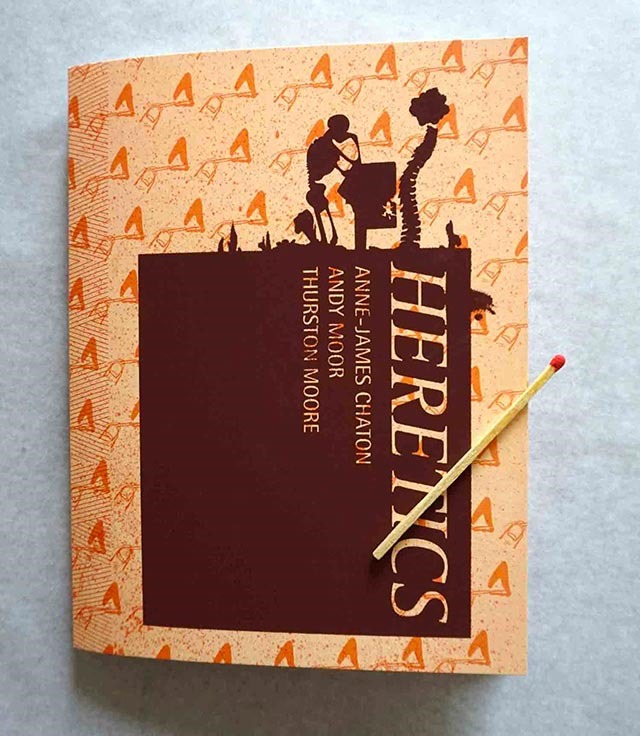
It’s not that I have any kind of objection to any of the artists in this three-way collaboration, or take issue with its premise, namely a series of portraits of radical heretical figures from across history, spanning Caravaggio and the Marquis de Sade, to William Burroughs and Johnny Rotten. In fact, it’s a concept I can get on board with, and for months I’ve looked at the magnificent packaging, a box-type affair which folds out to reveal a CD, a DVD and a book containing all of the words to the tracks – some in French, some in English, some in a combination of the two – forming a rich linguistic tapestry. Published in an edition of just 1,000 copies, including 26 lettered copies, it’s a work of art, not a disposable piece of trash. But the box is a giant flip-front matchbook. The front cover is made of fine sandpaper, and glued inside the flap, on its own, stark and inviting is a match, a full fore inches long. What would be more in keeping with the spirit of the project than burning it without hearing so much as a note, and reviewing the sound of the fire taking hold and the rustle of art burning, the colour of the dancing flames and the texture of the ash? It would hardly be Watch the KLF Burn a Million Quid, but nevertheless… I’m a pussy. I was also too curious to explore the contents of the package. And having heard the album and watched the film, there was no way I could even pretend to burn it. I’m weak. I’m no heretic.

Chaton, Moor and Moore are no heretics, either: they’re artists who appreciate heretics. It’s not always obvious to whom each piece relates, and perhaps a priori knowledge of the individual heretical figures is beneficial, as is an ability to translate French. ‘The Things that belong to William’ does not mention Burroughs by name. However, the bilingual text, in referencing ‘a Paregoric Kid’, ‘Pontopon Rose’, ‘Joselito’, ‘Bradley the Buyer’ and a host of characters and scenes from Naked Lunch and beyond, the connection is clear – to those versed in the author’s work. ‘Poetry Must Me Made By All’ is, then, presumably, a dedication to Comte de Lautreamont, pro-plagiaristic precursor of the Surrealists, Situationists and Neoists, as well as the cut-up technique of Burroughs and Gysin.

Textually – these are texts and not lyrics, delivered in a spoken word / narrative form – it’s an erudite work, researched, intertextual, referential. Sonically, it’s no more immediate. Oblique, obtuse, challenging: these are the first descriptors which volunteer their services in untangling Heretics.

‘Casino Rabelaisien’ is a tense effort, with angular guitar clanging perpendicular to a gritty, awkward bass grind. Chatton remains nonchalant and monotone amidst the chaotic no-wave cacophony. ‘Dull Jack’ begins with Thurston’s voice alone, before churning guitars slither in. There are no regular rhythmic signatures here, no ‘tunes’, no hooks or melodies: instead, this is a set which uses instruments in a more abstract way, conjuring uneasy atmosphere and often simply attacking the senses.

With the guitars of Moor and Moore duelling, playing across one another as much as with one another, the effect is jarring, uncomfortable. Both players employ atonality and discord within their performances, and when discordant passages collide, it’s a brain-bending experience.

Heretics is a work which delivers on its promise and conveys the spirit of the outré, unconventional artists who inspired it. It is, in addition, a true work of art. Don’t burn it.

Heretics