Posts Tagged ‘Alum Review’

Christopher Nosnibor

Bearsuit Records – 23rd January 2026

Christopher Nosnibor

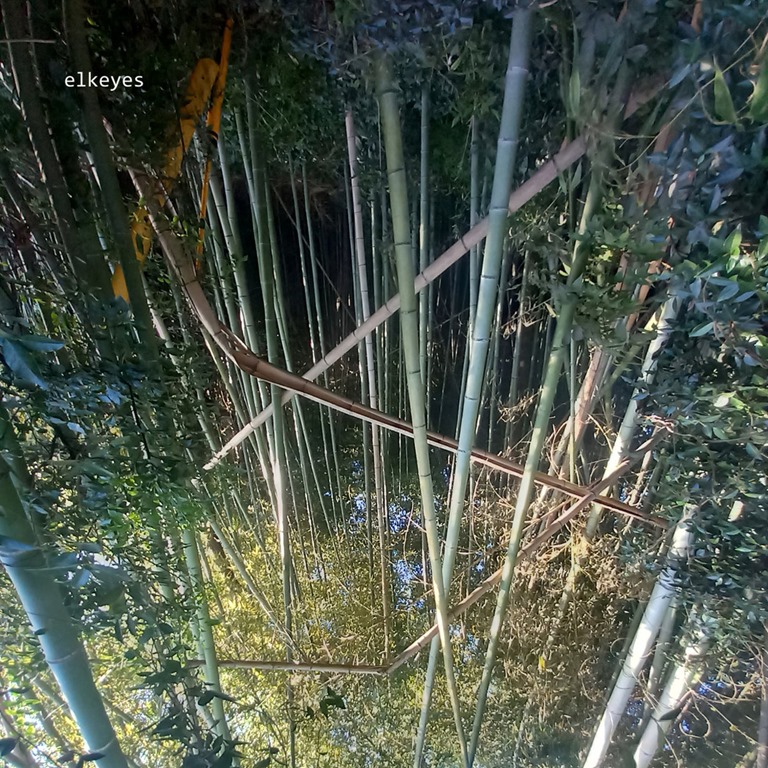
It’s been a little while since our favourite label for oddball quirky stuff, Edinburgh’s Bearsuit Records, tickled our eardrums with new noise, but they’re kicking off 2026 with the eponymous debut from Elkeyes, a new addition to the roster. And suffice it to say, it’s a good fit in their catalogue of curious compositional contortions. And since we have Wolf Eyes and Hawk Eyes, KATSEYE, and, er, Eagle Eye Cherry, why not Elkeyes? It’s an interesting choice of creature, but one which seems appropriate for this intriguingly leftfield musical project – although my eternal internal game of Mallett’s Mallet leads me to conclude that Elkeye Brooks should also be a band name. Christ only knows what they would sound like, but surely it would be no stranger than this twisted concoction, which should be filed in the ‘experimental electronics’ section.

‘Trial’ conjures the disorientating bewilderment of Kafka’s labyrinthine novel via the medium of sonic collage which brings together warping synths, clinks and clatters, disembodied, ghostly voices, sweeping string and echo-laden horns which add the most incongruous – yet somehow fitting – jazz element imaginable, plus fizzing blasts of extraneous noise.

‘Yamanote Line’ twitters and flaps its way into the realms of ambient abstraction, building atmosphere and an air of the uncanny. It’s not dark in the horror sense, but sets the nerves jangling, particularly in the quieter passages which evoke bleak moorlands and deserted cemeteries. This is the beauty of abstract, ambient, instrumental works, works which are free from the constraints of conventional form: rather than direct the listener in a specific direction, they encourage the opening of neural pathways and invite the formation of visualisations and ideas by free association. The scraping, trilling string sounds, stark piano chords, and random chimes which reverberate through the haunting ‘Thalassophobia’ (the fear of deep bodies of water, such as the ocean, seas, or lakes’).

Ironically, ‘The Dark Forest’ is the most light-hearted piece on the album, skipping oscillations and chiming chanks like dappled sunlight skips around this way and that on the album’s shortest track, although it does fade to darkness with a gong-like rumble and some dissonant chimes at the end.

There are vast expanses of minimalism. Soft tones drift. Time sits in suspension. Voices ring out – operatic, ghostly – amidst spacey swirls of phase. ‘Breathing the Blues’ is barely there at times, and the final cut, ‘Fallen’ is similarly sparse.

Over the course of these eight tracks, Elkeyes wander into some dark places, riven with static and low-level rumbles which disseminate tension, scrape at the cranium, gnaw at the intestines and fuck you up by stealth. In places, this feels like a slow unpicking of the seams of musical conventions. It’s sparse and transportive, hypnotic and simultaneously tense and soothing. Elkeyes are all the contradictions. And that is reason to love them.

AA
a0348064966_10

Gizeh Records – 23rd November 2018

Christopher Nosnibor

In their biography, FOUDRE! are described as ‘a telluric drone quartet composed of Frédéric D. Oberland (Oiseaux-Tempête, Le Réveil des Tropiques, The Rustle Of The Stars, FareWell Poetry), Romain Barbot (Saåad), Grégory Buffier (Saåad, Autrenoir) and Paul Régimbeau (Mondkopf, Autrenoir, Extreme Precautions) who meet punctually for sessions of ritual improvisation where they invoke noise and drone and the deities of chaos.’

I’m not sure I’m entirely convinced by the punctual meetings given my years of experience dealing with musicians, but no matter: KAMI , the collective’s fourth album, was improvised and recorded live at Le Rex de Toulouse while supporting French doom metal band Monarch! at their tenth anniversary show.

The five compositions which comprise the forty-five minute set are expansive, as much is sonic breadth and depth as duration, and as such, extend in all directions as the players audibly feed off one another intuitively to create immense aural vistas which are every bit as enigmatic as the titles, all of which reference Shinto gods.

Opening with a twelve-minute epic that evolves from dark, low rumblings and sparse down-tuned scraping string-like drones, tremulous, haunting, and hesitant, to a simmering ripple of waves that forge a subtle but sustained crescendo, ‘Raijin’ very much evokes images and sensations worthy of a god of lightning, thunder, and storms. ‘Raijin’ indeed.

Disembodied voices rise wordlessly, ghostly and demonic, against a heartbeat-pulsing beat. It’s all about the atmosphere, and it’s all about the slow burn. And because the shifts are so gradual, so slight, the listener’s attention becomes focused on the detail, attenuated to the tonality and texture of the individual sounds.

‘Ame-no-Uzume’ inches toward a pulsating hybrid of ambience and chillwave, with the eerie motifs of ‘Tubular Bells’ twisting into a funnel of extraneous noise against a stammering beat, and the pieces all segue seamlessly into one another, with an elongated organ drone rising up on ‘Fujin’ (the Japanese god of the wind) before the final piece, ‘Hachiman’, opens with a heavy, head-crushing crescendo of discord. All hell breaks lose amidst feedback and screeds of extraneous noise as the volume intensifies and things get ugly. Unintelligible screams and barks, distorted and inhuman, tear the air across a clattering industrial beat and blistering electronics forging a whorl of sound in a brutal blast reminiscent of Prurient.

If ever the opening and conclusion of a set emerged leagues apart, KAMI carves a most extreme trajectory, taking the full duration of the set to build from a whisper to a terrifying scream. And it’s this arc that makes KAMI so accomplished and so exciting.

More often than not, live recordings leave the impression that something is missing, and that being distant from the actual event is to subtract from the experience. KAMI is different, in that the hi-fidelity recording means it doesn’t sound like a live album, and sitting back while the sound in all its detail emanates from the speakers affords the opportunity to take in those details, the layers, the textures, and to reflect in a way that the in-the-moment experience simply cannot allow. This highlights the differences of the way we as an audience receive and experience different media and modes of delivery; the in-the-moment intensity may offer catharsis, instant gratification, and a sense of immediate impact, but when there is this much to absorb, the distance and benefit of time to reflect and repeat is invaluable. And KAMI is a work to digest at leisure.

AA

FOUDRE! – KAMI 神