Gagarin Records – 6th December 2024
Christopher Nosnibor
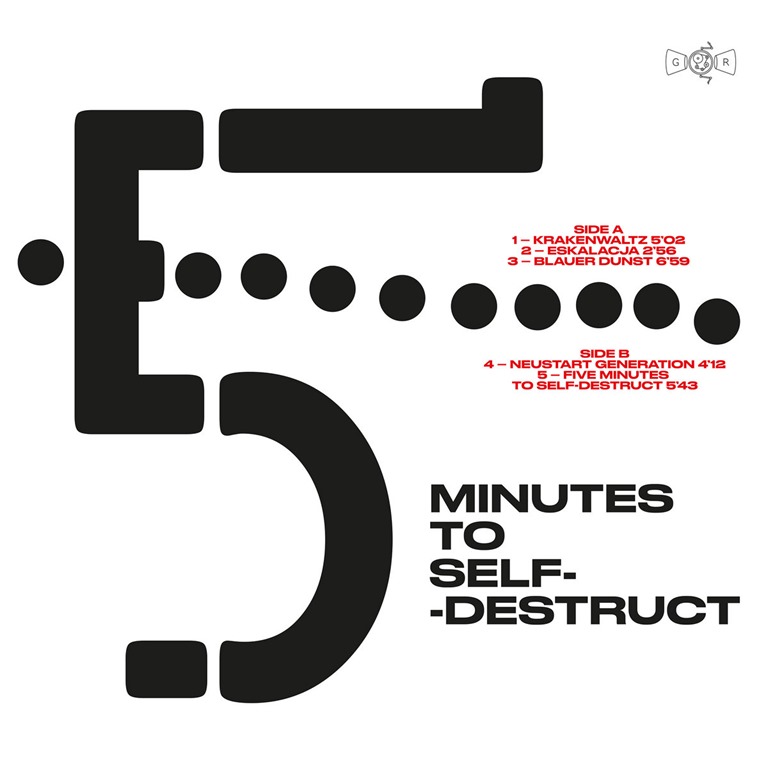
You might be hard-pressed to call CEL a supergroup, but Felix Kubin has been creating sound here, there, and everywhere for a long time now, and Five minutes to self-destruct is definitely a coming together of established creative forces, containing as it does five recordings of live tracks performed by longstanding Kubin and longstanding collaborator Hubert Zemler, remixed by Warsaw sound engineer Jan Wroński.
And the thing about creative collaborations is that they often rely on spontaneity, immediacy, the frisson between the individuals in proximity, feeding off one another in the moment. And so it is here, as the accompanying notes set out: ‘The expressiveness of these recordings is evident not only in their unbridled live energy, which can hardly be reproduced in the studio, but also in a musical nervousness that sets itself apart from the current wellness folklore of the modular community. The pieces gather in their DNA the paranoid plasma of cultural unease, chaos and upheaval.’
To make a small sidestep, we hear endless decrees that employees need to return to the office in order to foster the spirit of collaboration and all the rest. We know that this is bollocks, and is simply about working the instruments of control. Collaboration and the coalescence of energy for creative ends is not something which cannot be forced, and it happens, regardless of distance, time, and space, given the right connection and chemistry. Hearing the performances on Five minutes to self-destruct, it’s immediately apparent that this is not something that could ever be created by desire or will alone.
As the accompanying bio notes, ‘The expressiveness of these recordings is evident not only in their unbridled live energy, which can hardly be reproduced in the studio, but also in a musical nervousness that sets itself apart from the current wellness folklore of the modular community. The pieces gather in their DNA the paranoid plasma of cultural unease, chaos and upheaval.’
The title track ‘Five minutes to self-destruct’ is a quote from Michael Crichton’s sci-fi classic The Andromeda Strain, which describes a research team’s fight for survival against an accidentally triggered self-destruct mechanism, underpinned by trigger impulses and increasing panic.
My own experience of the modular community may not be on quite the same scale or the same higher circles as theirs, but it does feel primarily the domain of the middle-class, middle-aged white male these days, and there’s a certain air of ease and the satisfaction of hobbyism about it. Needless to say, not so here. There’s a tension that runs throughout the entirety of the release. ‘Krakenwaltz’ cartwheels and loops in jittery circles, head-spinning rhythmic cycles with no small degree of attack, with some sharp, aggressive snare sounds and a frenetic, frantic undercurrent which grows increasingly disorientating over its near-six-minute duration.
‘Eskalacja’ is dominated by hectic percussion and a whirl of fairground bleeps and toots running in ever-tighter concentric circles. It some respects, it calls to mind the frenzied looping and wild, vaguely manic excesses of early Foetus 12” singles, seeing just how far they can push the concept, and themselves in the creation of hyperactive sound.
The seven-minute ‘Blauer Dunst’ which sits as the album’s centrepiece marks a distinct shift in tone and texture, a rumbling dark ambient piece that invites comparisons to some of the more abstract works of Throbbing Gristle. It predates the rest of the set by almost four years, having been recorded in October 2020.
It’s back to more upbeat, stomping percussion-led synth work on the DAF-like ‘Neustart Generation’ – but don’t mistake upbeat for uplifting: it clatters and bangs with a clipped, regimented, Germanic feel, and the grooves are taut and tense, and it’s simmering tension which crackles beneath the lumping, shuffling, organic rhythms which underpin the sparse, tetchy title track. A couple of minutes in, a loping percussive cycle breaks out and the repetition of this and the dominant synth motif, amidst a swell of extraneous sounds – samples, sirens – makes this one of those tracks where you can feel your blood pressure increasing as it progresses and the pace quickens to a blur. It ends before reaching the point of inducing an aneurysm, and the assurance to the applauding audience, “We’re still alive, it’s ok,” at the fae injects some unexpected humour to proceedings.
AA
 Aural Aggravation