Kscope – 30th January 2026
Christopher Nosnibor
My parents weren’t really big on music. They had maybe fifty-odd, maybe seventy-five or so albums, and didn’t really seem to listen to many of them when I was growing up in the 80s. Most of those records were old… at least, that was how I perceived them at the time. There was a bunch of Beatles LPs, some Steeleye Span, and the same shit that occupied pretty much every collection at that time, at least for people of a certain age: Tubular Bells, Queen’s Greatest Hits, and Tangerine Dream’s Phaedra. They probably had Oxygene by Jean-Michelle Jarre, too. The 70s and 80s may well have been a boom time for the alternative breaking into the charts, with punk bands and the likes of Killing Joke making it onto Top of the Pops, and it may equally have been the period of peak postmodernism, but living through it then and reflecting on it now, the mainstream cultural dominance was anything but fragmented, and the comparatively limited choices of the time – can you imagine only four television channels, and no Internet? You had to be there, really – meant that there was a huge cultural homogeneity. Everyone watched the same TV shows – with something of an unspoken class division between BBC and ITV – and there was only really Radio 1 and Radio 2, and everyone listened to the radio.
And like most people their age, my parents thought they were hip buying the first Now That’s What I Call Music albums, and my mum would groove while listening to Phil Collins, The Bee Gees and Tina Turner while ironing, records purchased through Britannia Music. I’m not remotely nostalgic for any of this. If anything, my gentle, middle-class upbringing was marred by these experiences because it wasn’t just bland, it was… Look, imagine car journeys to UK holiday destinations in Devon and The Lake District spent listening to Barbara Dixon and Elkie Brooks and 80s Cliff Richard. I love Devon and The Lake District, but the soundtrack to my life as a child was fucking awful, and I feel a certain trauma tripped my life as a consequence. I don’t know if I ever heard Phaedra at home, I just spotted it while flicking through their collection.
Phaedra seems like something of an outlier in the context of such a collection, but it was a huge breakthrough release, the Hot Fuss of 1974. Or something. It spent fifteen weeks in the UK album charts, and achieved six-figure sales.
In context, it was truly a landmark album, famously the first to showcase their seminal sequencer-driven sound, and launched The Berlin School, the foundation of ‘space music’. The fact that it’s been fifty years since the album’s release is unfathomable, but it’s unquestionably appropriate to mark its anniversary. And while the thirty-fifth anniversary brought us Phaedra Revisited – a live performance of the album in its entirety, but reconfigured, retaining the thirty-eight minute duration of the original studio release, but with an abridged rendition of the title track making space for a new composition in the form of ‘Delfi’ at the end.
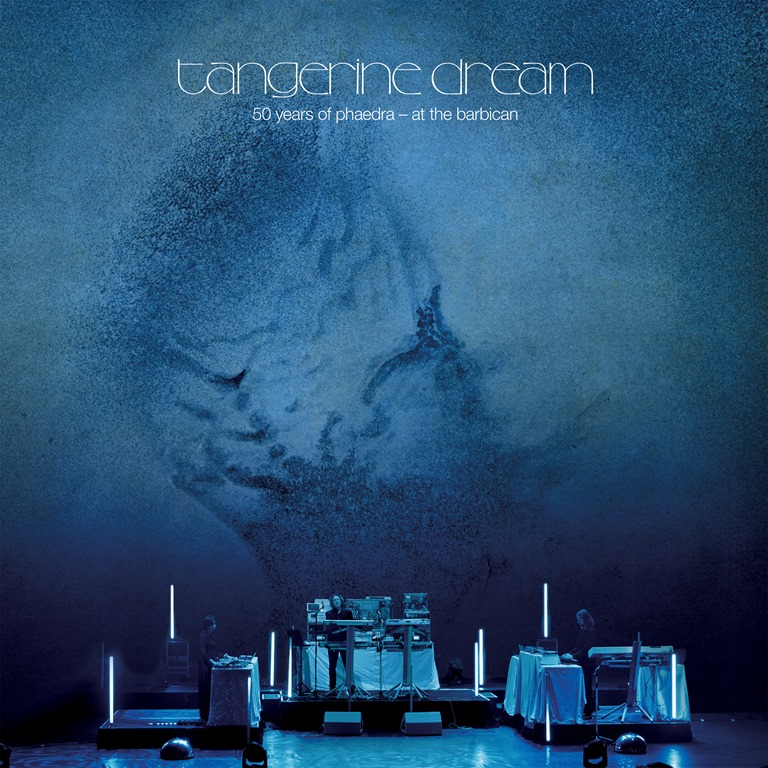
There’s no such sense of limitation when it comes to 50 Years Of Phaedra: At The Barbican – a colossal triple-disc of a commemorative live performance by the current incarnation of the band, consisting of Thorsten Quaeschning, Hoshiko Yamane, and Paul Frick – none of whom played on the studio version.
As the accompanying biographical notes acknowledge, ‘Part of Phaedra’s magic lay in its imperfections: the original sequences were never truly quantised, their timing drifting unpredictably through the Moog’s analogue circuitry. That subtle instability became part of its charm – a human pulse within the machine’ – before going on to explain that ‘it long left current bandleader Thorsten Quaeschning intrigued by what a fully realised version might reveal. Now, fifty years later, Tangerine Dream have revisited the work with the precision that technology once denied them. 50 Years of Phaedra: At the Barbican is the first time Phaedra has been performed fully quantised, each motif beautifully aligned with a crystalline precision previously unheard’.
It’s hard to find fault in either the performance or the fidelity here. It does sound great: there is so much detail, the experience is absolute, a sensory immersion, and that ‘crystalline precision’ means it feels more like an alternative soundtrack to something like Avatar.
The track listing also sees the current iteration move some considerable distance away from the sequencing of the original album: after a brief intro, they play ‘Sequent C’, followed by ‘Movements of a Visionary’, and then ‘Mysterious Semblance at the Strand of Nightmares’. Of these, the first two are substantially longer, the third a couple of minutes shorter. Then they transition away from the original compositions to explore ‘The Hippolytus Session’, a work in eight parts, spanning some forty-odd minutes, but returning to fragments of ‘Phaedra’ in the form of ‘Phaedra 2024’ (and much later, there’s a reprise of sorts with ‘Phaedra 2022’. Hippolytus being the stepson of Phaedra in Greek mythology, there’s a clear trajectory in what they’re doing here – pushing the original concept out and exploring the stated intention of discovering what the album may have been had current technology been available in 1974. The concept is interesting, but in some ways feels like it should exist as a satellite or supplementary work, and as is the case with last year’s monster From Virgin To Quantum Years: Coventry Cathedral, it’s very much one for the more devoted fans, and ones who are accommodating of the fact that this is a different lineup and a different time. It’s nice and all, but it’s by no means an improvement on the original.
AA
AA
 Aural Aggravation