SWANS have announced details of their seventeenth studio album, Birthing, due for release on Mute / Young God Records (N America) on 30 May 2025. Birthing will be released on triple vinyl (in a brown chipboard sleeve, double CD (in a brown chipboard digi-pack), and digitally. Initial pressings of the triple vinyl and CD editions will come with a bonus DVD featuring ‘Swans Live 2024 (Rope) The Beggar’, a live concert film directed by Marco Porsia from the last Swans US tour, plus Christopher Nicholson’s documentary from Michael Gira’s solo tour in 2022 entitled I Wonder If I’m Singing What You’re Thinking Me To Sing.
Listen to the first track to be shared, ‘I Am a Tower’ here:
“The material contained in this album was largely developed over the course of a yearlong Swans tour, during 2023 – 2024 (‘The Healers’, ‘I Am a Tower’, ‘Birthing’, ‘Guardian Spirit’, ‘Rope’, and ‘Away’), then recorded and further orchestrated and rearranged in the studio. Two pieces were created and performed in the studio (‘Red Yellow’, ‘The Merge’).
In all cases the material began with me sitting in my office with an acoustic guitar, singing and dreaming about what would become of these skeletal songs. I’m blessed to have such a stellar group of musicians to work with live (listed below), and through improvisation, endless revisions and an intensity of focus in performance (not to mention endurance), over the course of time the music morphed into what you generally hear on this collection.
This album, coupled with the recent live release, Live Rope, constitutes my final foray (as producer / impresario) into the all-consuming sound worlds that have been my obsession for years. We’ll do a final tour in this mode towards the end of 2025, then that’s it.
After that, Swans will continue, so long as I’m able, but in a significantly pared down form. Hints of that direction can be found in a few moments on the current album. In the meantime, my hope is that the music provides a positive and fertile atmosphere in which to dream.” – Michael Gira / Swans
On receipt of the new Swans album, I posted on Facebook that I was ‘too excited to download it.’ This wasn’t sarcasm or bathos. The arrival of a new Swans album is always an event of no small magnitude, and with a certain sense of duty to deliver a review of a band I’ve revered my entire adult life comes a certain weight of responsibility to do justice. Swans have always been more than merely a band, standing as a sonic entity with almost infinite capacity to overwhelm. And they haven’t lost that.
Their last three studio albums, The Seer (2012), To Be Kind (2014) and The Glowing Man (2016) redefined epic and over their course took extended improvisational forms to a logical conclusion, each with a duration in the region of two hours.
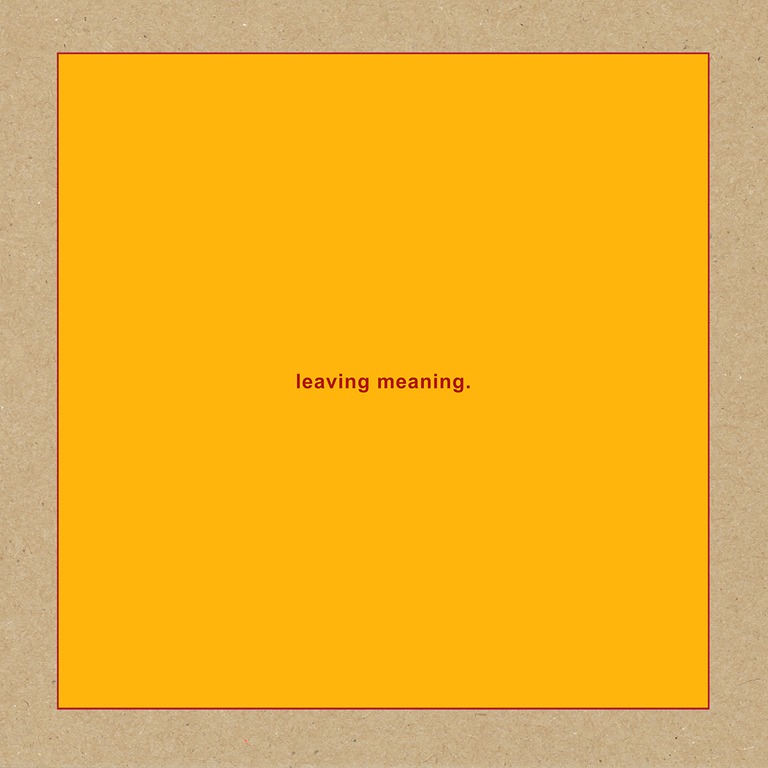
Given the tone of Michael Gira’s statement about the end of the iteration of the band who produced these albums, Leaving Meaning brings two substantial surprises, the first being that many of the personnel from the previous incarnation remain present, and the second being the speed of its arrival. Kristof Hahn remains in the latest lineup, which also features eternal mainstay Norman Westberg – arguably as integral to the band as Gira himself – albeit only on some tracks, and Thor Harris, Phil Puleo, and Christopher Pravdica. They’re joined by an immense cast of contributors including The Necks, Baby Dee, Anna and Maria von Hausswolff, and Larry Mullins.
Leaving Meaning sees Gira take a slightly different and more openly collaborative approach to the realisation of his ideas, and it’s a more concise record in comparison to its predecessors. It’s all relative, of course, but in context, ninety-three minutes is concise.
Because of its sheer enormity, Leaving Meaning isn’t an album it’s entirely appropriate to dissect, and it’s constructed in such a way that it is very much best experienced as an album rather than dipped into. That means its effect is optimal when experienced in a single session, but that also means – as was the case to an even greater extent with its predecessors – that it requires a significant commitment of time in a time-pressured world. But then, Swans’ music has the capacity to lift the listener out of time and into another zone altogether.
The longer tracks are considerably shorter than even most off the shorter tracks on the last three albums, with the twelve-minute ‘The Nub’ being the album’s longest track.
Intro segment ‘Hums’ is appropriately-titled, consisting of just two minutes of cascading, hovering drones interwoven for create a soft ambience. ‘The Hanging Man’ revisits the nagging, dizzying cyclical bass motifs of numerous extended workouts from the last trilogy, and grinds it out for ten minutes. Anyone who’s familiar with the band’s extensive back-catalogue will be aware that this style of composition harks back to the band’s dawning and has remained a trademark of theirs, as well as Gira’s solo work. Paired with Gira’s vocal delivery, which switches from a monotone drone to a maniacal holler of elongated vowels and jabbering ululations and monosyllabic barks and yelps, it’s vintage Swans that threatens a climax around the mid-point but saves the real intensity for the finish. It’s less about volume than plain, bludgeoning repetition.
‘Amnesia’ is not the same ‘Amnesia’ as on 1992’s Love of Life. Perhaps Gira’s forgotten about it. It is, however, a brooding acoustic-led folk song. At heart. One of the things that constitutes a significant point of departure on Leaving Meaning is the return to sparser structures: gone are the immense sustained crescendos and pulverising explosions of discordant noise. There’s an altogether more mellow feel about Leaving Meaning. That said, there are orchestral and choral surges which punctuate both here and elsewhere.
A
‘Sunfucker’ is another classic Swans composition built around endless repetition, and with its backing vocal chants serves as an apocalyptic counterpart to ‘I Am the Sun’ from The Great Annihilator. Tapering off to drones in the mid-section, it suddenly explodes into a stomping glam bash. It’s bewildering, unexpected, everything all at once and probably the most daring and adventurous thing Swans have recorded in their entire career.
‘The Nub’ is gloomily funeral. Ethereal, haunting, but ultimately bleak in mood; ‘Some New Things’ is mantric, looping, hypnotic, while ‘My Phantom Limb’, one of the album’s standouts, has stronger echoes of Greed-era’s tortured pounding. It sits at odds with the rest of the album, but then so much of the album sits at odds with itself it feels right in a perverse way.
So what do we take from this? More or less what we’ve take from Swans over the last thirty years: with their ever-shifting parameters but constant core focus and the creative vision of Michael Gira always the driving force, Swans never cease to evolve, but never cease to be Swans, and are immediately identifiable as Swans, however far out they go.
 Aural Aggravation