Music Information Centre Lithuania – 7th June 2023
Christopher Nosnibor
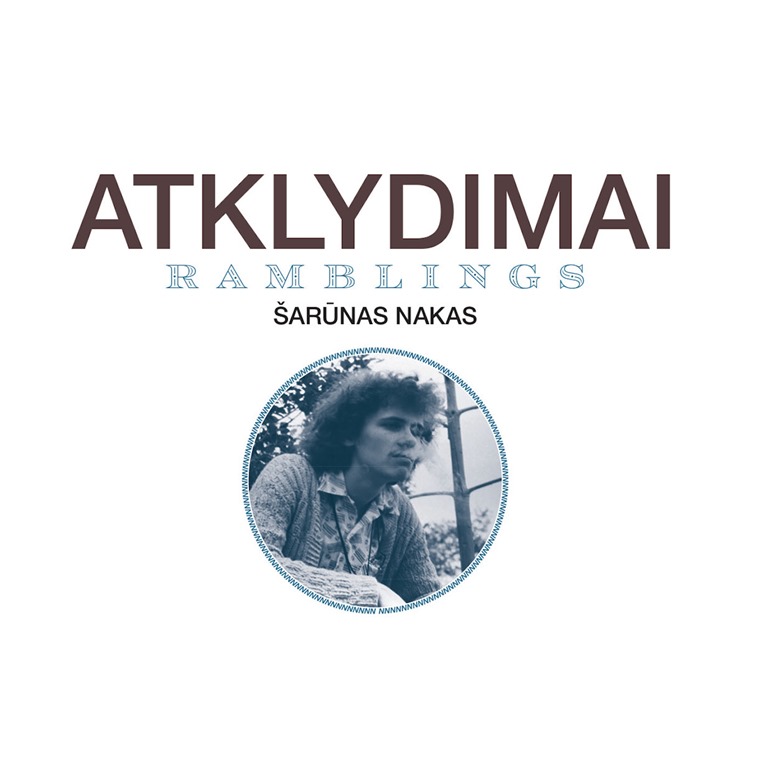
This is one of those releases where the context counts for almost as much as the content: ‘The cycle of nine vocal, instrumental, and electroacoustic pieces, Ramblings, a large part of which was written as music for the scandal-plagued drama play Literature Lessons by Jonas Vaitkus, was recorded in 1985 in the legendary Vilnius Record Studio, which at that time was very open to experiments. The recordings were made using a multi-channel tape recorder, a borrowed KORG synthesizer, saxophones, a prepared piano, a cello turned into a noisy bass, percussion, and bells. The composer used all the texts and the title for the cycle from the poetry collection Ramblings by Almis Grybauskas. According to the composer, this poetry is minor, cold, and laconic, like his favourite cool jazz style, while the title Ramblings itself raises a lot of questions, is a bit provocative and irritating.’
‘Provocative’ and ‘irritating’ are appropriate enough adjectives, it has to be said. Indeed, ‘ramblings’ suggest something unfocussed, incoherent, unstructured, and this is a wild ride which flies off on tangents every which way. Yet while the shapes of these compositions may be loose, there’s a definite sense of purpose, not to mention an atmosphere about them.
The further story is significant to this release, and it provides not only a fascinating insight into the way politics can often be the enemy of the arts, but also freedom of expression more broadly. It’s also a tale of underground rebellion, defiance, and strength of will.
‘After the premiere of the performance, the composer could have had a very bad ending – after “terrible” reviews and complaints appeared in the press, the Soviet censorship ordered the performance to be banned and the creators punished. Even the head of the composition department at the time suggested that this “cacophony” should be given the lowest grade, condemning Šarūnas Nakas to be expelled from the conservatoire, which would have meant being conscripted into the Soviet army during the Afghan war. Fortunately, professors Julius Juzeliūnas and Bronius Kutavičius saved their student.”
I mean, it is a “cacophony”. Ramblings is a jumbled mass of layered vocals, atonality, and exploratory jazz, the kind of jazz that prioritises performance over listenability, the kind of jazz that’s about the experience, the kind of jazz that’s interested in the relationship between notes and isn’t afraid of dissonance, discord, variable time signatures. At times tranquil, at others ominous and abstract, there are parts of Ramblings which are wild, chaotic, completely unconstrained. This is, of course, just how it should be.
The story continues as to how thew work escaped destruction at the hands of its persecutors: ‘It was the time of cassette tape recorders, and music was quickly reproduced, so Ramblings began its own journey, playing as background music on radio and television but never being published as a complete cycle. Later, only one piece called ‘Merz-machine’ was singled out from the cycle as an example of Lithuanian experimentalism and released in 1997. It then underwent a kind of renaissance: versions were created for different ensembles, including the Czech avant-garde rock orchestra Agon and the London piano sextet pianocircus. The sextet has performed the work more than 100 times in dozens of countries.’
It’s fascinating how an obscure musical work can infiltrate so many different channels, and effectively exist in a life entirely removed from itself. Consider the fact that parts appeared, internationally, unknown and uncredited. This isn’t only the most remarkable example of subversion for a supposedly ‘banned’ work, but also demonstrates how music can take on a life if its own. ‘Merz-machine’ is, without doubt, an outstanding piece, challenging and discordant as it is, but it’s only partly representative of the album as a whole: it’s certainly by no means background music.
The fact of the matter is that there is no one pierce on Ramblings which is really ‘representative’. Ramblings is truly eclectic, and odd, and that’s its design, its objective. From a critical perspective, it’s almost immaterial whether I like it or not – and I certainly like some pieces more than others – but it’s not aiming to please, and certainly not aiming to please all of the people for the duration. Despite being almost forty years old, Ramblings sounds contemporary – and still sounds challenging. That’s timeless.
AA
 Aural Aggravation