fals.ch – 9th June 2023
Christopher Nosnibor
On clocking this in my inbox, I fleetingly felt a flicker of amusement as I recalled a long-lost article I had written over a decade ago about fictitious musical genres, which included LARPcore, where bands inspired by Viking Metal re-enacted historical battles in full costume. (I also mentioned Symphonic Doom before the term appeared as a thing). Then I realised that, as I’m prone to doing when I’m not concentrating, I’d misread, but then on reading the notes which accompany the new album by Kent Clelland, aka LapCore (which makes a lot more sense in context of what he does musically), my amusement was replaced by a certain crackle of excitement.
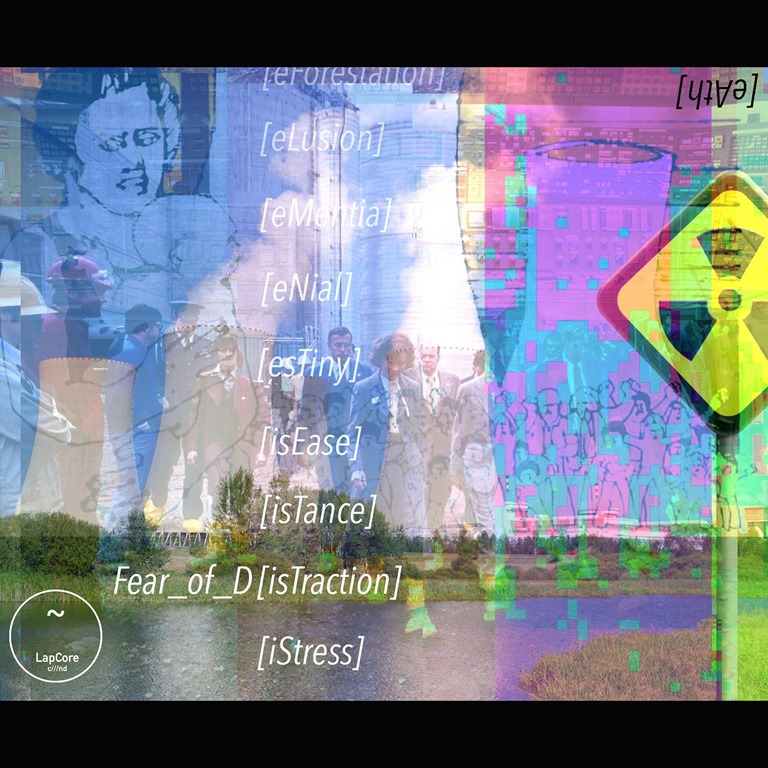
For this reason, it’s worth quoting: ‘With Fear_of_D[istraction] LapCore continues his exploration of digital audio synthesis and distortion techniques, researching the complex tonal digital structures he affectionately refers to as cTonality. In contrast to the more upbeat and aTonal album LapCore 132 (his 2017 full-length self-published release), Kent Clelland has freed himself to explore the darker, and more cerebral faces of computer music composition. With multi-channel oscillators he brings sonic entrainment into the musical range of frequencies as opposed to the typical sub-audible entrainment frequencies, composing melodic and harmonic parts with the artefacts to create cTonalities.’
But here’s where it gets interesting, and will likely prove divisive:‘Weaving polymetric binaural oscillators with a lopsided bass drum engine, he lulls your senses into a state of receptivity upon which he then sews synthesised tapestries inspired by his hyper-perceptual, cancer-treatment-infuenced dogma adventures in the pre-pandemic delirium. LapCore produces these tracks as an attempt to preserve his brain damaged audio hallucinations, sharing them in a venue larger than the space between his ears.
‘The performance of LapCore’s Fear_of_Di[straction] (2017-2022) is a 48 minute sonic quilt of recordings of AI Musical Agents during training sessions intricately hand-sewn into the fabricated projection of the audio dimension.’
Yes, Fear_of_D[istraction] incorporates elements of AI. ‘Nooo!’ people will likely shriek and no doubt some will be unhappy even with my writing about this album on this basis for propagating the death of the artist. But the death of the artist – if we take ‘the author’ in a broader context – has long been a preoccupation of literary theory and postmodernism, as far back as Roland Barthes’ 1967 essay of the same title. Yet now, as we find ourselves pondering what some are variously referring to as post-postmodernism or metamodernism, there is mass panic over the chimera we have created with speculation that not only artists but most occupations will be obsolete in a matter of years and we will soon be driven to extinction by our errant creation. I’m reminded of numerous sci-fi novels, not least of all Michael Chrichton’s Prey. Published twenty years ago, it feels more relevant now than ever, as is the way with much true science fiction, which takes current science and projects hypothetically forward, but also demonstrates that this fear is nothing new. And yes, of course, we – as a species – have pursued this end. Our demise through AI seems unlikely, but if it does happen, we probably deserve it.
While AI photos and even falsely-attributed Guardian articles are giving great cause for consternation – understandably – overall, it’s still the potential of AI which is scarier than the current capabilities, and this is nowhere more evident in music, where it’s fair to say that most purely AI generated compositions are toss. But also, in more experimental fields, composers have been using algorithms and customised programmes to generate sound since the advent of computers and synths – and I have covered countless of these in the last fifteen years.
LapCore incorporates AI as simply another tool in his kit, and has used this hybrid of man and machine to forge a work that melds Krautrock and minimal techno, microtonal experiments and harsh electronics to eye-opening effect.
The first of the album’s seven compositions, ‘Stuck Like a Magnet in Switzerland’ is built around grating oscillators and some extreme stereo panning, which is well-executed, and immediately grips both sides of your cranium and squeezes. The flow of blooping synthesised rhythms is rent with a buzzing distortion the like of which some of us will remember as the way a mobile phone signal would interfere with the TV – and at three times the volume of the busy bubbling track, it comes as an uncomfortable moment of shock. All kinds of feedback and interference disrupt the musical melange thereafter, dial-up tones and all kinds of electrical chaos collide and crackle unpleasantly. But being unpleasant doesn’t make it bad: this is one of those works that is relentlessly challenging in its pursuit of ‘difficult’ tones, textures, and frequencies, often simultaneously.
‘Microdose’ feels more like an overdose, as an angry hornet the size of a lion takes residence in the space at the front of your skull, right in the sinuses, and vibrates your brain without mercy against a backdrop of disjointed techno. This is some brutal synth torture, and elsewhere, there are drones and whistles reminiscent of early Whitehouse and Throbbing Gristle, atop dome very DAF-like electronica. ‘Americium’ is busy, a constant drip and froth of watery notes bouncing against one another – and it sounds experimental. And this is the key to appreciating Fear_of_D[istraction]: it’s not a work that tries to pretend to be a human creator hiding behind AI for a laugh, and nor is it the sound of AI running wild. Instead, it’s an album which sees its creator consider the challenge ‘how can we use this?’
If it sounds somehow ‘impersonal’, the same is true of much electronica; by the same token, Fear_of_D[istraction] very much sounds like a guy pressing buttons and twiddling knobs and looking to see just how much disruptive, disturbing synthy noise he can throw over a sequenced beat. The artist isn’t dead yet.

 Aural Aggravation