Cruel Nature Records – 28th July 2023
Christopher Nosnibor
The Sargasso Sea is a unique place on earth: situated within the Atlantic ocean, it is the only sea without a land boundary – a sea within an ocean, in other words – its borders defined by sea currents. Its name is derived from to the vast ‘sea’ of free-floating seaweed called Sargassum which occupies the space, and it’s an ecosystem like no other, the aquatic equivalent of the Amazon. And yet its existence appears to be considerably less well-known, despite the success of Jean Rhys’ 1966 novel, Wide Sargasso Sea, which has been adapted for film, stage, TV, and radio and has been lauded as a pivotal work of postcolonial feminism. And it’s this book which I think of when I hear the word ‘sargasso’ – although clearly, it has absolutely no bearing on this album. What even is a sargasso sky?
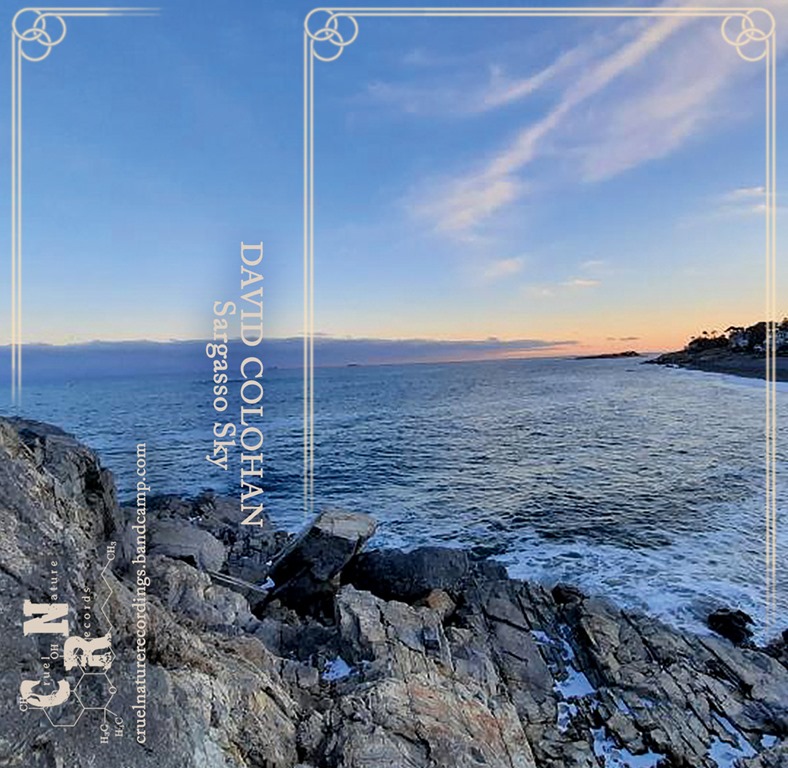
The liner notes paint the scene, where ‘A sargasso sky shimmers above a twilit American shoreline, slipping in & out of time. Via a way slowed down take on jazz fusion, limpid pools catch its reflection, ebbing & flowing with the soon to come stars… The cover images taken at Marblehead, Massachusetts depict something of the aura of an area that H.P. Lovecraft considered life-changing. Step into the sea & sky….’
There are many layers, then, to this release, which extend far beyond the surface of the music itself. But when it comes to the music, Colohan presents ten pieces, all comparatively concise (only four extend beyond the five-minute mark, and none reach beyond eight), and the form is ambient yet structured, with rippling washes of synth gliding over the mellow mists of sound which float invisibly through the air. Despite its title casting its eye above the horizon to the sky, parts of this album is given to a preoccupation with the water, still, as exemplified by titles such as ‘Sacred Teeming Waters’ and ‘Longshore Drift’.
Whereas much ambient music is formless, abstract, the instrumentation vague, on Sargasso Sky, David Colohan offers musical works with structure, and with the implementation of identifiable instruments.
‘Longshore Drift’ is led by sparse piano, backed by a sliding, bulbous synth bass that’s extremely eighties in sound, and elsewhere on the album, long resonant voices dominate, from flute to organ. These are clearly synth voices, sounds conjured digitally in response to creative needs but also evolving technology facilitating new music. There are some bold drones which surge and swash on ‘Anoint’, and ‘Summers Old as Stars’ brings late 70s and early 80s synth stylings to the fore, with hints of Tubular Bells and Vangelis, and the myriad music of this era which remained anonymous. But for all that, Sargasso Sky is subtle and it’s still not overtly electro for the most part, and it’s not of the prog persuasion either. But what is it? Certainly, there are parts which do very much pursue progressive forms, and Sargasso Sky is very much an exploratory work: spacious, undefined by limits of composition or instrumentation.
AA

 Aural Aggravation