Posts Tagged ‘circuit meltdown’

16th June 2025

Christopher Nosnibor

Gintas K’s latest offering was recorded live, using computer, midi keyboard and controller in January 2025, and first released by Japanese label Static Disc in May.

It’s worth perhaps mentioning that ‘Breakcore’ is – and I shall shamefully quote from Wikipedia here – ‘is a style of electronic dance music that emerged from jungle, hardcore, and drum and bass in the mid-to-late 1990s. It is characterized by very complex and intricate breakbeats and a wide palette of sampling sources played at high tempos.’ In the main, not really my personal field of expertise, or particularly within the remit of Aural Aggravation.

But this is a Gintas K album, and the nine pieces are typical of his style, combining experimentalism and the application of software and midi / laptop setup, producing a range of glitchy, frothy, gurgly sounds which stop and start intermittently, unpredictably. His live and improvised works always come with a sense of unpredictability, of spontaneity, while bearing his distinctive sounds. One of the key focuses within K’s work is on detail, zooming in on microtonality, granularity. When I say it sounds ‘bubbly’ or ‘frothy’, I mean it’s the sound one might consider the equivalent of the visual experience of slowly swirling a latte or a pint of ale, or hyperfixating on the bubbles in a bath. This is not, however, the gentle swill and flow of currents, but a frenzied effervescence, like the reaction between bicarbonate of soda and vinegar. And look long enough and hard enough, and patterns begin to emerge.

Listening to the bubbling blitzkrieg of digital clicks, beeps, and fizzing of any work by Gintas K can be stimulating to the point of eye-popping discombobulation. It’s almost too much – and this is nevermore true than the experience that is Breakcore. There are beats present – but they’re composed not of beats in the conventional sense, being neither rhythmic nor percussive, either from an analogue source or a digital sampled source or emulation. These are flickers, pulses, rapidfire stutters, hard sounds which replicate the essence of a beat without being a beat, per se. For example, those of a certain age may recall the successive ‘pink-pink-pink’ chattering digital babble of dial-up. Few would necessarily consider those sounds beats in context, but… yes, they have a certain beat-like quality. And this is how the beats often emerge from the clicks and pops, moans and drones or another quintessential Gintas K demonstration of circuit meltdown as an artform.

I had never considered his work in a ‘dance’ context before, and still wouldn’t: one feels as if the title is perhaps a shade ironic. But the tempo is certainly high and the beats are complex and intimate, emerging as they do from the thrum of what sounds like a revving engine, the whirr of an old hard-drive, the click of a CD driver whirring into action. Every second of this release sounds like some kind of digital or mechanical malfunction, as tempos whirl and blur, drawl and slow. Scrunching, crunching, twanging, springing, stammering and stuck, it’s a relentless attack of wrong sounds. But emerging from all of it, there are erratic beats, like a succession of deliberately jarring jazz fills and simply wild judders.

It is relentless, and it’s complete overload. The nine tracks run for a total of twenty-nine minutes: its intensity is such that you feel as if your brain is starting to melt after the first ten. In short, Breakcore is truly wild, and it’s not remotely easy or accessible – but it absolutely encapsulates everything that defines what Gintas K’s does.

AA

AA
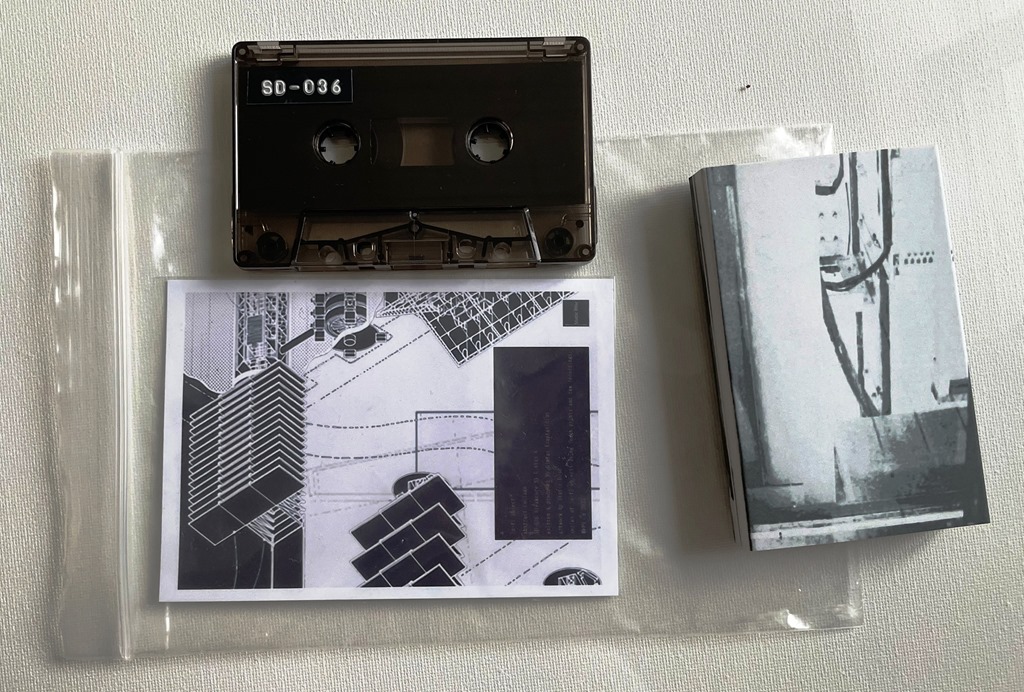
cover

Christopher Nosnibor

It seems as if this release is designed to cause maximum confusion. It’s called 2014 and is being released here in 2017. It was ‘originally’ released by German label Attenuation Circuit on 8th August 2017, and has been – so far as I can make out – independently released by the artist himself, with the subtitle of Attenuation Circuit 2017. Given the album’s contents, it sort of works.

The accompanying blurb – which is in fact culled from a review published on August 12th (is this chronology messing with your orientation yet?) is a curious mix of hyperbole, unusual metaphors and theoretical reference points:

‘Gintas K will shower the ears with a whole lot of incredible data streams, all clustering electronica bits and bytes that drop down in a wild way. As if data communications had been flushed through the shower head, tumble down and ending up together in the drain. Strangely when the tap is closed and these electrodes have calmed down in their dripping ways, they actually form beautiful sounding music… well, music might not be the word for all to say, but it does feel like there is a lot of beauty to be discovered in these busy data dada streams.’

As much as the quirkily playful application of abstract digitalism does clearly it comfortably within the framework of Dadaism, it’s also a work which readily aligns itself to the postmodern, in the way that it effectively recreates the experience of information overload, and does so in a fashion which is both nostalgic and retro (the sparking circuits are more dial-up than fibre optic) and executed with a certain hint of parodic pastiche. At the pace of progress as it stands, even 2014 feels like a point of nostalgia on the cultural timeline: a year which predates the vote for Brexit and the accession to power of Donald Trump, it may be a year with little going for it and which has little to mark it as memorable, but many would likely concur that 2014 stands in a period which is better than the present.

2014 is certainly one of Gintas K’s noisier and more challenging releases. While Slow was a subtle and quite quiet, delicate work, 2014 is far more up-front and attacking in every respect. It’s also more difficult to position, in that it absolutely does not conform to simple genre categories like ‘ambient’, instead straddling vague brackets like ‘electionica’, ‘industrial’, and ‘experimental’.

Hurtling from the speakers from the get go streams a barrage of gloopy digital extranea, a glissando of chiming binaries and a dizzying digital wash that flickers and flies in all directions, an aural Brownian motion of beeps and bleeps.

The eight-minute ‘max’ starts very much as ‘min’, with a full three minute’s silence, before a brief crashing facsimile of some metallic kind of percussion makes a fleeting appearance. There are sporadic clunks and scrapes and minute glimmers of higher-end frequencies, but for the most part, the silence of space dominates the clutter of sound.

‘5 zemu ir max2’ sounds like R2D2 having a seizure, with occasional blasts of distortion and random thuds punctuating the frenzied stream of bleeps. It’s ten minutes long. And I have no idea what the title – or indeed any of the titles attached to the individual pieces – stands a s reference to, just as the overarching 2014 has no obvious connection to the seven tracks it contains.

Crackled a gloops and bloops and whiplash blasts of static, crashes like cars impacting at speed and jangling rings all congeal into a digital mush which bewilders and disrupts the temporal flow. 2014 is disorientating, and not just in the immediate moment, but in terms of a wider placement and sense of time / space.

Gintas K - 2014